Misconcepts
Every Decision Has a Cost
April 21, 2026
By Syn Yun Phee & David Wang
Everything you ever do is either improving a misconcept or implementing one. Finite life resources impose constraints on how many misconceptsMisconcepts are the explanations we hold about how the world works, synonymous with mental models but named deliberately to acknowledge their fallibility. Unlike a misconception, a misconcept is not necessarily wrong.Full definition (opens in a new tab)→ you can improve and implement, while your arbitrary life goals guide where those resources are best allocated for the highest return.
These three high-level misconcepts provide the framework. The fourth is where it becomes actionable.
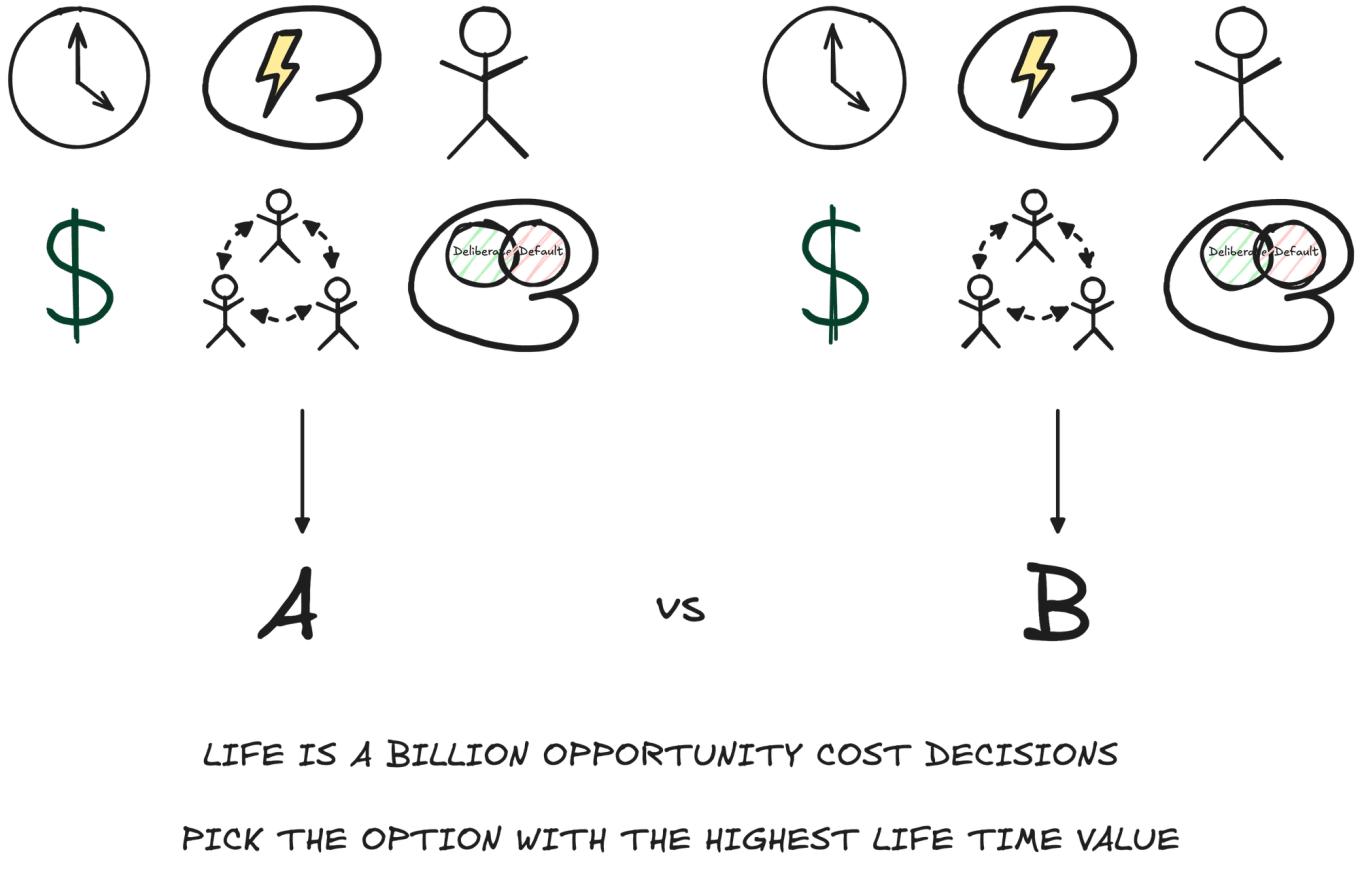
Opportunity cost is the lifetime value of the next best alternative forgone whenever you expend life resources to improve or implement a misconcept.
Because life resources are finite, opportunity cost is present in every decision you make, from what to do with the next hour to the decisions that shape the trajectory of your life. The next best alternative always exists, whether you have considered it or not.
"All intelligent people should think primarily in terms of opportunity cost. When deciding whether to do something, compare it with the best opportunity you have." – Charlie Munger
Lifetime Value
To assess opportunity cost well, you need a metric to compare your options and the expected return on your life resources. That unit is Lifetime Value (LTV).
Lifetime Value is the net value on your life resources across short, medium, and long-term horizons from expending life resources to improve or implement a misconcept. It is the difference between the life resources gained and the life resources expended.
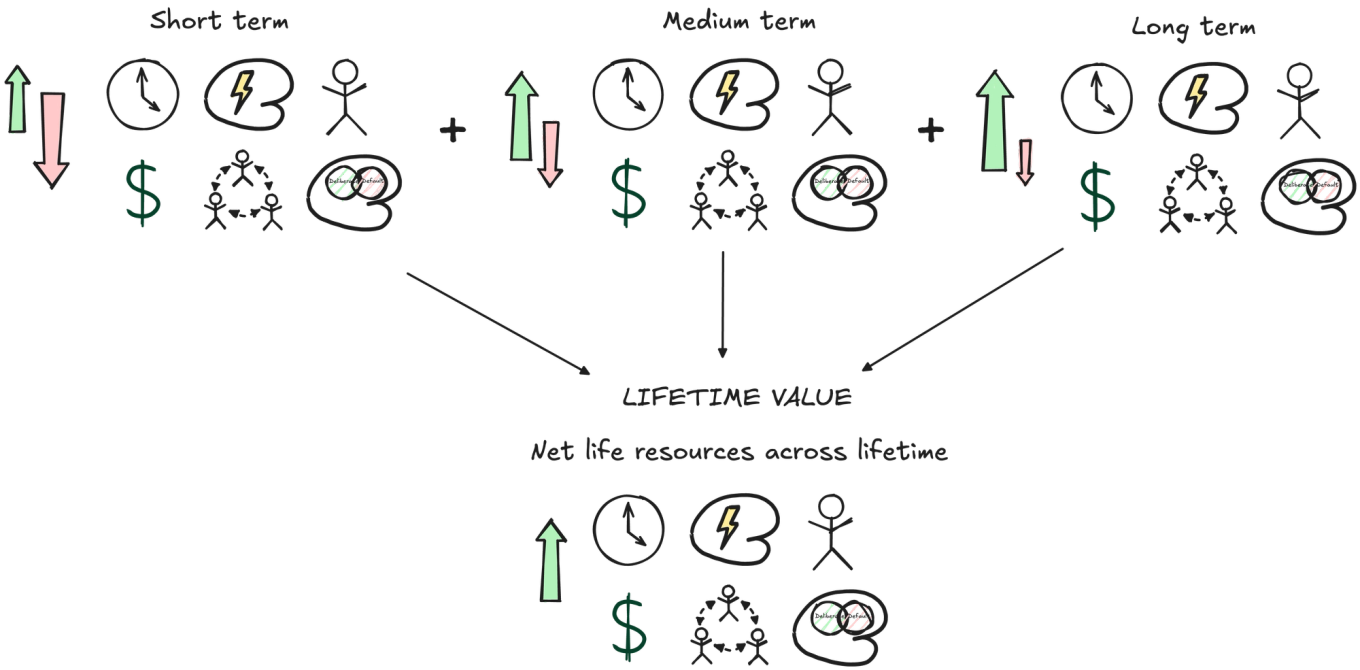
LTV works differently depending on the type of decision. When you implement a misconcept, you generate LTV directly through the outcomes your decisions and actions produce. When you improve a misconcept, you generate LTV indirectly by improving your misconcepts setThe collection of deliberate and default misconcepts we hold.Full definition (opens in a new tab)→. A better misconcept compounds across every future implementation decision that draws on it. This makes a well-chosen improvement to your misconcepts set disproportionately valuable relative to the resources it costs. The compounding nature of medium and long-term gains means LTV can grow non-linearly, which is why early investment in high-ROI misconcepts carries particular impact.
Accurately assessing a decision's LTV is harder than it seems. The quality of your misconcepts set matters, because the more closely your misconcepts reflect reality, the more accurate your assessments will be. But two cognitive defaults actively work against you here. Hyperbolic discounting makes short-term rewards feel disproportionately valuable relative to future ones. Linear thinking causes you to underestimate the compounding effects of your actions. Neither can be eliminated entirely, but knowing they are there is the first step to accounting for them.
Accurate LTV assessment also depends on clarity about your arbitrary life goals and your current life resource inventory. Two people with different goals and different resources would be expected to make different decisions about the same choice, and they both can be optimal. The LTV calculation is always personal.
Consider the simple decision of eating a packet of chips. The short-term impact is easy to see. A packet of chips tastes good, costs little, and has minimal immediate effect on your body. A quick boost to mental resourceThe ability to creatively conjecture, rationally criticise, and focus.Full definition (opens in a new tab)→, minimal cost to physical. But do it daily and the real cost emerges over the medium and long term, a decline in physical resourceThe function of our biological machinery.Full definition (opens in a new tab)→ through weight gain and fatigue, and mental resource through increased cravings and brain fog. For most people, an occasional treat remains a high-reward, low-cost indulgence. Turning it into a daily habit is a different equation, because the short-term benefit offers diminishing returns while the long-term costs compound.
The same logic runs in the other direction. Investments that feel costly in the short term, such as building a new skill or improving a relationship, often produce outsized long-term returns. LTV captures what the short-term view misses in both directions.
Marginal utility as a complementary lens
Marginal utility is a useful complementary lens for thinking about opportunity cost.
Marginal utility is the incremental gain in lifetime value per incremental unit of life resource expended.
The optimal allocation point is where the marginal return from your next unit of resource investment drops below the marginal return available elsewhere. Beyond this point, continuing costs you more than it returns relative to what you could be doing instead.
Most people err in one of two directions. They under-invest by stopping before reaching the optimal point because the path feels slow or difficult. Or they over-invest by continuing past it because momentum or sunk cost makes it hard to redirect. Marginal utility gives you a rational basis for recognising when to commit further and when to move on.
Like LTV, marginal utility works differently depending on the type of decision. When implementing misconcepts, it reflects the incremental outcome improvement from committing additional resources to a single implementation. When improving misconcepts, it reflects the incremental improvement in misconcept quality from committing additional resource to a single update, which then compounds across every future implementation decision that draws on it.
On optimisation
Optimisation has earned a bad reputation in some circles, where it has come to be associated with hustle culture, burnout, and the reduction of a life to a productivity system. But a lot of what gets called optimisation is really an anxious accumulation of tools and tactics, driven by a fear of not doing enough or not being enough. You end up spending life resources optimising without ever asking what you are optimising towards. And when you look closely, the target is usually social validation, or the relief of feeling productive, or keeping up with what the environment happens to reward. Optimising towards those targets does not yield the highest return on your life resources because the goals were never deliberately chosen to begin with.
Even with a chosen goal, a second subtler failure mode can appear. You can choose the right target and still over-invest past the point where the marginal return justifies the cost. Anxiety has a way of creeping in, quietly shifting the goal from what you actually want to avoiding the feeling of not doing enough.
In both cases, the goal was either never examined or it drifted without being noticed.
You are always optimising towards something, whether you are conscious of it or not. What matters is what you are optimising towards, whether that target is one you actually chose, and whether you know when you have reached the point of optimal return.
Life optimisation in the Misconcepts framework is the ongoing process of allocating your finite life resources for the highest lifetime value relative to your self-defined arbitrary life goalsA conjectured desired state that an individual chooses to pursue.Full definition (opens in a new tab)→. It is not a fixed endpoint but an open-ended process of error correction applied to how you spend what you have. What that looks like is entirely personal, because the goals are yours.
The framework does not prescribe what to want. It gives you a clearer way to actually get it.
Bringing it together
Life can be thought of as a billion opportunity cost decisions. Lifetime value is the metric that allows you to navigate them well, giving you a basis for getting the highest return from the finite life resources you have.
Making those assessments well depends on the quality of the misconcepts driving them. Fit-for-purpose misconceptsA misconcept that has been improved to the point at which further improvement yields diminishing marginal utility and unacceptably high opportunity cost.Full definition (opens in a new tab)→ at every level and across the domains relevant to your goals are what allow you to compound consistently toward what you actually want.
Every decision you have ever made was an opportunity cost calculation. The only variable is how well you made it. The next article takes up the question of how you actually improve the misconcepts driving those decisions.
If this resonated, get Micro Misconcepts in your inbox every Friday.
Subscribe to Micro Misconcepts →