Misconcepts
How to Improve a Misconcept
April 21, 2026
By Syn Yun Phee & David Wang
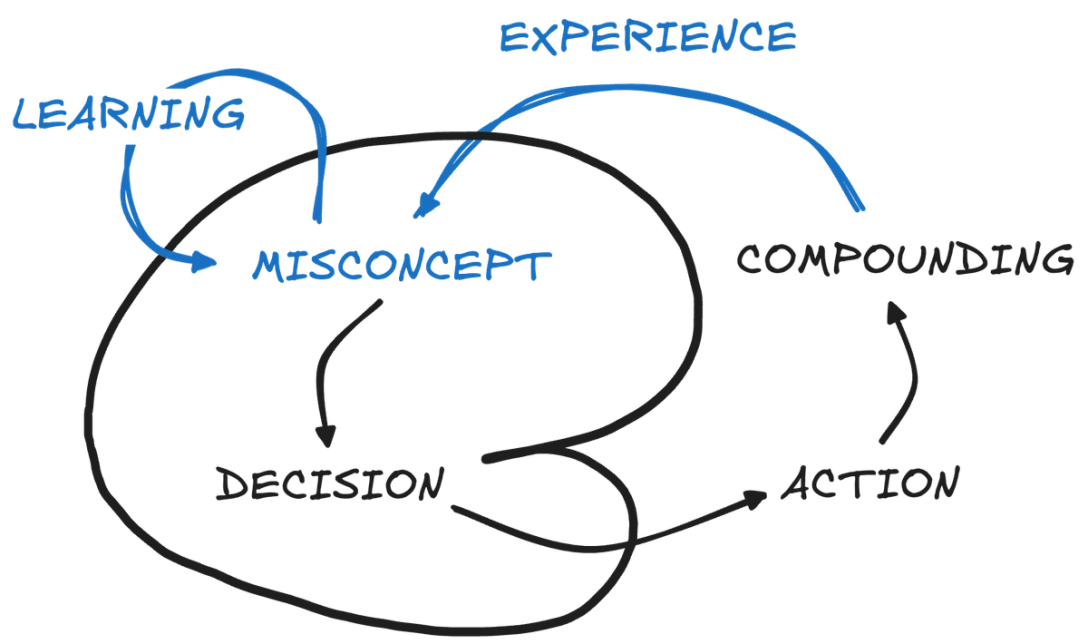
In a previous article, we established that misconcepts, the fallible explanations you hold about how the world works, determine both your internal experience and your external results. Higher-quality misconcepts generate expectations closer to reality. The closer your expectations track reality, the less friction you experience internally, and the more reliably you compound toward your goals externally.
Given that your life resources are finite, which misconcepts do you improve first, and how? That is what this article answers.
Two ways to improve a misconcept
There are two ways to improve a misconcept: learning and experience.
Learning is the acquisition of misconcepts from external sources such as books, media, and other people. We conjecture misconcepts from what we consume rather than passively absorbing it, which means the quality of what we take in depends on the source, the quality of the misconcepts we already hold, and our capacity to critically evaluate both. Learning is efficient but carries a risk. Without direct real-world feedback, you can acquire many misconcepts quickly and not know which ones are wrong.
Experience works differently. You implement a misconcept, observe the gap between your predicted and actual outcome, and error-correct accordingly. That gap is the input for rational criticism and misconcept updating. Experience is slower than learning but more reliable, because the feedback comes directly from reality rather than from a source that may itself be wrong.
The strongest updates usually involve both, learning from an external source then applying it against problems in real life. This is how you avoid becoming what risk researcher, author, and philosophical essayist Nassim Nicholas Taleb called the "Intellectual Yet Idiot," someone who accumulates knowledge in theory but is systematically wrong in practice because their ideas were never tested against reality.
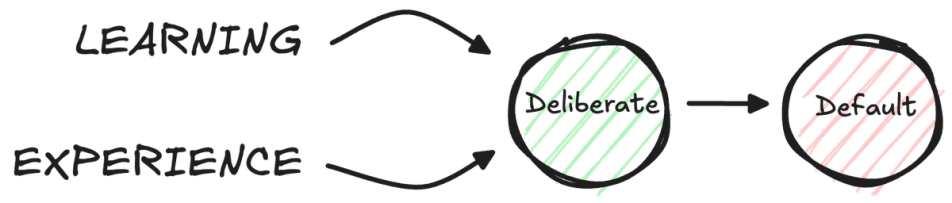
Deliberate and default improvements
Improvements always begin with deliberate misconcepts. But improving a deliberate misconcept does not automatically improve the default version. It takes practice, repetition, and often some discomfort, before they shift into your defaults.
Directed or non-directed
Both learning and experience can be directed or non-directed.
Non-directed learning and experience are pursued under inherited or unclear life goals.
Directed learning and experience are pursued to improve the misconcepts with the highest ROI relative to self-defined arbitrary life goals.
For directed learning and experience to be possible, you need three things:
- Clarity on what your self-defined arbitrary life goals are.
- An inventory of your current misconcepts and their quality relative to those goals.
- An identified priority misconcept to work on next.
Together, these allow you to allocate your finite life resources toward the highest-ROI improvements rather than whatever the environment happens to offer.
The hand you were dealt
Before awareness of misconcepts, it is unlikely you will have self-defined life goals that are intrinsically aligned. Without them, all learning and experience is non-directed. The misconcepts you accumulate, and the inherited life goals embedded within them, are shaped by who you were born to, in what community, in what country, and under what circumstances. That is the hand you were dealt.
That hand comes from two sources.
- The first is evolution. Natural selection of alleles through our ancestors has encoded cognitive biases into our default misconceptsThe set of misconcepts accessed automatically and without conscious effort (System 1 thinking).Full definition (opens in a new tab)→ over millions of years. These biases are shaped to increase the propagation of those alleles rather than to support our flourishing in modern life. Examples include loss aversion, social conformity, and status-seeking. They persist not because they serve us well today, but because they were propagated through the selection pressure on our ancestors.
- The second is inheritance. You acquire misconcepts through whatever learning and experience the context you were born into provided. These arrive before you have the misconcepts and awareness to question them.
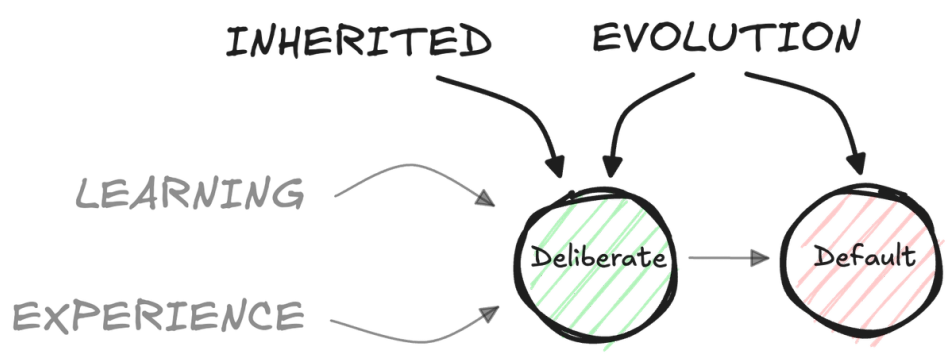
The result is a misconcepts set shaped more by circumstance than intention. There will be domains where your environment delivered high-quality misconcepts. But the hand you were dealt is unlikely to be ideal for optimising your internal experience or your external results.
The hand you play
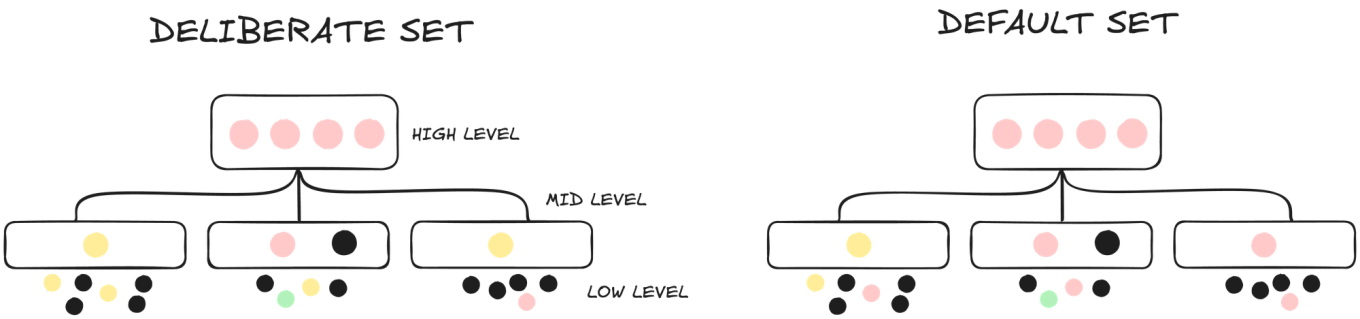
After awareness of misconcepts, the priority becomes clear. Your high-level misconcepts come first, one of which is arbitrary life goals. As you iterate toward goals that are genuinely yours, you are able to apply directed learning and experience and identify which other misconcepts are worth improving next.
The Strategy:
- Start with high level misconcepts
- Improve them to be fit-for-purpose
- Shift them into your defaults through practice and reinforcement
- Use your self-defined life goals, current life resources, and opportunity costThe lifetime value of the next best alternative forgone when expending life resources to improve or implement misconcepts.Full definition (opens in a new tab)→ assessment to identify the highest-ROI mid and low-level misconcepts to develop next
- Repeat as your context evolves
The goal is to turn your misconcepts set into this.

External success without awareness
Some people achieve significant external success without ever becoming aware of misconcepts. This usually reflects learning and experience that happened to be directed toward a domain in short supply and high demand. For example, the ability to discover real problems and build business models to deliver a solution, to administer an anaesthetic, to win court cases, to design buildings that will not fall over, to turn ideas into functional software.
The misconcepts set that results is strong within that domain, and the journey there tends to build quality misconcepts in other areas too. But not all high-level misconcepts may be fit-for-purpose.
Their misconcepts set may look something like this.

This is why many people at the peak of external success report a deep sense of unfulfillment. The external results are real. But without fit-for-purpose high-level misconcepts, the internal experience remains misaligned regardless of what has been achieved.
When awareness arrives, the work already done is not wasted. The life resources built along the way, the financial resourceAll assets an individual owns that can be converted to purchasing power.Full definition (opens in a new tab)→, social capitalThe value of your relationships, built on trust, shared understanding, and support.Full definition (opens in a new tab)→, and strong domain-level misconcepts, all become part of the hand they play from that point forward.
The barrier that makes all of this harder
No matter how strong your deliberate misconcepts become, cognitive biases do not go away. They are evolutionary defaults, responses etched into your genome that served a purpose in the environment they evolved in but are mostly counterproductive in modern life. They can short-circuit your deliberate misconcepts in ways that are easy to miss.
They can prevent you from accessing your deliberate misconcepts at all, leaving you operating on defaults even when you intend to think carefully. They can prevent you from improving a deliberate misconcept even when the evidence for a better explanation is clear. And they can prevent an updated deliberate misconcept from shifting into your defaults, keeping the better version inaccessible for the majority of your decisions.
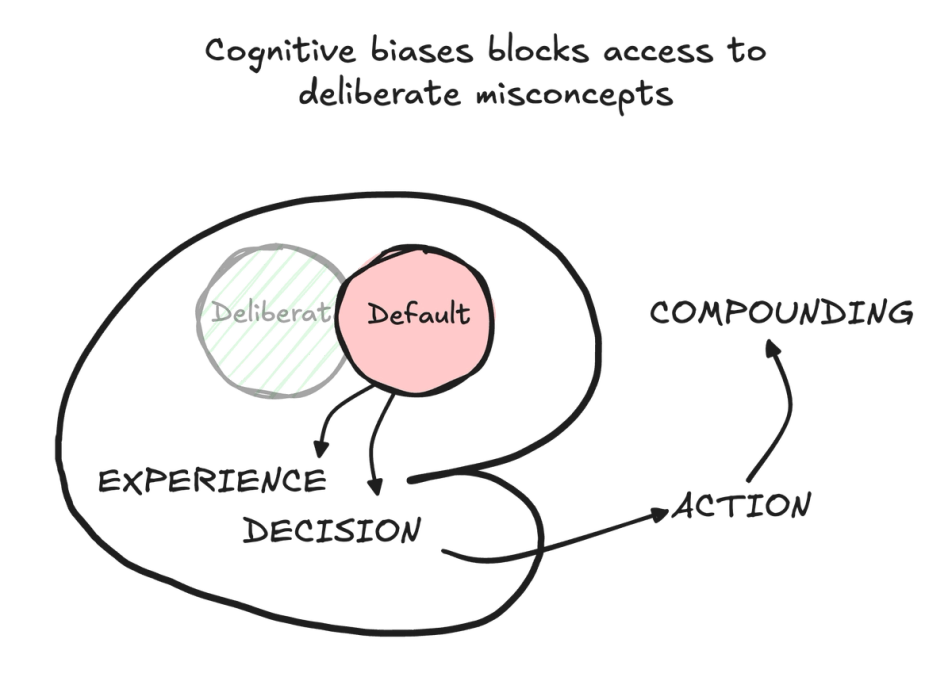
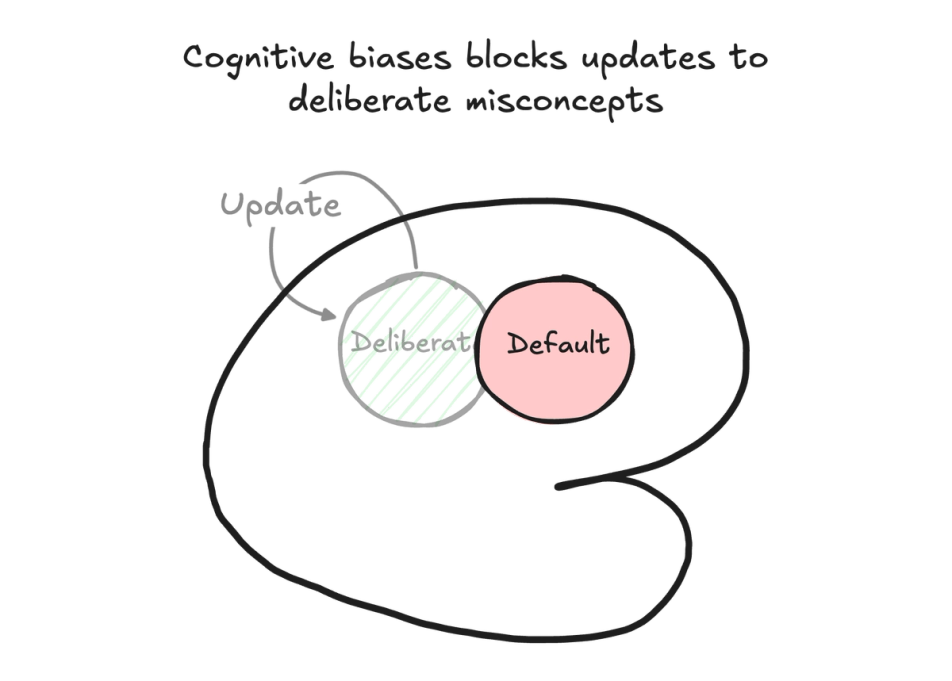
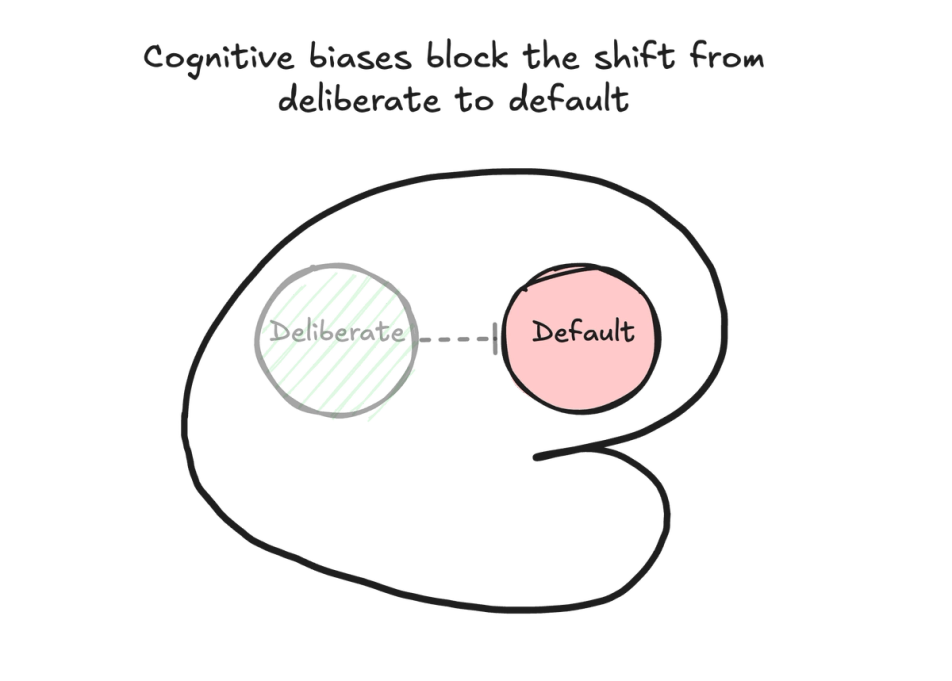
The result is that your internal experience and external results remain driven by lower-quality defaults. Cognitive biases are a permanent feature of your default set, but awareness of how they operate allows you to anticipate when they are likely to fire and build the guardrails and systems that reduce your vulnerability to them.
This is the practice
The hand you were dealt was shaped by circumstance. The hand you play from here is shaped by the quality of your misconcepts and whether you are improving them deliberately.
Improving your misconcepts is an ongoing practice. When pursued relative to your self-defined arbitrary life goals, your internal experience and external results compound in a direction you actually chose.
If this resonated, get Micro Misconcepts in your inbox every Friday.
Subscribe to Micro Misconcepts →