Misconcepts
Not All Misconcepts Are Equal
April 21, 2026
By Syn Yun Phee & David Wang
In the last article, we established that misconcepts, the explanations you hold about how the world works, determine both your internal experience and your external results. And that the only two things you can ever do in life are improve or implement your misconcepts setThe collection of deliberate and default misconcepts we hold.Full definition (opens in a new tab)→.
If that's true, which misconcepts are worth improving first?
Not all of them carry the same weight. Some are foundational to almost everything you do. Others show up occasionally. Understanding the difference gives you a rational way to decide which misconcepts to prioritise and invest your finite life resources in.
This article introduces two ways of categorising misconcepts.
The first category is based on how often a misconcept is invoked in our decisions. The “level” of a misconcept.
The second category is based on how easy the misconcept is accessed and therefore, how often they are implemented. There is a clear dichotomy between our “default” (Type 1) and “deliberate” (Type 2) misconcepts.
The categorisations improves our explanations about misconcepts and puts us a step closer to prioritizing misconcepts to get the highest return on our finite life resources.
Misconcepts level
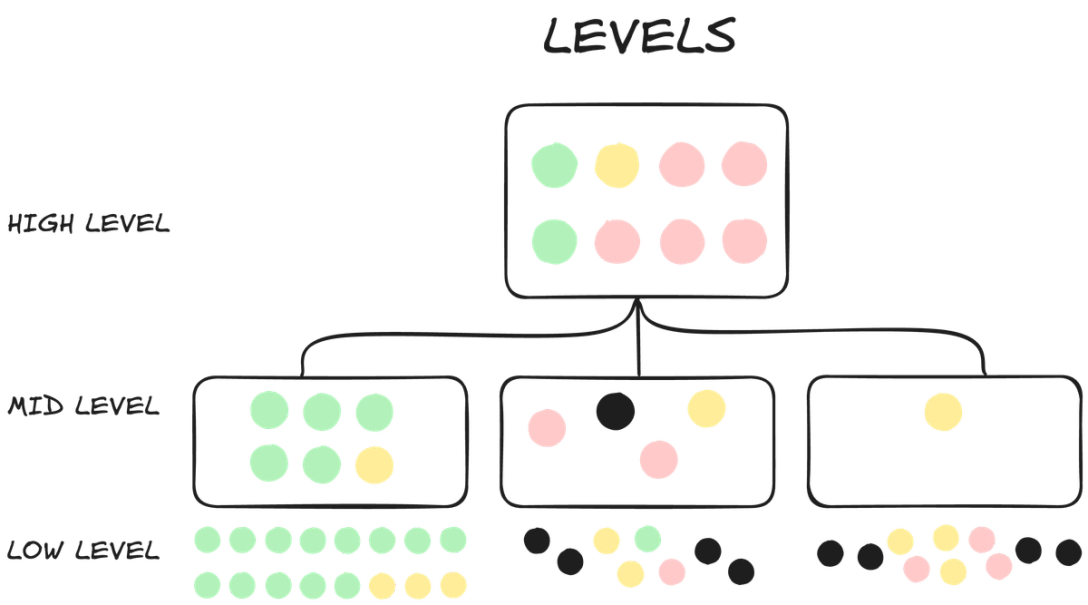
Every decision you make invokes multiple misconcepts. But not every misconcept gets called upon equally often.
Some are invoked for every decision you make. Others show up only within specific domains, like how you think about health, money, or relationships. Others are highly specific, relevant only to detailed choices within those domains.
The level of a misconcept can be defined by the percentage of decisions it is invoked in.
- High-level misconcepts are invoked in 100% of decisions.
- Mid-level misconcepts are invoked in roughly 1-10% of decisions.
- Low-level misconcepts are invoked in under 1% of decisions.
The precise percentages matter less than the idea behind them. A misconcept that shows up in every decision has vastly more influence on your life than one that shows up occasionally. That asymmetry is critical.
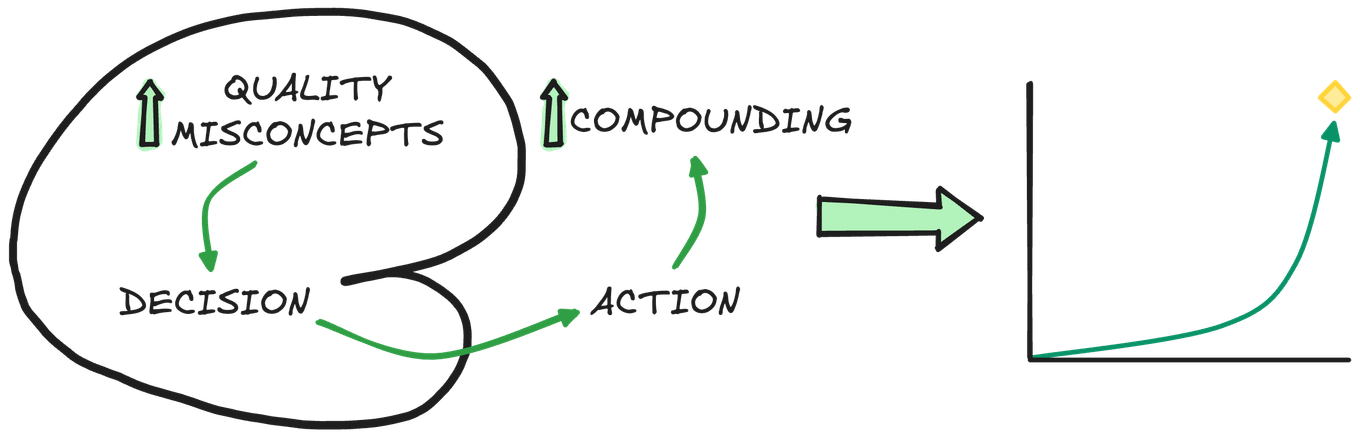
It follows directly that high-level misconcepts have the highest ROI to improve first. An improvement there compounds across every decision you make for the rest of your life, affecting both your external results and your internal experience.
On external results, the logic is straightforward. Every misconcept-decision-action-compounding cycle draws on your high-level misconcepts. Improve them, and every cycle improves with them.
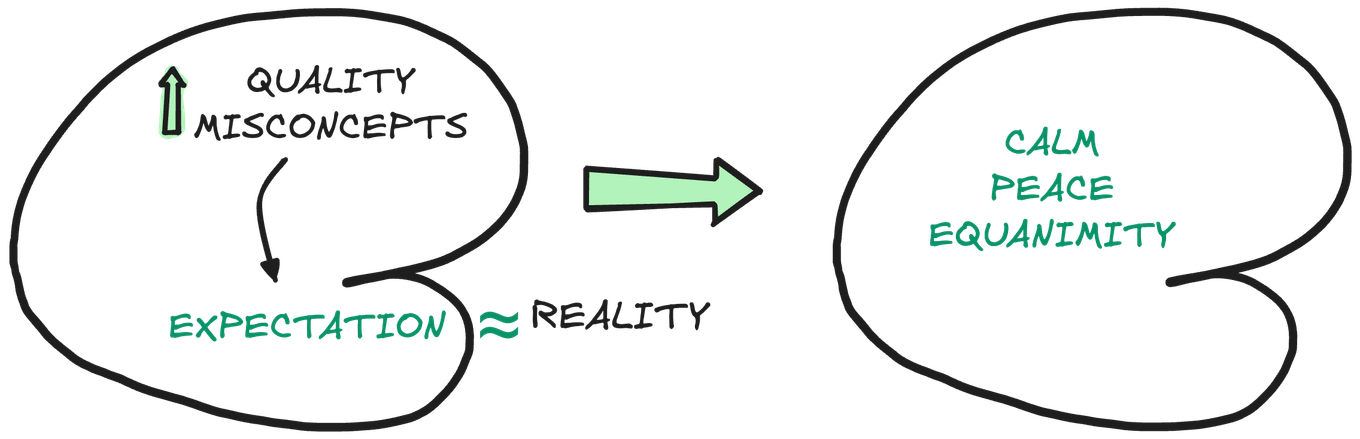
On internal experience, the effect is subtler but just as significant. Your high-level misconcepts are the constant filter through which you interpret everything that happens to you. They set your broadest expectations about how life works. When those expectations are closer to reality, the result is clarity and equanimity. When they contain errors, those errors surface repeatedly, across hundreds of moments every day, as recurring frustration and dissatisfaction. Improvements at this level have more reach than improvements anywhere else.
There is a third reason to start here.
The number of mid and low-level misconcepts you could potentially improve is near infinite. Every domain of life contains thousands of specific things worth knowing better. Without high-quality high-level misconcepts to guide you, there is no principled way to choose which ones to prioritise. Your high-level misconcepts, particularly your understanding of your goals and resources, are what narrow that near-infinite field into something you can actually navigate.
High-level misconcepts are necessary but not sufficient to make a good decision. A single decision draws on misconcepts from all three levels simultaneously. High-level misconcepts set the direction and constraints. Mid-level misconcepts handle the domain-specific knowledge required to operate within that direction. Low-level misconcepts resolve the granular calls that actually produce action. Without fit-for-purpose mid and low-level misconcepts, even the highest quality high-level understanding cannot result in good decisions and actions.
A good decision requires quality high, mid, and low-level misconcepts. However, without quality high-level misconcepts to set the direction and prioritisation, it is difficult to efficiently develop quality mid and low-level misconcepts.
The four high-level misconcepts are discussed further below.
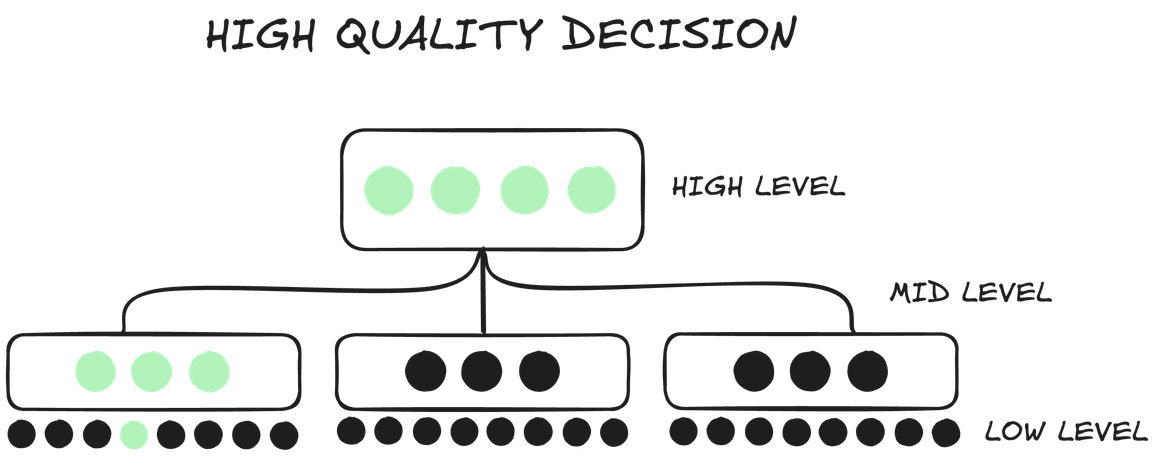
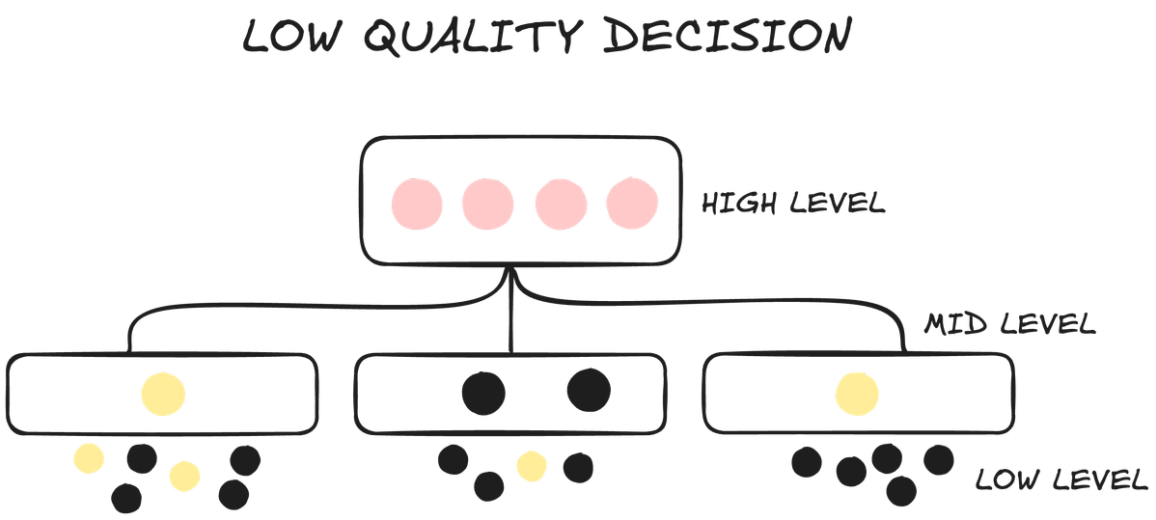
One of our arbitrary life goals is time freedomThe state in which you can sustain your desired consumption level indefinitely without any further input of primary life resources (time, mental resource, and physical resource).Full definition (opens in a new tab)→, the ability to do what you want, when you want. It may be one of yours too. Arbitrary life goals are one of the four high-level misconcepts, which is why having clarity on them makes the mid and low-level misconcepts to prioritise obvious. For us, the highest-ROI mid-level misconcepts to improve were those around what time freedom actually requires, how to earn, invest, consume, and allocate resources towards achieving it. From there, the relevant low-level misconcepts followed naturally, what work to pursue, what skills to acquire, what to invest in, whether to buy or rent. A high-quality high-level misconcept, in this case a clearly defined goal, meant every life resource we invested was directed towards something specific rather than scattered across the near-infinite field of things that could be learnt.
The misconcepts running the show
There is a second categorisation that tells you something equally important: which misconcepts are actually driving most of your decisions.
Every misconcept you hold sits in one of two modes.
Deliberate misconceptsThe set of misconcepts accessed through conscious mental effort (System 2 thinking).Full definition (opens in a new tab)→ require conscious mental effort to access. They are slow and resource-intensive, but are of higher relative quality as they reflect reality closer than their default counterparts. They correspond to what Daniel Kahneman called System 2 thinking.
Default misconcepts are accessed automatically and without conscious effort. They are fast and feel entirely natural, but are of lower relative quality. They correspond to System 1 thinking.
Think of them as two sets of misconcepts. Each misconcept you hold has a version in each set. At any point in time you are invoking either the deliberate or default set.
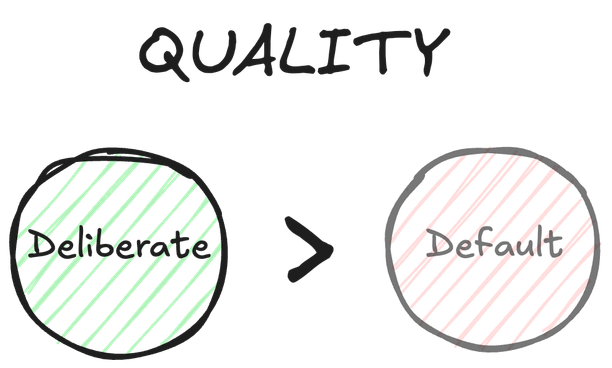
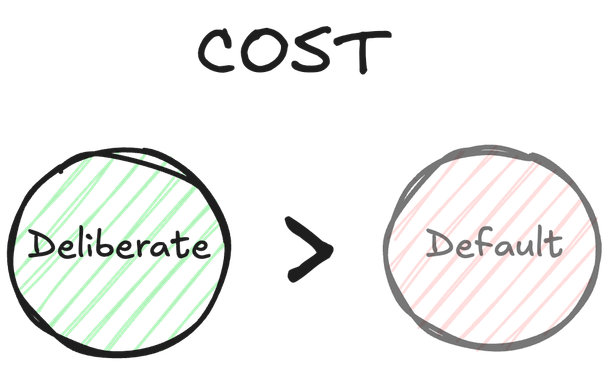
This categorisation matters because:
- The quality of your default misconcepts is capped by the quality of your deliberate ones.
- As default misconcepts are accessed with little effort, they are implemented the majority of the time. This means they have:
- Disproportionate influence on your external results
- Disproportionate influence on your internal experience.
External results
Life consists of approximately a billion decisions.
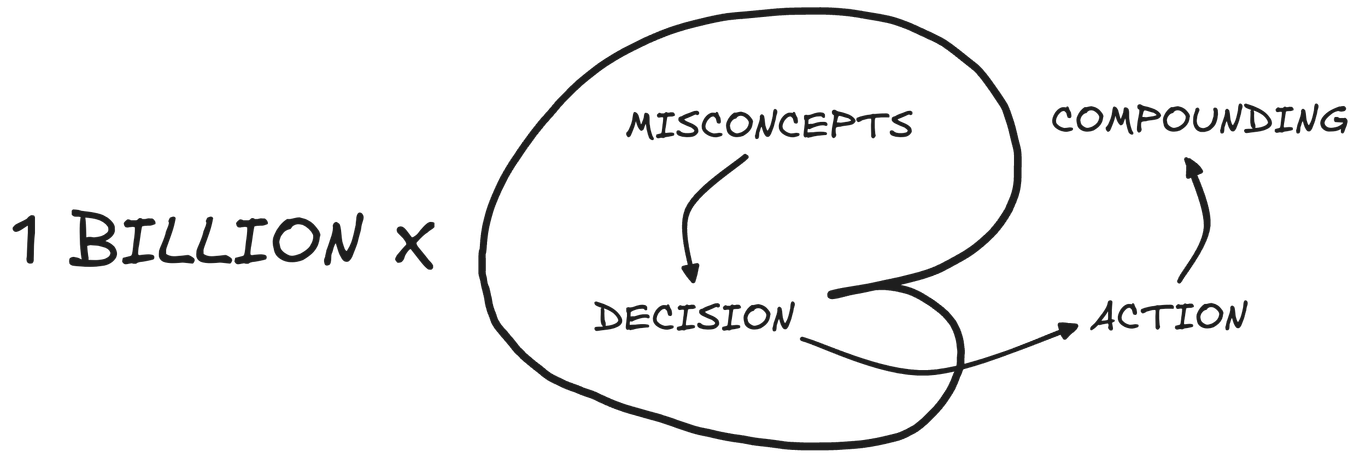
Ideally you would make every decision through your deliberate misconcepts, producing the highest-quality decisions and the most rapid compounding toward your goals. But practically, you do not have the mental resources or time to do that. The sheer volume of choices we face in modern life means conserving mental capacity is not laziness but a necessity. Default misconcepts allow you to handle the load.
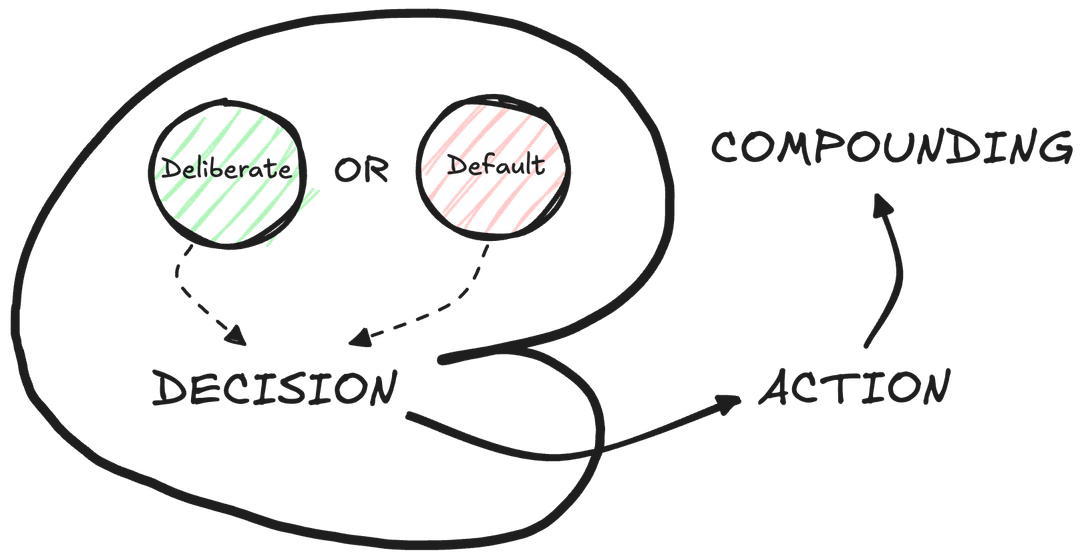
Let’s generously estimate that 5% of your one billion lifetime decisions are made through your deliberate misconcepts. The remaining 95% run on default.
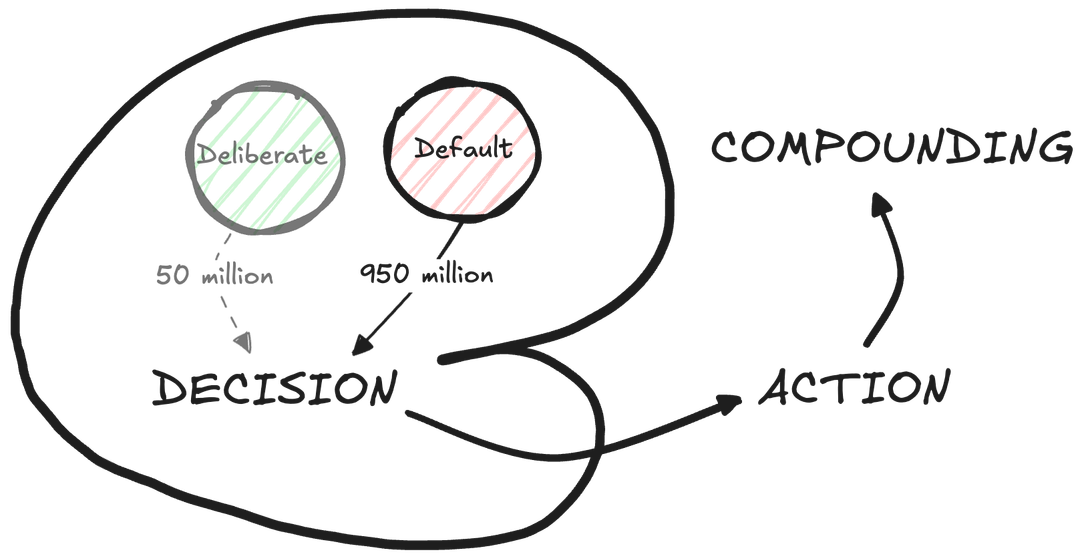
The vast majority of the decisions shaping your external results are therefore being made by misconcepts you did not consciously choose, have probably never examined, and may have inherited from sources you would not endorse if you did examine them.
That 95% includes the small daily decisions to the larger ones, all of it accumulating into the texture of your days and the trajectory of your life.
There are 3 options to improve the quality of your decisions and therefore your external results:
- You can increase the percentage of decisions made through your deliberate misconcepts. However, this comes with an increase in mental resourceThe ability to creatively conjecture, rationally criticise, and focus.Full definition (opens in a new tab)→ cost.
- You can increase the quality of your default misconcepts, though this is capped by the quality of your deliberate misconcepts.
- You can increase the quality of your deliberate misconcepts, though this is only effective if the updated deliberate misconcept is then used to make a decision or update a default.
Internal experience
Default misconcepts are easy to access, socially validated, emotionally entrenched, and reinforced by evolutionary instincts. They are the path of least resistance for interpreting the world. As a result, your internal experience is disproportionately shaped by your defaults. Deliberate misconcepts, though of higher relative quality, require conscious effort and reinforcement to exert comparable influence.

The quality gap between your deliberate and default misconcepts is therefore not just a decision-quality problem. It is the primary driver of the friction, frustration, and dissatisfaction you experience day to day.
The ceiling effect
The quality of your default misconcepts is capped by the quality of your deliberate ones.
Improve your deliberate misconcepts in any area, and over time, through practice and repetition, better versions shift into the default set. Leave them unexamined, and the defaults stay where they are.
Shifting defaults is hard because challenging them through deliberate misconcepts can be uncomfortable, particularly when those defaults are tied to ego or social belonging. Deliberate misconcepts must therefore be practised, emotionally integrated, and socially supported to compete.
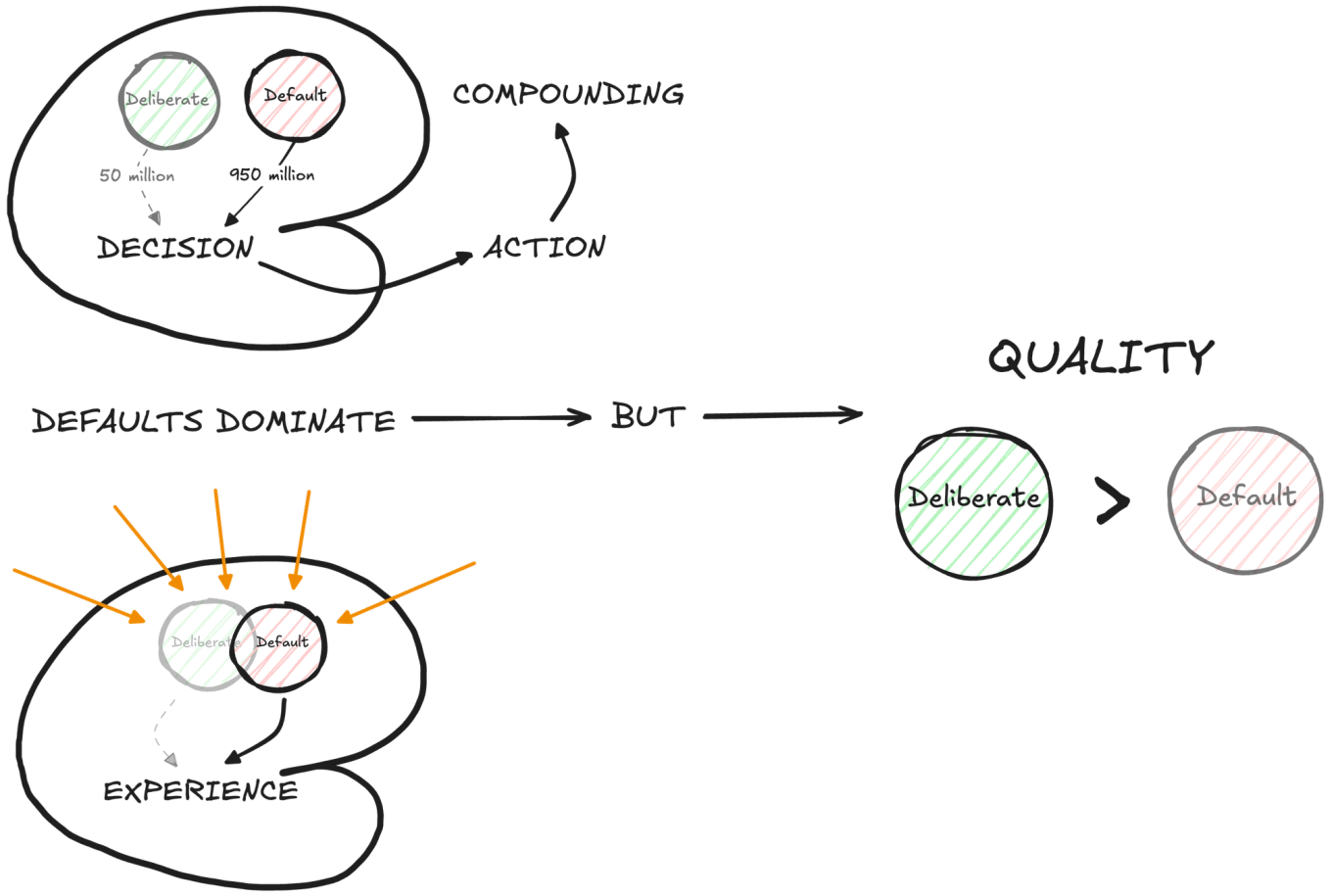
But deliberate misconcepts are the only route to raising the quality of what runs automatically. This is what makes improving them the highest-leverage move available to you. Not because they do the work directly, but because they set the ceiling for everything else.
Relative and absolute quality
Higher relative quality of deliberate misconcepts does not guarantee high absolute quality. Deliberate misconcepts tend to be closer to reality than their default counterparts, but that does not make them necessarily good explanations.
Your misconcepts set
Combine the two categorisations and you get an overview of your misconcepts set.
Congratulations, this is the first high-level deliberate misconcept you have improved and you have instantly increased the ROI on all your future life resources by doing so.
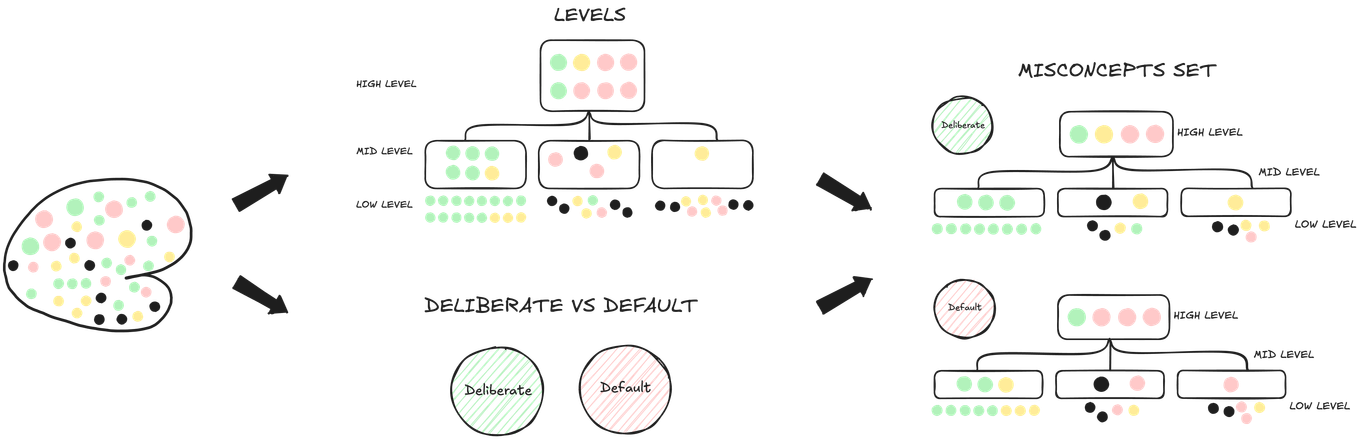
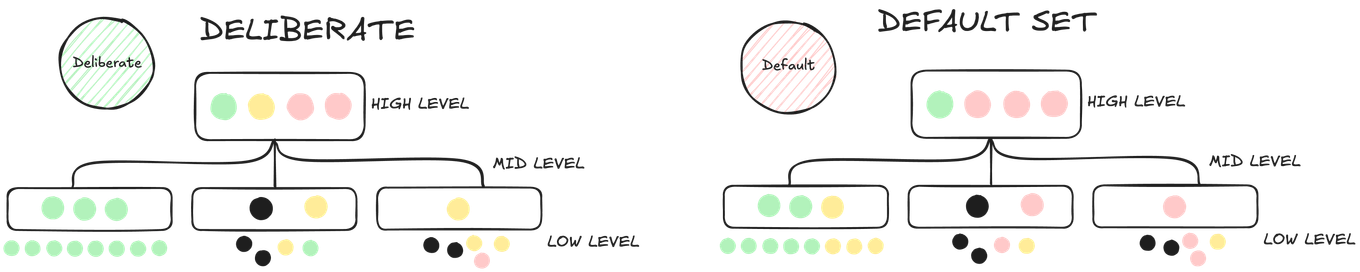
A strategic implication becomes visible. Your high-level default misconcepts are the highest ROI target in your entire misconcepts set. They are invoked in every decision you make and they run automatically, which means they are shaping your life constantly, mostly outside of your awareness.
But you cannot improve your high-level defaults directly. They are capped by your high-level deliberate misconcepts. To raise the ceiling, you have to work at the deliberate level first, and then practise and reinforce until the better versions become the automatic response. Before anything else, get your high-level deliberate misconcepts to a quality that is fit-for-purpose.
So what are the high-level misconcepts worth focusing on first?
The four high level misconcepts
There are four misconcepts invoked in every decision any person ever makes. They are invoked constantly, with varying quality and awareness.
The first is misconcepts itself. Understanding what misconcepts are, how they work, and how they can be improved is the foundation everything else builds on. By reading this article you have begun updating this deliberate high level misconcept.
The second is life resources. Every decision and action involves the expenditure of finite life resources, your time, mental resource, physical resourceThe function of our biological machinery.Full definition (opens in a new tab)→, financial resourceAll assets an individual owns that can be converted to purchasing power.Full definition (opens in a new tab)→, social capitalThe value of your relationships, built on trust, shared understanding, and support.Full definition (opens in a new tab)→, and misconcepts set. Without a clear understanding of what your resources are, how they can be managed, and how they interact, you cannot make good decisions about where to spend them.
The third is arbitrary life goals. Every expenditure of your resources is aimed at something, whether you have consciously defined that something or not. If the goals driving your decisions are inherited rather than self-defined, the compounding runs in a direction defined by someone else. Arbitrary life goals are not static. They are also conjectured, and constantly iterated through taking action and criticising the results. The misconcepts framework uses a pragmatic approach to iterating arbitrary life goals by evaluating the medium and long term effect on mental resource.
The fourth is opportunity cost. Because your resources are finite, every decision to do one thing is a decision not to do something else, assessed not just in the moment but across a lifetime. The quality of your opportunity cost assessment determines whether you are consistently choosing the option with the highest lifetime utility and the highest ROI for your finite life resources.
The previous article and this article has covered the first. The next three articles take up life resources, arbitrary life goals, and opportunity cost in turn. Improve any one of them, and it changes the trajectory of your external results and the quality of your internal experience while maximizing the ROI of your finite life resources.
If this resonated, get Micro Misconcepts in your inbox every Friday.
Subscribe to Micro Misconcepts →