Working to buy relief from work
October 6, 2026
By Syn Yun Phee
Most of us start out by trading our time, mental and physical resourceThe function of our biological machinery.Full definition (opens in a new tab)→ for a salary. The job we fall into might not be our ideal one. It might not be work that engages us, or how we'd choose to spend our finite time, but we take it anyway, telling ourselves it's temporary. A stepping stone. Soon we'll be doing something closer to what we actually want.
But a job that doesn't engage us drains us more than we expect. Some weeks, we feel the whole weight of it. Back-to-back meetings, evenings disappearing into the inbox, and by Friday we've got nothing left in the tank.
So we do what feels natural. We book the weekend away, buy ourselves a little treat, upgrade something that didn't really need upgrading. We've earned it, after all.
And it works... for a while. There's a relief in the moment we buy, a lightness that feels a lot like the happiness we were promised.
Then Monday arrives, and with it the same job that drained us in the first place. Except now there's a slightly higher bar for what treating ourselves needs to look like next time, and with it, a slightly bigger bill to pay. To pay it, we need the job a little more than we did last week. And the more we need it, the more trapped we feel, which only adds to the stress we were trying to escape and sends us looking for relief again.
We never set out to live like this. The stepping stone was only ever meant to be temporary. But the loop runs quietly enough that most of us never notice we're in it. It simply feels like ordinary adult life.
"After twelve months of Excel modeling until 3 a.m., you have an urge to prove to yourself that it was worth it, offsetting what you sacrificed. It's like someone held underwater for a minute — they do not take a calm breath when they surface; they gasp. A lot of spending is gasping." — Morgan Housel
Money can create the conditions for a good life. But when our unexamined defaults decide how we spend it, it funds a loop where we trade more and more of our time for less and less of what we actually wanted. If we want the highest return from our financial resourceAll assets an individual owns that can be converted to purchasing power.Full definition (opens in a new tab)→, we first need to understand how the loop works, and why it's so easy to fall into.
Taught to buy
We are social animals. For most of our evolutionary history, belonging to the group meant survival, and being cast out from it could mean death. So we come wired with a deep need to belong and, closely intertwined with it, a need to be respected by the people around us. Those needs haven't gone anywhere just because the world around us has changed.
Alongside those needs, evolution equipped us with mental shortcuts for meeting them. We look to what others are doing to work out what's normal and worth doing. We learn what to want by watching what the people around us want. And we judge how well we're doing by comparing ourselves to those around us rather than against any objective standard. In a small tribe, these shortcuts kept us in step with the group. In a world of targeted ads, algorithmic feeds and paid influencers, they're remarkably easy to exploit.
Which is exactly what advertising is designed to do. An ad's job is to sell us a product, and often the most effective way to do that is to promise us that buying it will make us respected, happy and fulfilled. If we look carefully at most ads, we'll notice that the promise is similar no matter the product being sold.
Drive this car and people will admire you.
Wear this watch and they'll know you've made it.
Take this holiday and you'll finally feel like you're living well.
Unless we grew up somewhere remote with no screens or an internet connection, we were surrounded by these messages every day, long before we were aware it was happening, let alone able to rationally criticise what we were being told. So a learned default forms on top of the evolutionary ones, the belief that buying things is how we meet our need to belong, to be respected, to be happy.
That default wasn't our choice. It's part of the hand we were dealt, shaped by our biology and by people with the incentives to take advantage of it. Blaming ourselves, or even them, gets us nowhere. Recognising the hand for what it is does, because we can only play it better once we can see it.
Stuck in the loop
Seeing our defaults is harder than it sounds, because the loop keeps us too exhausted to notice we're in it.
Work we don't care about drains our mental resourceThe ability to creatively conjecture, rationally criticise, and focus.Full definition (opens in a new tab)→ faster than work we do. By the end of a draining week, there's little left for clear, effortful thinking. And when mental resource runs low, we fall back on our defaults. So the decision about how to relieve the stress gets handed to the same defaults that marketing has spent our whole lives shaping. The rested version of us might pause and ask whether we actually want the thing. The depleted version just reaches for it.
We can see the whole loop play out in the money cycle. We trade primary life resourcesThe life resources we are born with. They are expended to improve or implement misconcepts, and to acquire secondary life resources.Full definition (opens in a new tab)→ for money. We spend some (or all) of that money on consumption to replenish our mental and physical resource, and save or invest whatever is left.
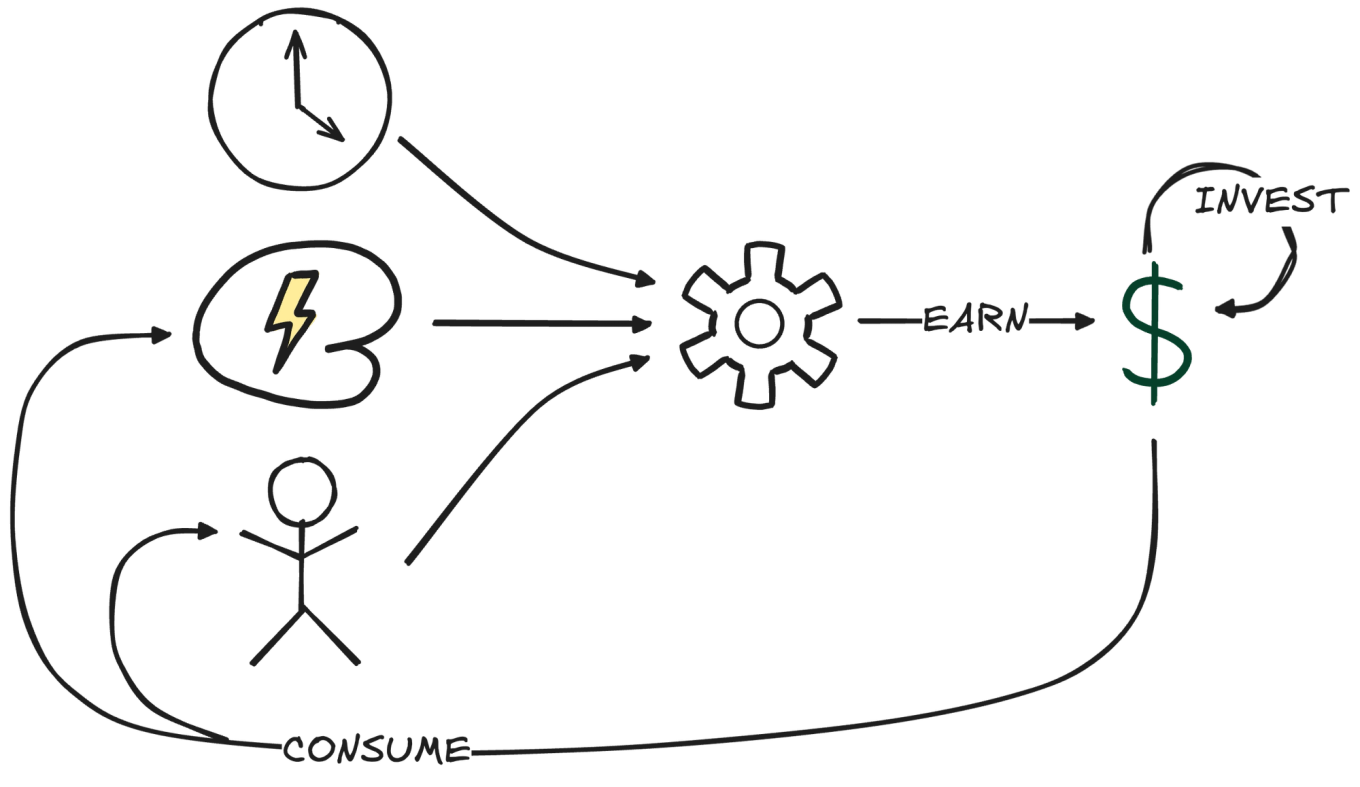
In the loop, earning and consumption both speed up. More time traded for money, more money traded for relief. Some of what we buy becomes a repayment or a subscription, so the cycle has to run faster just to stand still. We end up buying painkillers from the very system that's causing the pain.
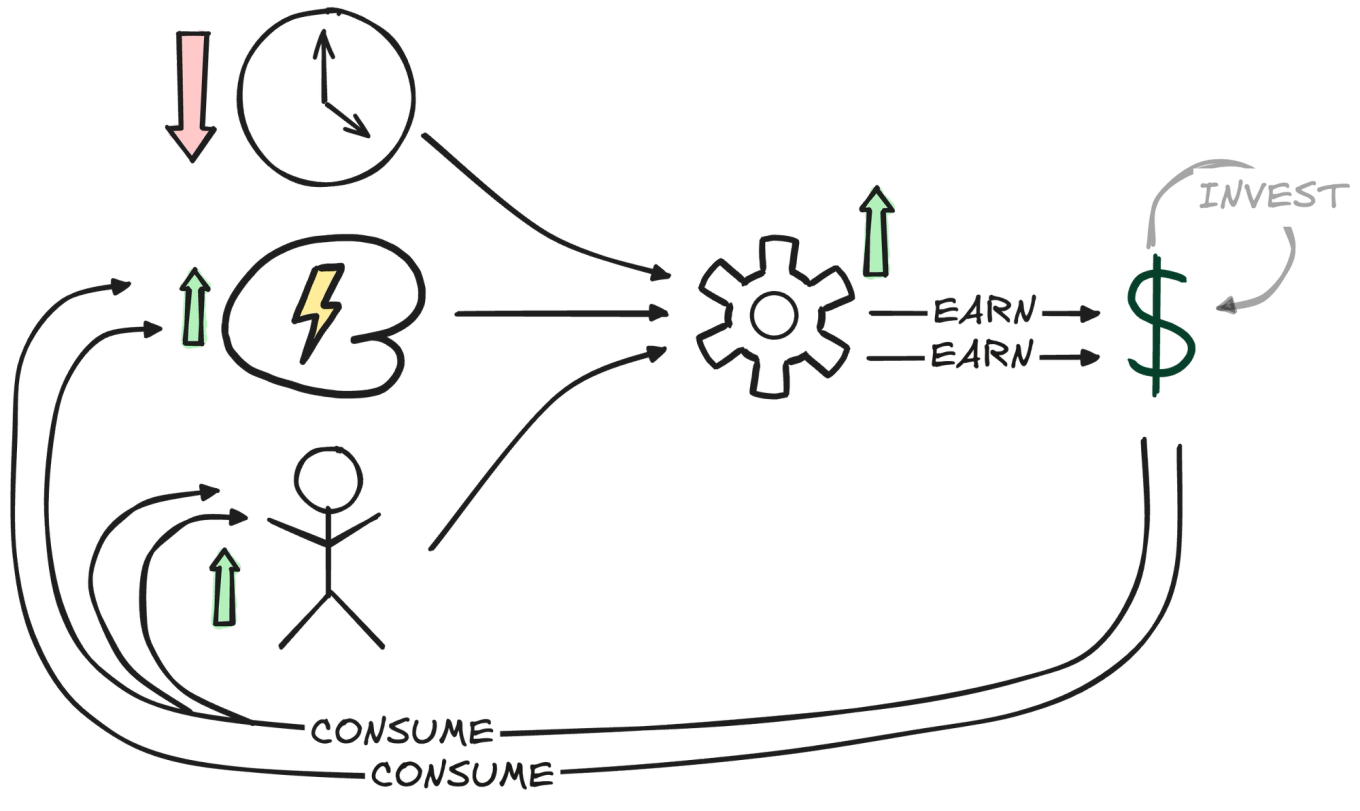
In the meantime, there's less leftover to save or invest. And every dollar we don't save is a dollar that isn't buying our independence. All the while, time, the one resource we can never get back, keeps depleting. Eventually we can end up in a financial position where we feel we have no choice but to keep doing work that isn't what we want. The money that could have bought our freedom becomes the reason we can't leave.
What money can buy
None of this makes money the villain. It would be deeply naive to say so. We need money to solve the most basic problems of survival, safety and security. A roof over our heads, food on the table, the ability to see a doctor. Few things return more to our lives per dollar than meeting those needs.
Money also solves a wider set of problems. It lets us absorb a shock, like losing a job, an illness that stops us working, or a sudden shift in the economy, without our lives falling apart. It can give us the freedom to leave a bad situation, and eventually, control over how we spend our time.
What it doesn't do is hand us happiness at the point of sale.
Think about it like a vaccine. A good vaccine protects us from a specific set of diseases, and going without one can be catastrophic. But nobody expects a vaccine to magically make them fit, strong or full of energy. That part is largely up to us.
Money works the same way. It can solve the problems that come from not having enough, and that is enormously valuable. But removing the bad is not the same as adding the good. That depends on what we do with the conditions money creates.
What money can't buy
Once the basics are covered, there's no single answer to what will make our lives feel worth living, because what fulfills us varies from person to person. For one person it may be cooking for friends on a Sunday. For another it may be creative expression through painting, or restoring an old motorcycle, or simply time with their kids without one eye on the clock.
But some needs are shared by almost all of us. We want love and belonging. What differs is how each of us goes about meeting those needs, and the trap is mistaking a purchase for one of those ways.
When we reach for the nicer car or the more impressive holiday, what we're often after is the respect and admiration of others. Underneath that is an assumption that if others respect and admire us, then we'll be loved and accepted. But as we explored in an earlier article, other people tend to see our nice things as a measure of what they want for themselves, rather than a reason to admire us. And even when they do admire us, admiration isn't love. It can be won from a distance, by people who barely know us.
Love and belonging come from our relationships, our social capitalThe value of your relationships, built on trust, shared understanding, and support.Full definition (opens in a new tab)→. And social capital needs a continuous investment of our primary life resources, our time, mental and physical resource, to build and maintain. Which brings us to another irony of the loop. The work-and-spend cycle drains exactly the resources we'd need to invest in the people around us, and trades them for things that were trying, and failing, to meet the same need.
"But after meeting our basic needs as creatures, we enter into the human universe of desire. And knowing what to want is much harder than knowing what to need." — Luke Burgis
Knowing what to want is hard because so much of our wanting is borrowed. We look to the people around us to show us what's worth wanting. Most of that was learned before we could question it, and it has been reinforced by our environment every day since. And because these wants arrived so early, they feel like our own preferences. The better we understand these defaults, the more of our spending we can decide deliberately rather than leave to them.
No one can tell us what to spend our money on. But we can notice what each purchase actually returns to us over time, relative to our self-defined life goals. The relief purchase gives us a short lift in mental resource that's gone by Monday. A dinner with close friends, a bike that gets us outdoors, a course that turns into work we care about tend to keep paying back over the medium and long term, well after the money is spent. Same dollar, far greater lifetime valueThe net value in life resources across a lifetime — short, medium, and long term — from expending life resources to improve or implement misconcepts.Full definition (opens in a new tab)→. Watching for that difference is how we get a little better at telling what we want from what we've been told to want.
Money is very good at creating the conditions for a good life. What it can't do is build one for us. Left to our defaults, it builds the loop instead.
The loop doesn't end when we earn and consume enough. It ends when we know what enough looks like.
If this resonated, get Micro Misconcepts in your inbox every Friday.
Subscribe to Micro Misconcepts →