On the pursuit of happiness via consumption
August 17, 2026
By Syn Yun Phee
Ask a friend what they want for their life and you'll likely get some version of this response.
I just want to be happy.
But prod a little further, ask what that actually means, and most people start fumbling. Few can give you a coherent answer, yet everyone claims to be pursuing it. And in this frantic pursuit, without a clear vision of what happiness actually means to us, we are left vulnerable to the many interpretations available under this broad term.
If we look at what people actually do, rather than just what they say, we get a glimpse into the dominant cultural meme of what it means to be happy today.
Buy a nicer car.
Upgrade the kitchen.
Book the trip everyone's posting about.
Eat somewhere with a three-month waitlist.
At some point in history, the default belief has morphed into equating happiness with the ability to purchase increasingly luxurious goods and accumulate an impressive-sounding resume of experiences. We are, often unknowingly, pursuing happiness via consumption.
Almost nobody thinks of themselves this way though. Most would say they are opposed to consumerism and they value experiences over things (even though the pursuit of experiences has itself been turned into a form of consumerism in disguise). Nonetheless, we all remain vulnerable to the trappings of consumerism as it has a few strategies up its sleeve to keep itself alive.
To begin building our defences and pursuing happiness via a route that actually returns what it promises, we need to start by understanding how the consumerism meme successfully spread across society.
The anti-rational meme
In his book The Beginning of Infinity, the physicist and philosopher David Deutsch explains that memes are units of information or knowledge. He argues that memes survive and spread among human minds by utilising one of two very different strategies.
The first type spreads because they're true or beneficial to the holder. They provide real-world value. When people critically evaluate the idea, they see that it works so they choose to adopt it and pass it on. He calls these rational memes. Rational memes don't mind being subject to criticism. In fact, they welcome it because it helps to refine them, which means the improved version works even better, in turn reinforcing its spread. Examples of these include a scientific method, an engineering technique or a really good recipe that lasts generations.
The second type survives by doing the exact opposite, via actively disabling the recipient's critical thinking, thus preventing them from being criticized, modified, or abandoned when exposed for its flaws. Deutsch calls these anti-rational memes. Rather than offering objective truth or utility, they bypass rational scrutiny through exploiting our cognitive biases, convincing us that altering or questioning the meme is dangerous. Think taboos, ideas where doubt is framed as a moral failure, or ideas where belonging and identity are at stake.
The pursuit of happiness via consumption became a cultural default because the consumerism meme was a particularly successful anti-rational meme. In this case, its success involved hijacking one of our most deeply ingrained evolutionary drives, status.
In a tribal setting, status mattered for survival. If you were highly valued by the group, you were fed and protected. That drive for status has not left us today and remains a deeply emotional pull. And when strong emotions are involved, deliberate thinking often takes a back seat.
There is nothing wrong with wanting to be well regarded by the people around you. The problem arises when you care about not just what the few people who really matter to you think, but also what people you don't like or don't even know think as well. All this is exacerbated by the ease with which we can compare our relative social standing via a single scroll session on any major social media platform.
If before you only compared yourself to people in your small neighbourhood, today you compare yourself to a stranger on the internet living halfway across the world. This creates an endless string of desires to satisfy, more stuff and experiences to covet.
The irony is that people often buy luxury items because they want respect and admiration from others, and yet the reality is that others don't admire you for having these things. They just imagine themselves having the same things and how others would admire them for it.
It's a strange, sadly funny paradox. Author Morgan Housel called this the “Man in the Car Paradox”, summing it up in his book The Psychology of Money:
"When you see someone driving a nice car, you rarely think, 'Wow, the guy driving that car is cool.' Instead, you think, 'Wow, if I had that car people would think I was cool.' Subconscious or not, this is how people think. There is a paradox here: people tend to want wealth to signal to others that they should be liked and admired. But in reality, those other people often bypass admiring you, not because they don't think wealth is admirable, but because they use your wealth only as a benchmark for their own desire to be liked and admired."
What makes this even harder to notice is that it all feels very normal. Your sense of what is ordinary, what you should want, how you should live, is all shaped by where you happen to live and who you happen to be surrounded by. The desires that arise feel normal because everyone around you is pursuing it too.
Then hedonic adaptation gets employed to keep you on the consumption treadmill. When you buy the thing, you get a brief burst of satisfaction or status elevation. This short term dopamine hit feels like verification that the consumerism meme "worked" because it made you feel good. But when the feeling inevitably fades and you return to baseline, the discontent returns, creating yet a new psychological itch to scratch once again. Each time, you need something new, bigger or better to feel equally satisfied. The upgrade always feels necessary because what was once extra is now just an expectation.
"If you're not happy with a cup of coffee, you're not going to be happy with a yacht." — Naval Ravikant
The meme survives because we don't sit down, weigh the evidence, and conclude that buying things doesn't work. Instead, we think it was just the wrong purchase or we haven't bought enough of it yet. In the words of Daniel Gilbert, we keep expecting “the next car, the next house, or the next promotion to make us happy even though the last ones didn't and even though others keep telling us that the next ones won't."
The consumerism meme has been highly successful in spreading as an anti-rational meme because it taps into our deep emotional need for status, then reinforces its armour by exploiting our cognitive biases. Its dominance is not a reflection of its truth or utility but its efficiency in spreading among human minds. And in our modern society, it has another force working in its favour.
It’s profitable
For our economies to keep growing, people need to keep working, earning and spending. An insatiable hunger for stuff keeps the system going and growing because if everyone were content with the stuff they had, growth would slow.
But the needs of a thriving economy aren't necessarily synergistic with the needs of a thriving human being. Most of us get up in the morning driven by our own desires, not the economy's. So how do you align the two?
Well, if people hold the false belief that producing more and consuming more will make them happy, the incentive problem solves itself. They'll keep producing, procuring and consuming without anyone having to ask. I've always found it perplexing how we buy stuff we don't use, then buy storage space, a bigger house or a self-storage unit, to store it.
The psychologist Daniel Gilbert makes this point in his book Stumbling on Happiness:
"Economies thrive when individuals strive, but because individuals will only strive for their own happiness, it is essential that they mistakenly believe that producing and consuming are routes to personal well-being."
We think more money and more stuff would lead to happiness, that someday we'd reach a magic number and finally feel content. But the only magical thing about that number is that it doesn't exist, and we still believe in it anyway.
One of my favourite ideas from Naval Ravikant is that "desire is a contract you make with yourself to be unhappy until you get what you want." A lot of that desire is manufactured well outside of you, by an environment that has every reason to keep it renewing. You're not obligated to sign that contract.
You can choose to opt out. And you can do so without becoming a monk or living in austerity. It starts with seeing money clearly for what it is.
What money is
Money isn't a real thing in the way food or shelter is. It's a shared fiction, a very convenient invention to facilitate trade.
If you trace it back to where it came from, you find something more concrete than colourful pieces of paper and imaginary numbers on a screen. For most of us, we trade our time, mental resourceThe ability to creatively conjecture, rationally criticise, and focus.Full definition (opens in a new tab)→ and physical resourceThe function of our biological machinery.Full definition (opens in a new tab)→ through some form of work in exchange for money. Money thus acts like an IOU that society issues to track the value you've provided, redeemable later for value someone else provides. We can trade that money back into goods and services that replenish our mental and physical resources, thus redeeming that stored value. Money is your primary life resources in disguise.
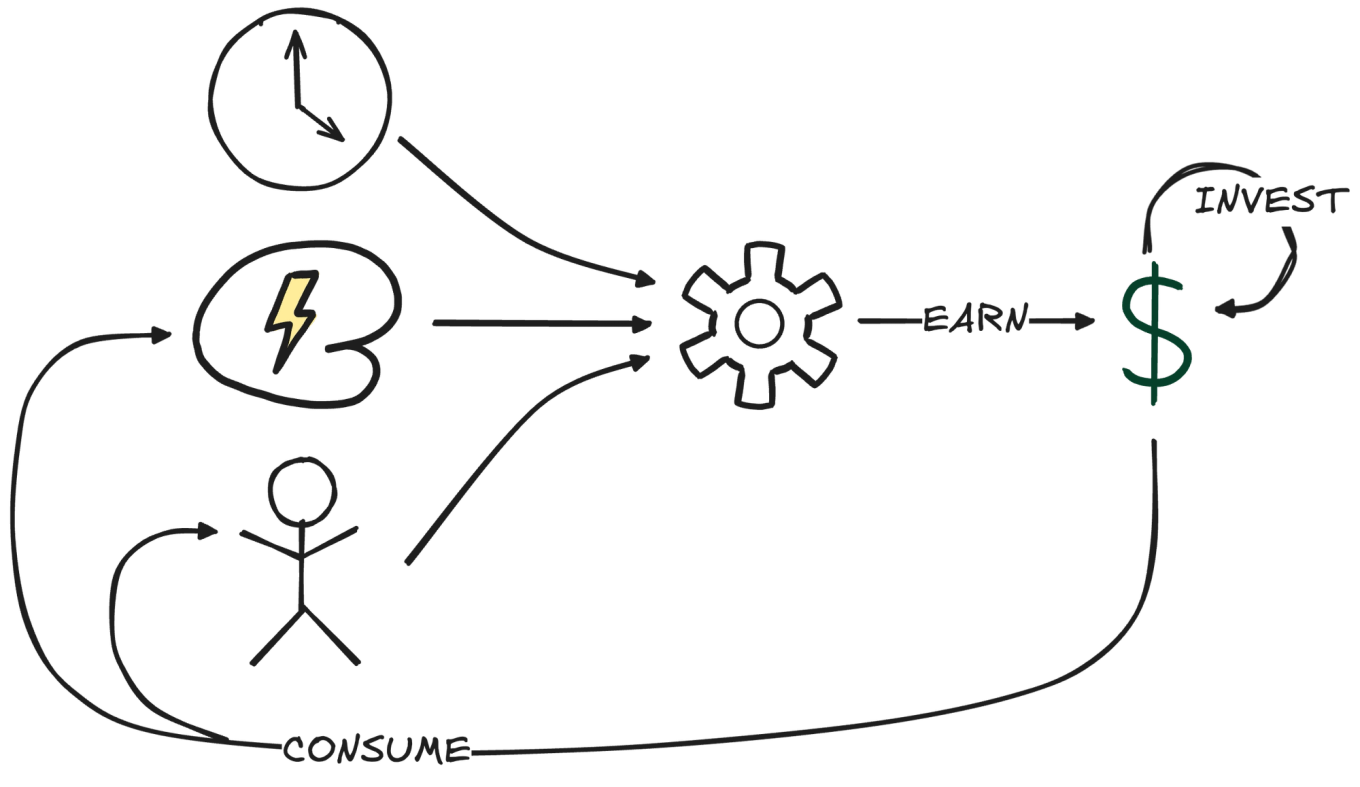
That extra conversion step is what makes it so easy to lose track of what you're actually spending. A price tag shows you a number. Translate it back to what it cost you to earn it, and it shows you something different. Earn fifty dollars an hour and a five-hundred-dollar purchase isn't just five hundred dollars, it's ten hours of your life.
Seeing money this way immediately raises the question of how to best allocate it, bringing us to the very useful economic concept of marginal utilityThe incremental gain in lifetime value per incremental unit of life resource expended.Full definition (opens in a new tab)→.
Wealth and consumption have declining marginal utility, which is a fancy way of saying that it hurts to be cold, hungry, thirsty, sick and scared, but once you solve for them, every dollar after that buys you less and less.
Spending money on meeting these basic needs gives you enormous returns on your dollar, representing the steepest parts of the marginal utility curve. It's easy to take for granted the enormous value we get from having something basic like access to clean water because it's abundant, everyone has it, and it has become the baseline. It only takes a natural disaster and temporary interruption to supply to make us realise the actual value derived from this one basic thing.
The next question then is what you do after you meet these basic needs.
Choosing consciously
Once you can see money for what it is, spending stops being a simple yes or no and becomes a question of conscious resource allocation. How do you consume in a way that gives you the highest return from your finite life resourcesThe finite resources we expend to improve or implement misconcepts.Full definition (opens in a new tab)→?
It depends on where you currently sit on that declining marginal utility curve, and that looks different for everyone. It's not about being frugal and austere for the sake of it, but finding the point of consumption that is optimal for you given your current goals, life resources and the opportunity cost you are willing to accept.
Consider the simple example of food. Fundamentally, we eat to live. It does not cost a lot to meet this basic need. You can meet your macro and micronutrient requirements with the most basic of foods. But we don't eat purely for nutrition or we'd just boil rice and beans and knock down some shakes. We also eat for pleasure and social connection.
The difference is finding where you get optimal utility from food, for both mental and physical resources, rather than letting external forces dictate what you think you should want. Some people don't care much about food and are happy eating the same basic meal every day. Others might be avid foodies, getting a lot of mental resources from trying different cuisines. The trap arises when you chase after food experiences not because it genuinely provides value to your mental resource, but because you've adopted a belief that that's what it means to be successful or live a good life, having seen an instagram feed full of pictures of people eating out at nice restaurants.
Conscious life resource allocation requires knowing what you're actually optimising for, and that brings us back to the question this piece opened with and left unanswered. People say happy. But what does that actually mean?
Fortunately, we're not completely clueless.
The clues we have
It might look slightly different for everyone, but a few themes repeatedly emerge, whether from centuries-old wisdom, modern psychology research, or the experiences of people who've "made it" and realised it was not what they thought it would be.
Health. Relationships. Meaningful work. A quiet mind.
These are the themes you hear again and again.
Actor and comedian Jim Carrey famously warned against the allure of wealth and status when he said "I think everybody should get rich and famous and do everything they ever dreamed of so they can see that it's not the answer."
Robert Waldinger, psychiatrist and director of the Harvard Study of Adult Development, shared his findings in one of the most-viewed TED talks of all time, titled "What makes a good life? Lessons from the longest study on happiness."
He noted that “the lessons aren't about wealth or fame or working harder and harder. The clearest message that we get from this 75-year study is this: Good relationships keep us happier and healthier. Period."
We can even look to psychiatrist and Holocaust survivor, Viktor Frankl, who through his experiences put forth his theory of Logotherapy. Derived from the Greek word logos (meaning or reason), Frankl's conjecture is that the primary human drive is not the pursuit of pleasure or power, but the "will to meaning."
In other words, we seek meaning and a sense of purpose as our core motivational force. In his book Man's Search for Meaning, he describes the three categories in which individuals source meaning. These include work ("by creating work or doing a deed"), love and connection ("by experiencing something or encountering someone") or suffering ("by the attitude we take toward unavoidable suffering.").
This theory explains why entrepreneurs who've just had a major exit often find themselves feeling lost once the year of leisure wears off. The outcome might've been rewarding but when the work stopped, so did their source of meaning and purpose. The point was engaging in the process of solving problems they cared about.
None of this is to say that consumption of goods and experiences is inherently wrong. They can certainly play a role in a well-lived life, such as in creating memories and enriching relationships through experiences you undertake together. The mistake lies in believing the act of more and more consumption will lead you to happiness itself, keeping you running on an endless treadmill, exhausted but wondering why you never "arrive".
As you're running on this treadmill, it's easy to lose sight of the bigger picture simply because a dollar figure is easier to measure. In a recent issue of the Brain Food newsletter (#693), Shane Parrish, host of the Knowledge Project Podcast, made the observation that “We trade time for money and power, then discover that what we wanted all along was time.”
This takes us back to the question of how best to allocate your financial resources once basic needs are met. The default is to spend more as you earn more, but there is another less visible way to utilise your financial resources, one that better enables you to build a good life given what the clues so far suggest.
Buying back your time
In our early twenties, David and I appeared frugal relative to our peers. But this lifestyle wasn't forced by circumstance nor an attempt to appear on a moral high ground. We were splurging, just on something most people can't see, our future time.
We made a deliberate decision to sit on the very steep part of our consumption marginal utility curve than is typical of our peers because we were optimising for achieving time freedomThe state in which you can sustain your desired consumption level indefinitely without any further input of primary life resources (time, mental resource, and physical resource).Full definition (opens in a new tab)→ asap. This meant most consumption decisions beyond meeting a level of basic needs carried a high opportunity costThe lifetime value of the next best alternative forgone when expending life resources to improve or implement misconcepts.Full definition (opens in a new tab)→. In less than 10 years, that trade-off paid off, allowing us to achieve time freedom by 30.
This is one of the things people don't realise money can buy. Time freedom. The financial threshold where you can sustain your desired consumption level indefinitely without any further input of primary life resourcesThe life resources we are born with. They are expended to improve or implement misconcepts, and to acquire secondary life resources.Full definition (opens in a new tab)→ (time, mental, and physical resources), giving you absolute autonomy over how you choose to spend your remaining finite time.
"Money’s greatest intrinsic value – and this can’t be overstated – is its ability to give you control over your time." — Morgan Housel
Another one of my favourite lines from Naval Ravikant goes like this.
"A fit body, a calm mind, a house full of love. These things cannot be bought – they must be earned." — Naval Ravikant
It shines light on the limitations to the problems money can solve. Whilst money provides baseline security and ensures our basic needs are met, its utility afterwards becomes more precarious if we’re not careful in how we allocate this resource.
Using money to gain control over your time doesn't directly hand you a fit body, a calm mind, or a house full of love, but it certainly creates the conditions to better build towards these things.
What's more, time freedom gives you the optionality to pursue meaningful work without money being a forcing function. You get to work on problems you care about without worrying whether it pays enough to put food on the table. You can say no to what's draining you and yes to work you find meaningful, without money being the reason you can't.
Bringing it together
There's no right or wrong way to spend what you have. This isn't a case for austerity dressed up as wisdom, nor is it a case for wanting less. It's a case of thinking deliberately about what you actually want, before you spend another hour of your life earning more money to chase whatever you defaulted into wanting instead.
The opening question, what happiness actually means, still doesn't have a universal answer. But it doesn't need to. It just needs your best current answer and the conscious allocation of your resources towards that answer.
Get those right, and you stop playing a game you inherited and start playing your own. That's how you get the highest return on your finite life resources.
If this resonated, get Micro Misconcepts in your inbox every Friday.
Subscribe to Micro Misconcepts →