Issue 051
What money actually is
June 22, 2026
Before money, people traded goods directly.
Apples for eggs.
Cattle for fabric.
It worked, but only to an extent.
Some goods were perishable.
Some were difficult to transport.
And prices were impossible to standardise.
So we invented coins.
Then paper.
Then digital accounts.
Each iteration lighter, easier to carry, easier to transact, but also one abstraction further from the original value it represented.
Money is an invention. An imagined reality.
It exists because enough people believe in it and trust the institutions that enforce it as legal tender.
Its power lies not in any inherent value but in the collective belief we place in it as a medium of exchange.
Without that agreed fiction, the intricately designed pieces of paper and numbers on a screen cannot keep you sheltered, hydrated, or fed.
Now trace it one step further back.
Most people acquire money by trading time, mental resourceThe ability to creatively conjecture, rationally criticise, and focus.Full definition (opens in a new tab)→ and physical resourceThe function of our biological machinery.Full definition (opens in a new tab)→ for it, usually through employment in exchange for a salary or wage.
Once earned, money can be traded for goods and services that sustain and enhance those same resources. Or converted into assets that compound and grow purchasing power over time.
Money is your primary life resourcesThe life resources we are born with. They are expended to improve or implement misconcepts, and to acquire secondary life resources.Full definition (opens in a new tab)→ in disguise.
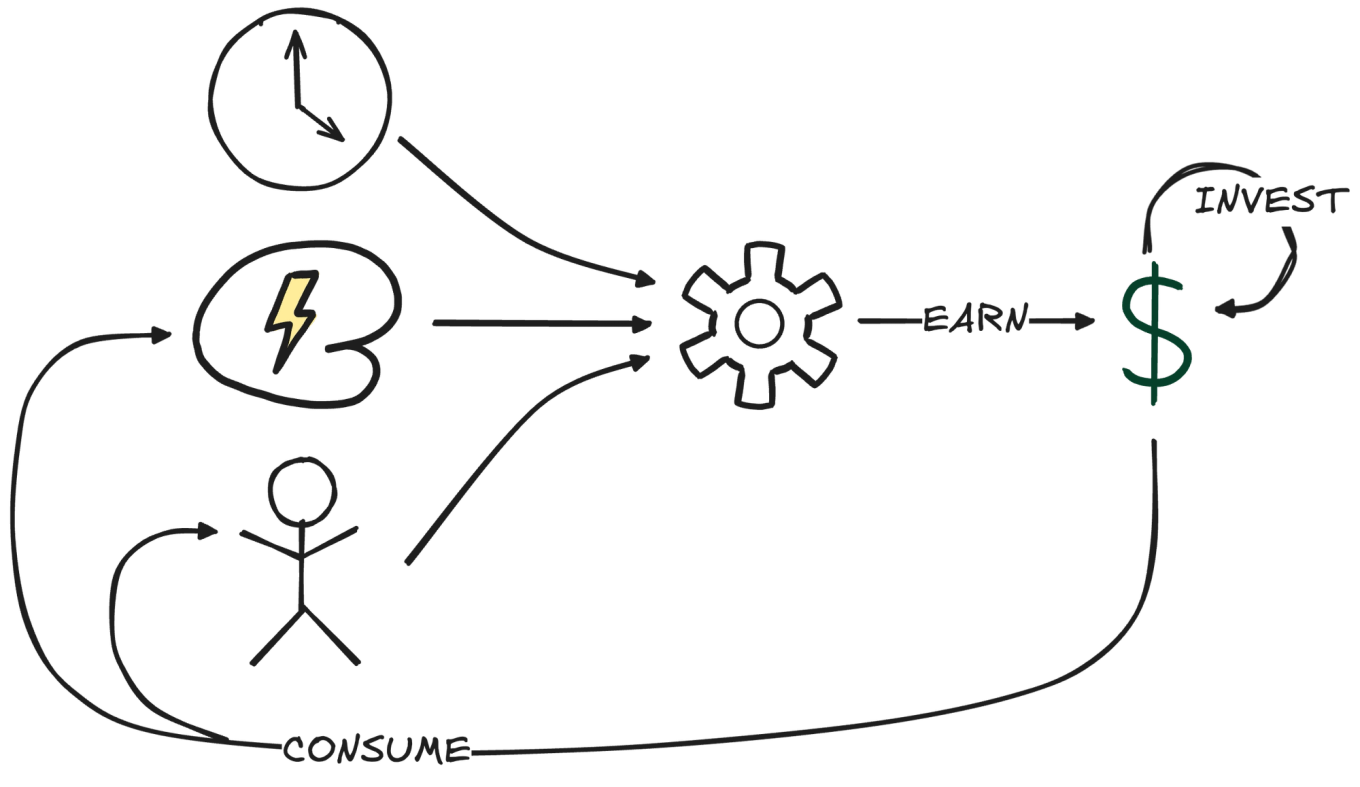
When you see a price tag, you see a number. Translated back into the primary life resources it took to earn it, you see something different.
"The cost of a thing is the amount of what I will call life which is required to be exchanged for it, immediately or in the long run." — Henry David Thoreau
When you earn $50 an hour, a $500 price tag is ten hours of your life, already spent, waiting to be redeemed. What you are deciding is whether that redemption is worth it.
The answer looks different for everyone. It depends on what you earn, what value the purchase returns to your life, and the opportunity costThe lifetime value of the next best alternative forgone when expending life resources to improve or implement misconcepts.Full definition (opens in a new tab)→ given your goals.
Someone earning $1,000 an hour sees a different trade-off than someone earning $20. No answer is objectively right, but this frame makes the real cost of any answer visible in a way that dollar terms never can.
The reframe also works as a filter on price itself. Price reflects what the market believes you will pay, shaped by marketing and manufactured desire, not by what a thing actually returns to your life.
Dollar terms keep you inside that frame.
Life resourceThe finite resources we expend to improve or implement misconcepts.Full definition (opens in a new tab)→ terms let you step outside it.
When you see a price tag, translate it first. Then ask whether what you're buying is worth the life you spent to earn it.
That is the question that gets you the highest return from your finite life resources.
If this was useful, the next one will be too.
Subscribe →