We cannot have multiple first things
September 8, 2026
By Syn Yun Phee
Open your to-do list right now.
How many things on there are marked as top priority?
I'd put money on there being more than one.
We do this to our daily routines and with our lives in general. If we ask someone what they're working towards this year, we'll likely get a list. Career, health, relationships, learning something new, seeing more of the world before the kids arrive or the parents get older. None of these are wrong to want. But the problem is, all of them are apparently priorities.
That's odd, because the whole point of a priority is that it must come first. And we can't have multiple things coming first.
So what's going on?
What a priority actually means
The word priority comes from the Latin word prioritas, which means the state of being earlier or first. When it entered the English language, the word priority meant the most important thing. There was no version of the word that let two things be first at the same time, because that would make it redundant. By definition, it is impossible to have multiple most important things.
But somewhere along the way, we started saying priorities in the plural. We reasoned, perhaps, that if we called it priorities, we could somehow have more than one first thing. Of course, this is illogical. But it sure is comforting because it gives us the illusion that we can have it all.
Every time someone tells us they have five top priorities, what they're actually telling us is that they haven't chosen yet, or they can't bring themselves to, paralysed by the notion that they'd have to make a trade-off somewhere. The problem is, when everything is first, our finite resources get scattered across multiple directions at once. We end up stuck, busy without ever quite progressing.
“...the core challenge of managing our limited time isn’t about how to get everything done — that’s never going to happen — but how to decide most wisely what not to do, and how to feel at peace about not doing it.” – Oliver Burkeman
Our finite life resources
When we look at life from first principles, we have three primary life resources that are all finite: time, mental resource, and physical resource.
The time we have is our lifespan. While this differs for everyone, influenced by factors out of our control such as genetics and early development, one thing remains constant. Our time is non-renewable and constantly depleting. Every second spent is gone forever (this holds until ageing and disease are solved and we can prolong our biological machinery indefinitely.)
Our mental resource is our ability to creatively conjecture, rationally criticise, and focus. But this ability doesn't exist in a vacuum. It is bounded by our physical resource, the functioning of our biological machinery. Over a lifespan, our physical resource follows a typical trajectory of growth, peaking around age 30 before steadily declining. While we can manage exercise, nutrition and sleep to delay the rate of decay, no matter how well we do so, our physical resource will still decline with age.
Because these three life resources are finite, choosing to spend them on one thing inevitably means choosing not to spend them on something else. This is the inescapable reality of opportunity cost. Our modern temptation to list multiple "priorities" is simply our refusal to accept this reality.
“All intelligent people should think primarily in terms of opportunity cost. When deciding whether to do something, compare it with the best opportunity you have.” – Charlie Munger
None of this means we can only care about one thing. A good life needs a strong foundation across multiple domains such as relationships, health, meaningful work, and financial security. We just can't invest in all of them at 100% at the same time.
It helps to think of it less like an on-off switch and more like a dial. In this season of life, perhaps finance is the priority, because we're trying to reach financial independence as fast as we can. That doesn't mean health and relationships get no attention. Their dials just turn down, maybe to seventy percent, and we're still investing in them, just not at maximum capacity. As our seasons change, our priorities change with them, and so do the dials for every other domain.
Deciding what matters
In my previous corporate job, I used to undertake an annual development conversation that asked us to reflect on our goals and aspirations for our career progression. As part of this exercise, we were required to use a pairwise comparison matrix to rank what matters most to us across various work-related attributes.
Here's how it works. We take everything on our list and compare it against every other item, one pair at a time. Autonomy against status. Growth against stability. Money against innovation. The idea is that human brains are terrible at ranking ten things at once but great at choosing between two. For each pair of options, we ask ourselves "between option A and option B, which one is more important?" Whichever one wins the pair gets a point. Once we've been through every possible combination, we tally up the wins, and there's our ranking.
To make this more concrete, here's an example using general life categories. Imagine we're trying to figure out where to allocate our finite life resources for the coming year across 8 options.
- A = Career
- B = Physical Health
- C = Mental Health
- D = Relationships
- E = Finance (savings & investing)
- F = Creative Hobbies
- G = Personal Growth
- H = Travel
Once we finish filling out the table, we might end up with something like this (or something completely different, but that's beside the point.)
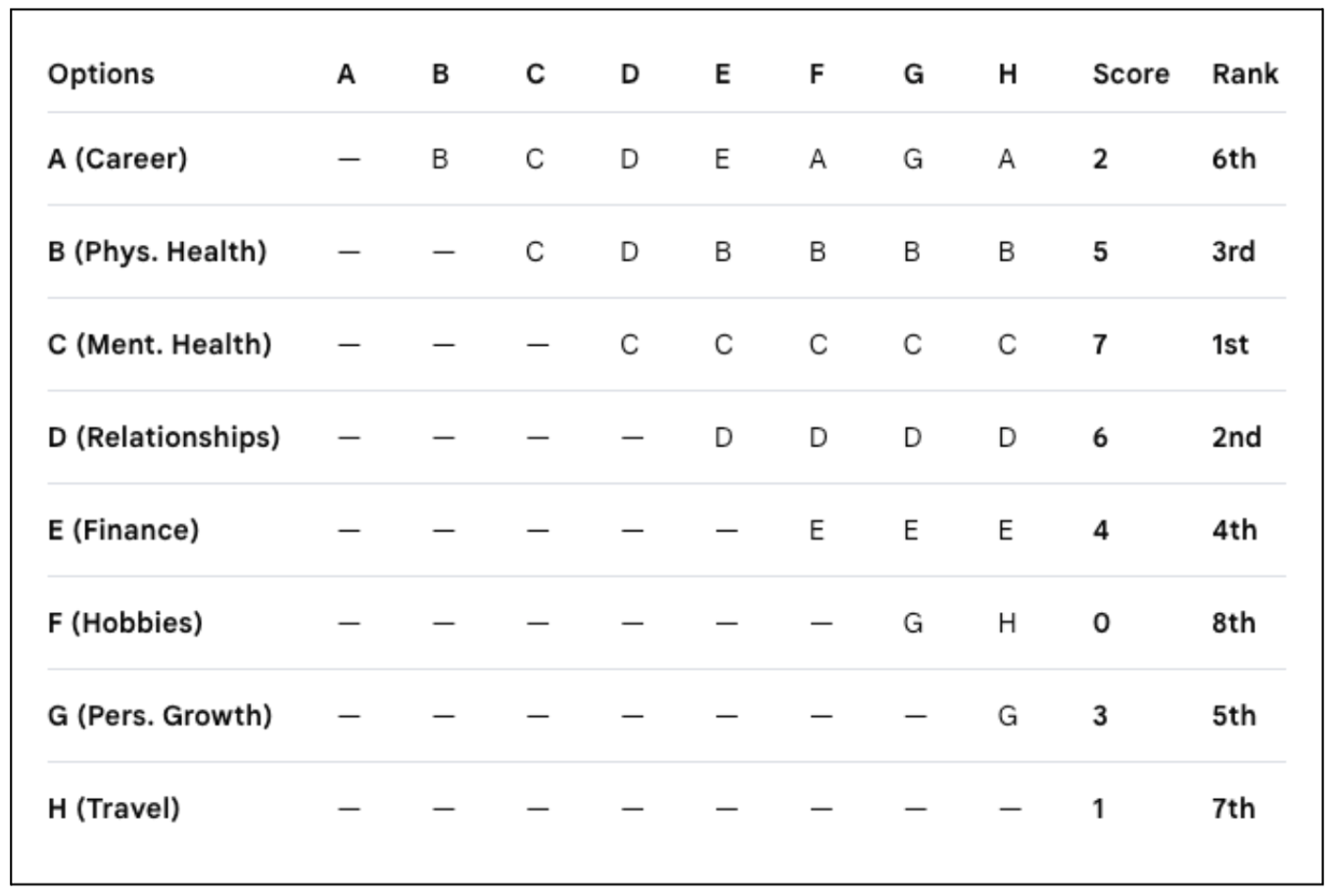
Every year I did this, two things happened. First, I'd feel unsure I'd made the right calls, because some part of me thought my results should look a certain way, a way that probably just reflected what I thought I was supposed to want. Second, I'd feel disappointed having to choose between my top three or four. I wanted all of it to be a 1. Which is completely unrealistic, and I knew that.
The exercise feels terrible because it strips away the comfortable delusion that we can have it all. It also nudges us to confront the possibility that our actual preferences are different to societal expectations. Deciding one thing matters more than another means admitting what we actually want, and what we want might not match what everyone else wants for us. And that feels risky because if we tell the truth about what we value, we are opening ourselves up to judgement.
We find ourselves staring down two divergent paths, where one is to conform and live with a quiet nagging dissatisfaction, while the other is to face potential criticism and social isolation (at least temporarily).
And so it's easier to say that everything is a priority.
But deciding means something else too. It means accepting the finitude of our lives, and that's uncomfortable on its own. So a lot of us don't decide at all. We let life decide for us, and sit in the back seat hoping it's taking us somewhere good.
If we do make our list and it looks different than someone else's, they will call ours wrong. At times like this, it feels tempting to change our opinions to suit that of the critic. Fortunately, entrepreneur Alex Hormozi has a useful reframe for moments like this. When someone doesn't like the choices we've made, what they're really saying, in Hormozi's words, is that "you do not live your life the way they would prefer." Put like that, it's almost too obvious. Of course we don't. They have their life. We have ours. Their disapproval is just a reflection of their own preferences.
We cannot please everyone. There are billions of people on this planet, which means there are billions of conflicting opinions about how we should live and what we should care about most. Pleasing one inevitably means disappointing another.
We don't have to live according to anyone else's preferences. If we do, we end up letting them decide how we allocate our finite life resources, and that is the greatest waste of all.
“You get to pick your regrets. You get to pick what you think is less important or they will be chosen for you.” – Alex Hormozi
Living with the trade-off
We've established that we have to make trade-offs. Whether we like it or not, whether we realise it or not, life is simply a series of opportunity cost decisions.
The natural reaction is to want to make the best ones we can at every point, weighing their value across our lifetime. This is what we hope to help people do at Misconcepts, and what we do ourselves. But there's a warning worth heeding.
Our life will still look suboptimal in hindsight. Even if we made the best possible opportunity cost decision at every point, we'll look back and think we could've chosen differently, for two reasons.
The first reason is that we are constantly learning and changing, so our past choices will look suboptimal by comparison. That's because we have the benefit of hindsight, with more information, knowledge and altered circumstances than we had at the time.
The second reason is that we'll do our best with the trade-offs in front of us, and still catch ourselves thinking it would have been nice to do the other things too. It would have been nice to be a better friend. To have shown up more for our community. To have invested more in our health. But we think this from a position of already having the benefits of the choices we did make, forgetting, yet again, that there are trade-offs. Perhaps it's human nature to want whatever we don't currently have.
Single people want to be married. Married people miss being single.
Employees dream of running their own business. Business owners envy employees who can clock out and not think about work again until Monday.
Those who delayed gratification wish they'd spent more on experiences. Those who chased experience wish they'd saved more for the future.
So until we go inwards and confront the reality that we have to make trade-offs, until we make peace with that fact, we will continue to be our own source of dissatisfaction.
We will live an imperfect life. We will live a suboptimal life, even as we try to make the best decision at every point.
But a good life was never about doing everything perfectly. It's about deciding, deliberately and often against the fear of what people will think, what actually matters to us, and using what little time, mental resource and physical resource we have left to go after it as best we can.
That decision, repeated for the rest of our life, is how we get the highest return from our finite life resources.
If this resonated, get Micro Misconcepts in your inbox every Friday.
Subscribe to Micro Misconcepts →