Issue 071
What you don’t know can hurt you
November 11, 2026
From me
Ignorance is not bliss.
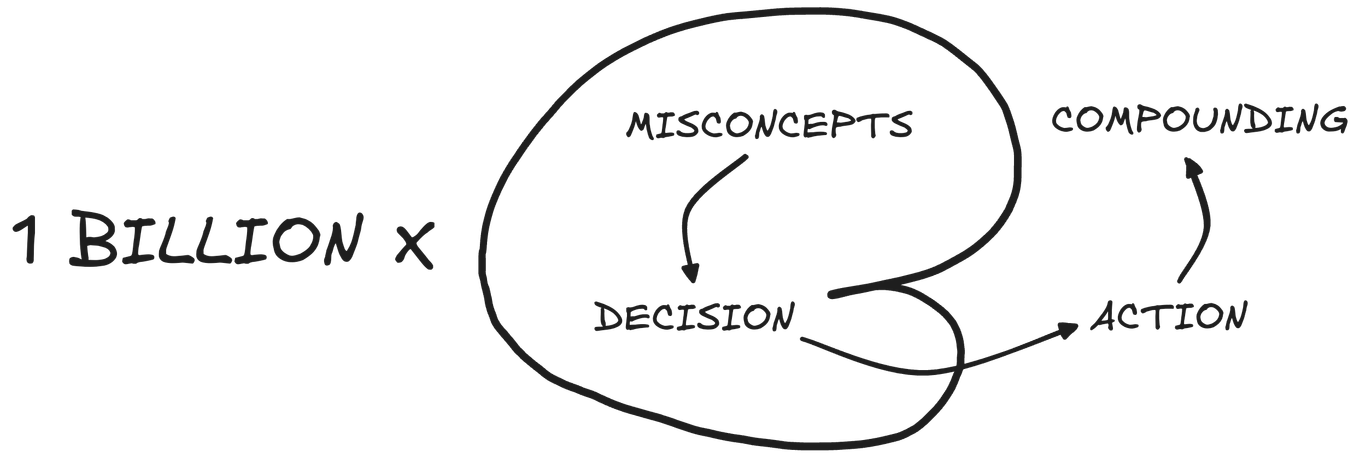
What we don't know can still hurt us, because not knowing doesn't stop reality from unfolding. We keep making decisions and taking actions regardless. Every day, we decide how to spend our finite life resources, our time, our money, and our mental and physical resourceThe function of our biological machinery.Full definition (opens in a new tab)→. Those decisions simply get made by whatever misconcepts we already hold by default.
Every one of those decisions carries an opportunity costThe lifetime value of the next best alternative forgone when expending life resources to improve or implement misconcepts.Full definition (opens in a new tab)→, and reality doesn't care whether we know or not. It delivers the outcome either way.
So ignorance hides the choice. It doesn't remove it.
We just don't see the cost until we have less time left to do anything about it. Perhaps it arrives as a midlife crisis, or as a regret we only face at the very end.
From others
Writer and philosopher Aldous Huxley on facing the facts:
"Facts do not cease to exist because they are ignored."
Source: Proper Studies (1927)
Astronomer and science writer Carl Sagan on choosing reality over comfort:
"For me, it is far better to grasp the Universe as it really is than to persist in delusion, however satisfying and reassuring."
Source: The Demon-Haunted World (1995)
For you
What's your most important goal, and which misconceptsMisconcepts are the explanations we hold about how the world works, synonymous with mental models but named deliberately to acknowledge their fallibility. Unlike a misconception, a misconcept is not necessarily wrong.Full definition (opens in a new tab)→ do you need to improve to get there?
P.S. Life is made up of about a billion decisions, each one made using our misconcepts. Which is why small differences in their quality compound into very different lives. And why developing fit-for-purpose misconceptsA misconcept that has been improved to the point at which further improvement yields diminishing marginal utility and unacceptably high opportunity cost.Full definition (opens in a new tab)→ is one of the highest-return uses of our finite life resourcesThe finite resources we expend to improve or implement misconcepts.Full definition (opens in a new tab)→.
If this was useful, the next one will be too.
Subscribe →