Issue 066
The burden of being the smart one
October 6, 2026
From me
The "gift" in academically gifted can also be a burden.
If you were good at school, you were probably called "smart". Repeated enough times by enough people, "smart" stops being a description and starts being an identity.
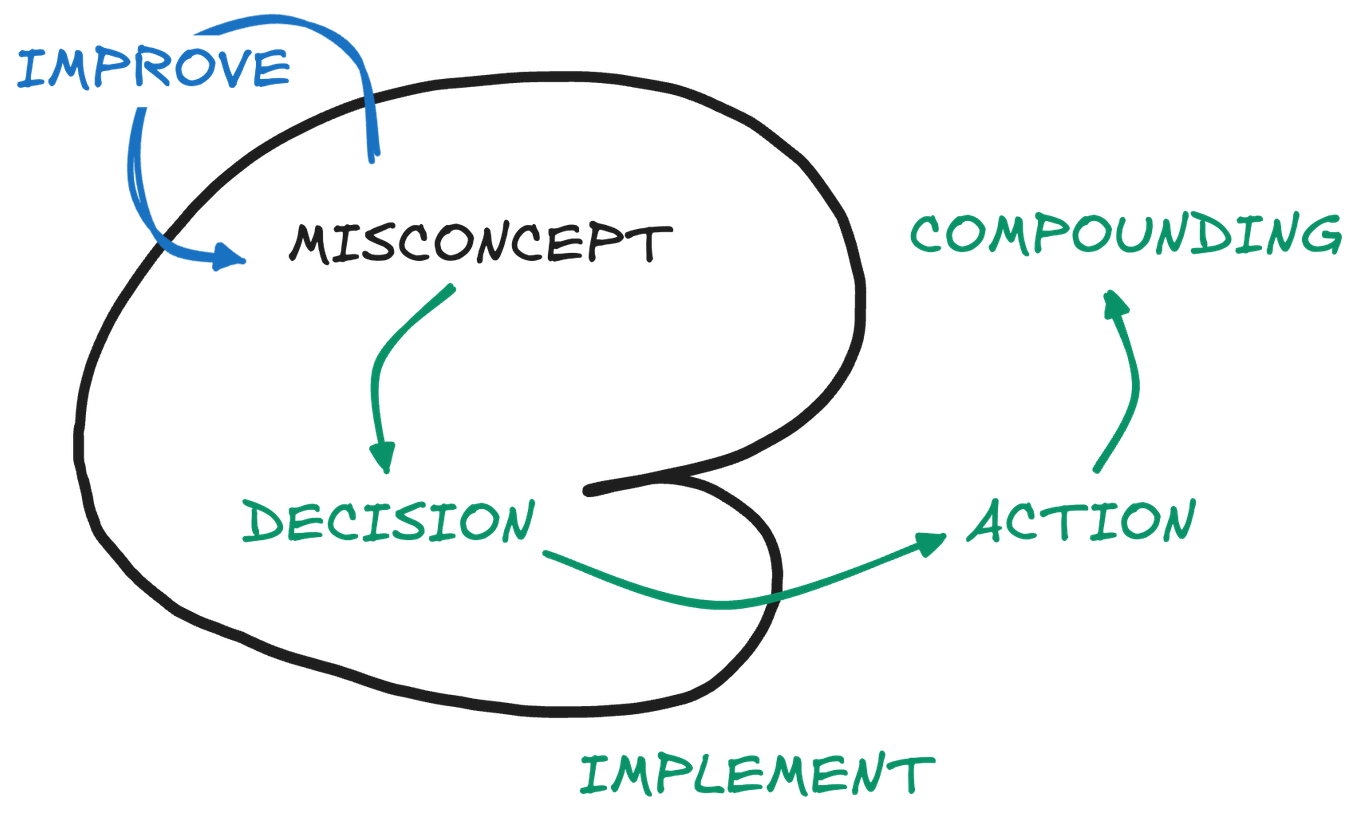
But being "smart", as school defines it, means not getting things wrong. So a misconceptMisconcepts are the explanations we hold about how the world works, synonymous with mental models but named deliberately to acknowledge their fallibility. Unlike a misconception, a misconcept is not necessarily wrong.Full definition (opens in a new tab)→ starts quietly forming that if I'm smart, I shouldn't fail.
That misconcept turns into risk aversion. Succeed and nothing changes. Of course you did, you're smart. Fail and your identity is on the line. So avoiding failure becomes your default.
This fear shows up in a lack of courage to act in the face of uncertainty, and then a lack of perseverance to keep going in the face of failure, because every mistake feels like a threat to who you are.
But progress in life comes from error-correction. You make a bold conjecture, act on it, get real-world feedback, then correct your errors. Courage is what gets you into that loop, and perseverance is what keeps you in it.
Being smart was never the problem.
Needing to be seen as smart is. Let go of that need, and you make room for the courage to act and the perseverance to keep iterating.
That's when the gift stops being a burden.
From others
Psychologist Carol Dweck on the cost of needing to prove yourself:
"Why waste time proving over and over how great you are, when you could be getting better?"
Source: Mindset (2006)
Philosopher Karl Popper on the craving to be right:
"The wrong view of science betrays itself in the craving to be right; for it is not his possession of knowledge, of irrefutable truth, that makes the man of science, but his persistent and recklessly critical quest for truth."
Source: The Logic of Scientific Discovery (1959)
For you
What did you abandon because you weren't immediately good at it?
P.S. At any moment, we are either improving our misconcepts or implementing them.
If this was useful, the next one will be too.
Subscribe →