Confidently wrong
July 21, 2026
By Syn Yun Phee
Every decision you make compounds in one direction or another. But how do you make sure it's compounding the right way?
It comes down to your misconcepts, your mental models of reality. The closer they reflect reality, the more likely your decisions, and everything that follows from them, move you toward the results you actually want.
When a misconcept is accurate enough to solve the problem in front of you, health, wealth, relationships, whatever it is, we call it fit-for-purpose.
But two traps commonly get in the way of developing fit-for-purpose misconceptsA misconcept that has been improved to the point at which further improvement yields diminishing marginal utility and unacceptably high opportunity cost.Full definition (opens in a new tab)→.
The trap of outsourcing your thinking
"Science-backed" and "evidence-based" have become trendy terms. They earn instant trust by tapping into an evolutionary default, deferring to authority. In modern society, science is seen as one such authority.
If science proved it, it must be true.
Right?
Wrong.
There's good science and bad science, strong studies and weak ones, results that replicate and results that never held up again. The word "science-backed" tells you nothing about which one you're getting.
I've fallen for this plenty myself. I read an article, listen to a podcast, hear about the latest science-backed strategy for my health or longevity, and take it as gospel without questioning the actual quality of science behind it. All I hear is "research shows that," and my mind quietly concludes "so I should do this."
Then I mention it to my fiancé, David, who actually has a medical background and research experience, catch his usual sceptical smile, and know I've fallen for it again.
Deference to authority runs deep.
One explanation is evolutionary. For most of human history, falling in line was how you survived. Being accepted and protected by the tribe relied on social cohesion and compliance with the tribal leader, and those who challenged it risked being cast out.
On top of this, your brain is an energy-intensive organ that likes to seek shortcuts so it doesn't have to spend energy it doesn't need to. Authority bias is one such shortcut. Treating an expert's word as settled fact lets you outsource the thinking to a perceived authority and saves you the effort of doing it yourself.
If a doctor, a scientist, or a financial expert makes a claim, your brain bypasses the heavy lifting of critical analysis and accepts the conclusion to save time and energy. In most cases, this is useful. There are an infinite number of things to know in the world and you can't possibly be an expert in them all. But in some cases, that shortcut just means adopting someone else's fallible model as an irrefutable fact.
Then there's a quieter incentive too. Deferring to an authority relieves you of the burden of responsibility when it comes to making decisions. If it goes wrong, it isn't your fault. Someone else told you to do it. There's a certain comfort in that, which you fool yourself into seeking.
It's no wonder authority bias is so seductive.
This bias kept our ancestors alive, and it still keeps society running. But it was never designed to help you find the truth. It was designed to stop you from having to look for it yourself.
It doesn't help that marketers and journalists profit from your deference. "Evidence-based," "science-backed," "research shows," these phrases exist because they work, which is exactly why a white lab coat in an ad still earns your trust even when you know it's worn by an actor.
From the perspective of Critical Rationalism, authority bias is a flawed model of how knowledge grows and progresses. The source of an idea is entirely irrelevant to its validity.
A truth claim does not become more true just because a Nobel laureate or a CEO said it, nor does an idea become false because it came from a novice. That doesn't mean every source deserves equal weight before you've checked it. A credentialed track record is still a reasonable starting point. It just means that starting point is a conjecture, not a verdict.
The evolutionary default asks, who's the authority here? The harder, deliberate question is, how do I find the error in this, regardless of who said it?
Every explanation you hold, no matter how expert the source, is provisional. The experts you trust are themselves fallible, and what they share can carry errors or nuances you're not equipped to catch. The mistake was never in listening to them. It's in treating what they say as final.
And sometimes the deeper problem is that the person you're listening to was never an expert in the first place. They just sound like one because they come across as confident and certain. But in reality, they've fallen into the next trap themselves.
The trap of mistaking confidence for competence
You know the feeling. You learn something new, get confident fast, then learn a bit more and realise how little you actually knew, embarrassed at how sure you'd been. It's a classic example of the Dunning-Kruger effect, the pattern where a small amount of knowledge in a domain produces a disproportionate amount of confidence in it. You're standing at the peak of Mount Stupid.
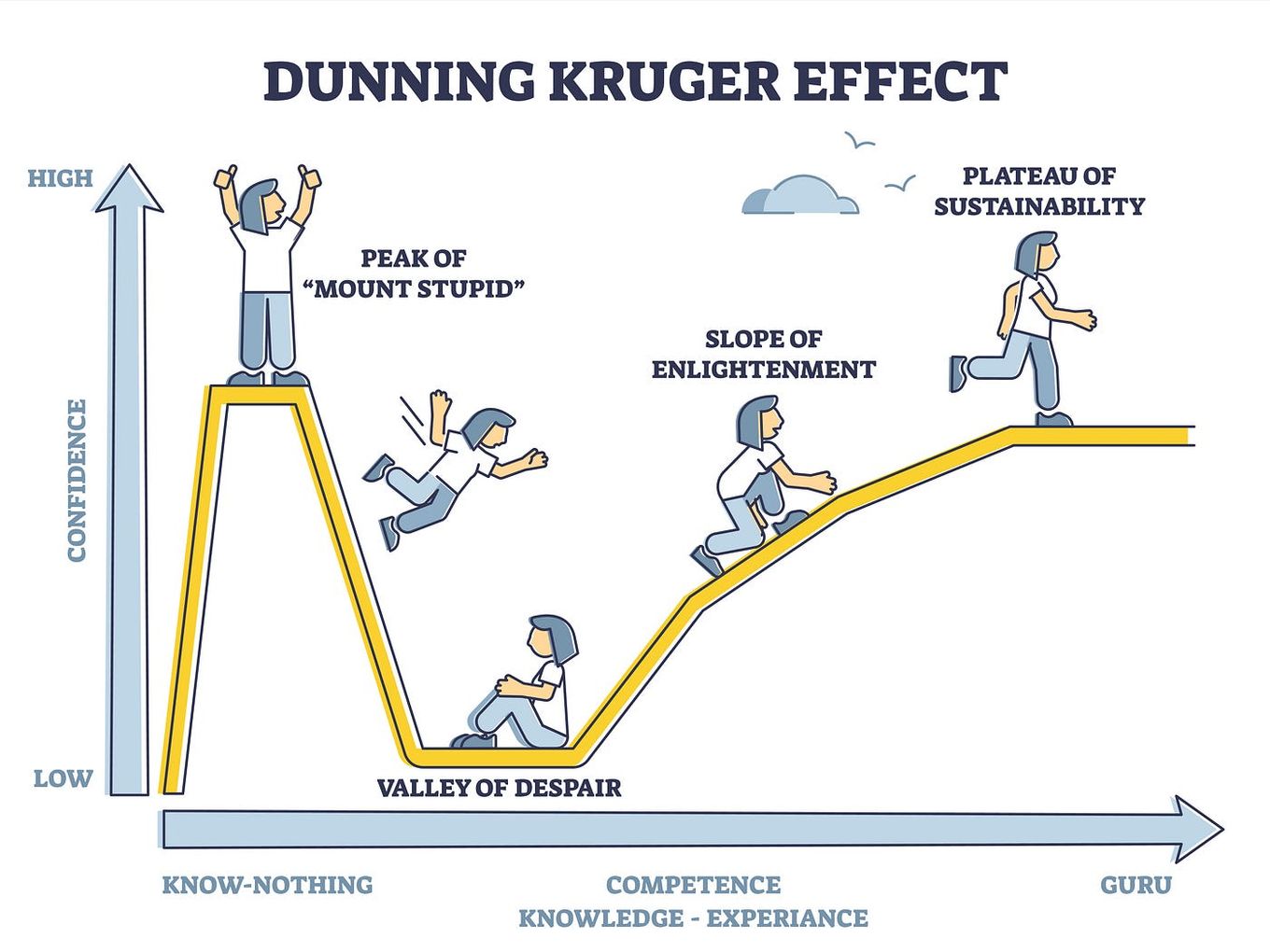
The trouble is, you don't realise you're there. Some decisions get made while you're still stuck at the peak, confidence blinding you exactly when you need clear sight the most. This trap is insidious because you don't know what you don't know.
It gets worse if you've been labelled smart and tied your ego to that identity. Success in one domain has a way of feeling like proof of competence in every domain. It isn't. But the label follows you regardless, and your ego is happy to let it. Now you have an additional incentive to appear like you have it all figured out, blinding you further to your own false competence.
How do you guard against it?
Notice your own defensiveness as the signal. The urge to look knowledgeable, to be right, to be seen as certain, means you've stopped optimising for truth and started optimising for your ego. Optimising to appear knowledgeable ironically leaves you less so, since you're now defending what you know instead of being open to correcting it.
This is costing you exactly the thing you're trying to build. A fit-for-purpose misconcept, one you could actually trust to make good decisions from.
Changing your mind isn't weakness. It's error-correction, the same process that makes any explanation better. This is what intellectual humility actually is. Not meekness, but the discipline of updating a misconceptMisconcepts are the explanations we hold about how the world works, synonymous with mental models but named deliberately to acknowledge their fallibility. Unlike a misconception, a misconcept is not necessarily wrong.Full definition (opens in a new tab)→ the moment you find the error in it.
No neutral option
Every misconcept you hold and every decision you make from it compounds in one direction or the other. There's no neutral option.
Outsource your thinking, and you inherit someone else's errors along with their confidence. Protect your ego, and you keep an error you could have corrected. Either way, the misconcept you're left with is weaker than the one you could have built, and every decision that follows from it compounds that weakness forward.
Both traps are the same mistake, aimed in different directions. Trap one is granting someone else's conjecture too much certainty. Trap two is granting your own conjecture too much certainty.
Critical Rationalism resolves both by treating all knowledge, including your own, as provisional. Every model is fallible, whether it came from a Nobel laureate, a stranger who sounds certain, or the version of you standing at the peak of Mount Stupid. Practising this intellectual humility, always being willing to change your mind when presented with new evidence, is how you can avoid both traps.
Optimising for truth over ego is thus the highest-ROI move you'll ever make, because it's the only way to end up with fit-for-purpose misconcepts. Ones that compound your finite life resourcesThe finite resources we expend to improve or implement misconcepts.Full definition (opens in a new tab)→ toward the goals you chose, not the ones deference or ego chose for you.
If this resonated, get Micro Misconcepts in your inbox every Friday.
Subscribe to Micro Misconcepts →