Issue 042
Most People Spend Four Decades Without Asking This Question
April 22, 2026
Of all the resources you have, time is the only one that depletes whether you use it well or not.
Money can be earned back.
Mental and physical resources can be recovered, to a degree.
But time just goes. Every hour spent is an hour that cannot be reclaimed, regardless of what you do with it.
That makes time freedomThe state in which you can sustain your desired consumption level indefinitely without any further input of primary life resources (time, mental resource, and physical resource).Full definition (opens in a new tab)→ a more logical goal than most people treat it.
Time freedom is the point where you no longer have to trade your time, mental and physical resources for money to sustain your desired lifestyle. Where you don't have to show up somewhere, at a set time, doing a set thing you'd rather not be doing. Where your time is fully yours.
Most people never build towards it, not because they've thought it through and decided it isn't for them, but because it hasn't occurred to them that it could be.
I was one of them. I never questioned the script.
Everyone around me was on the same trajectory. We even joked about it, collective misery on Mondays, collective relief on Fridays, the decades between treated as something to endure. That was just life.
Then my partner said he wanted to be time free in his 30s. He said it like someone who'd already worked out the mechanism. That was the first time the option felt real.
"People are frugal in guarding their personal property; but as soon as it comes to squandering time they are most wasteful of the one thing in which it is right to be stingy." - Seneca, On the Shortness of Life
The squandering Seneca describes doesn't usually feel like squandering. It feels like following the only plan there is.
If you assume you'll work until 65, you never ask what it would actually take to stop sooner. You don't look at your consumption and what it costs to sustain your lifestyle. You don't calculate the number your assets would need to generate. You never set a target, so you never build towards one.
No target, no path.
No path, no progress.
And when you look around and see no one else making progress either, the belief reinforces itself.
Seeing the decoupling moment is where that changes.
It starts with a simplified money cycle.
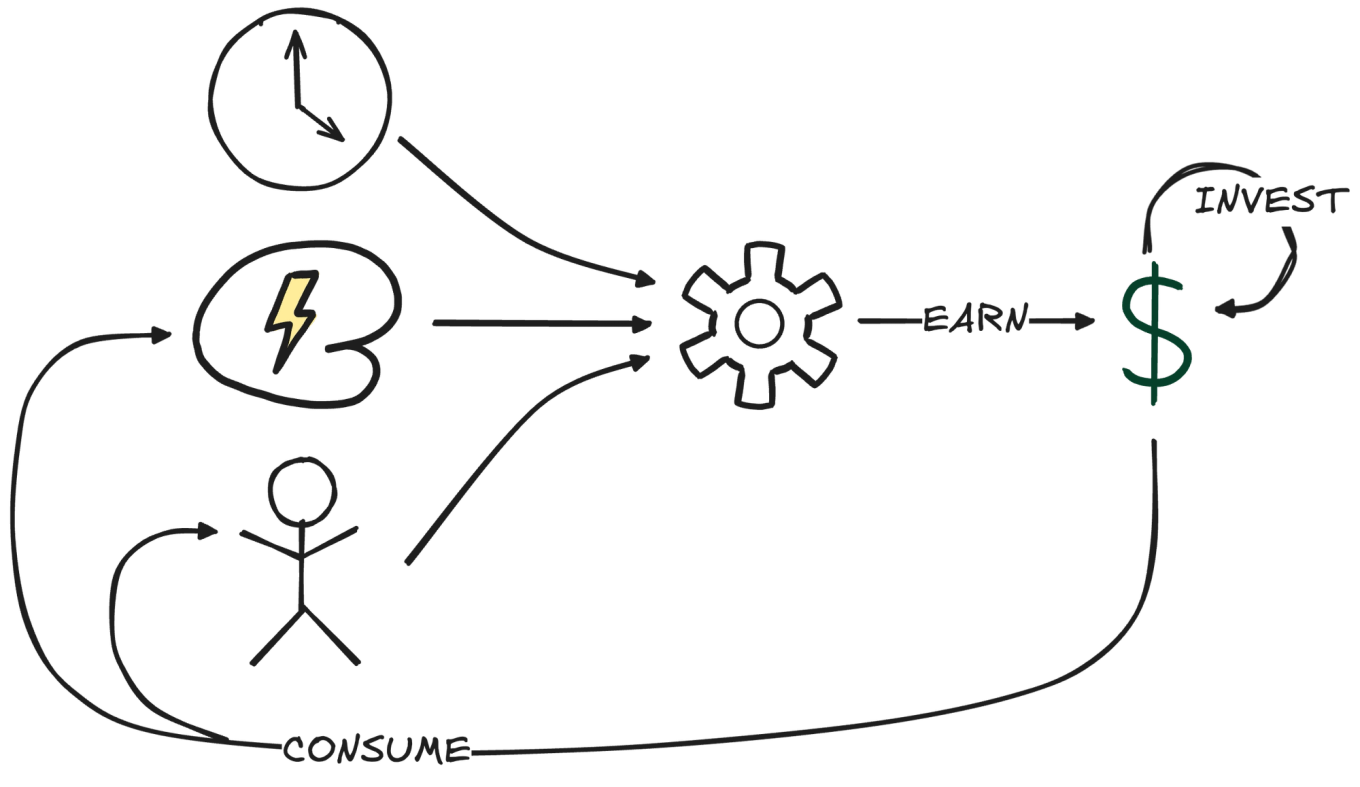
As you earn, some money goes to sustaining your basic needs and lifestyle, and some goes to assets. As those assets grow and compound, they generate their own returns. At some point, those returns become large enough to cover your consumption without any further input of your time, mental and physical resources. That's the decoupling moment.
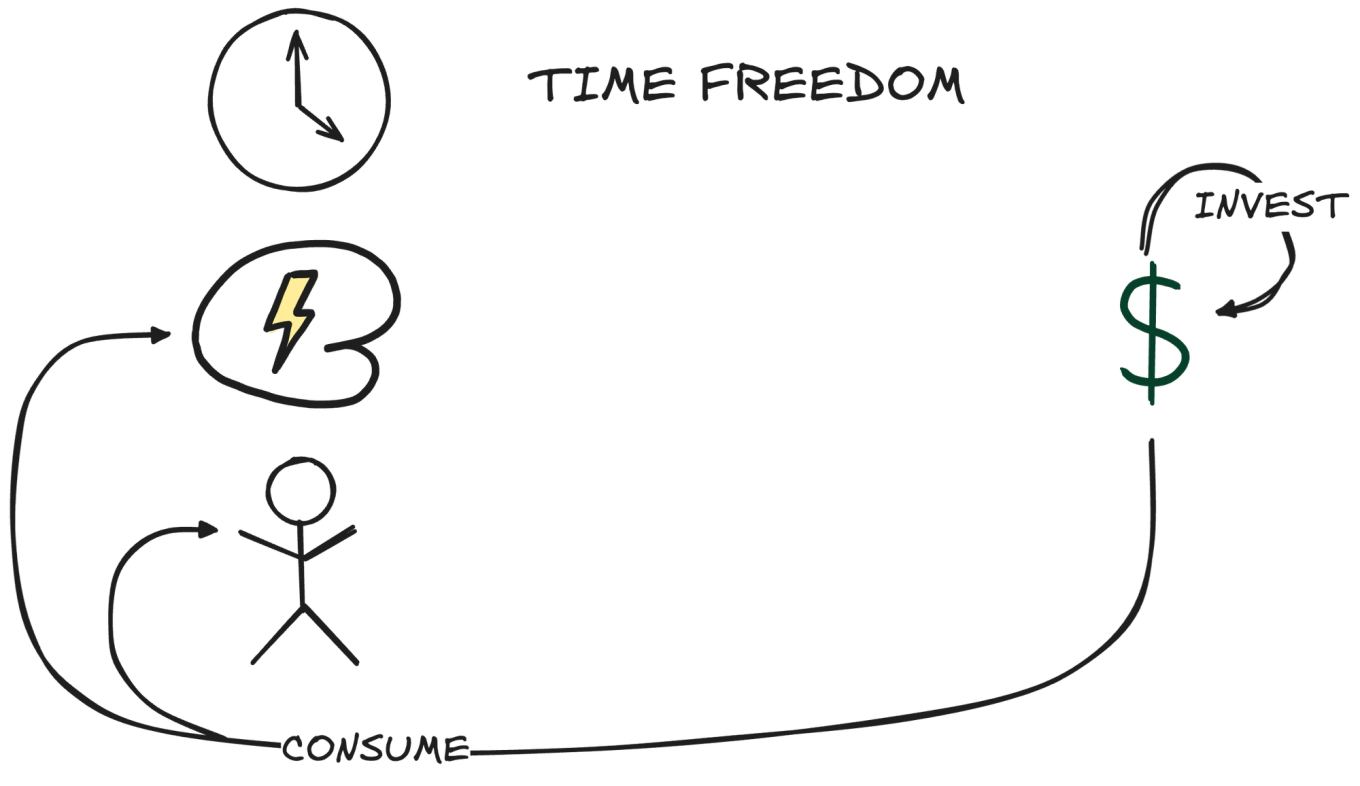
Three things determine how quickly you get there:
- How clearly you understand your consumption
- How well your assets are working
- How intentionally you're building your earning.
Each one can be optimised by developing fit-for-purpose misconceptsA misconcept that has been improved to the point at which further improvement yields diminishing marginal utility and unacceptably high opportunity cost.Full definition (opens in a new tab)→ on the subject. Most people never adjust any of the three towards this goal.
Not because they can't. But because four decades can pass before it occurs to them to ask whether there's another way.
If this was useful, the next one will be too.
Subscribe →