Issue 047
Ego from good iterations
May 27, 2026
Centuries ago, the Roman emperor and Stoic philosopher Marcus Aurelius noticed something that bothered him enough to write it down.
"I have often wondered how it is that every man loves himself more than all the rest of men, but yet sets less value on his own opinion of himself than on the opinion of others." – Marcus Aurelius
This stings. Because most of us can see a bit of ourselves in it.
We know we shouldn't base our self-worth on external metrics. Most of us would even agree with that in conversation.
But we still do it anyway.
We are social animals after all, wired from birth to constantly monitor where we stand in the eyes of others.
But a problem arises when you derive your ego from external metrics like status, income, and the approval of people you don't even know or like.
You end up optimising for optics.
You make decisions based on how they look rather than whether they move you closer to your own arbitrary life goalsA conjectured desired state that an individual chooses to pursue.Full definition (opens in a new tab)→. And in many cases, you don't just fall behind on those goals. You stop playing for them entirely.
You get absorbed in a completely different game, one you never consciously chose to enter. A game where you let the crowd dictate what winning looks like.
Except, there is no winning that game.
Each time you reach the thing you thought would finally be enough, you look up and there is more to achieve, more to perform, someone further ahead. The finish line is always moving.
An ego based on external metrics is fragile by design.
"The big question about how people behave is whether they’ve got an Inner Scorecard or an Outer Scorecard. It helps if you can be satisfied with an Inner Scorecard." – Warren Buffet
Contrary to popular belief, ego itself isn't the enemy. You will always have one. It is your mind's sense of self, the narrator in your head, and the mental construct you build to separate yourself from the rest of the world. It is a functional necessity to navigate life.
The shift isn't to have no ego. It's to change where you source it from.
This is what Buffett meant by an Inner Scorecard. He illustrates it with a thought experiment: Would you rather be the world’s greatest lover, but have everyone think you’re the world’s worst? Or the world’s worst lover, but have everyone think you’re the world’s greatest? The question cuts to the core of what you are actually optimising for.
An Inner Scorecard doesn't ask what others think of your progress, status, or achievements. It asks whether you made a good iteration today towards your own arbitrary life goals.
Did you conjecture the next best action, take it, review the feedback, and error-correct? Repeat that cycle consistently and you compound in a deliberate direction you chose, not towards the dominant success script of the decade.
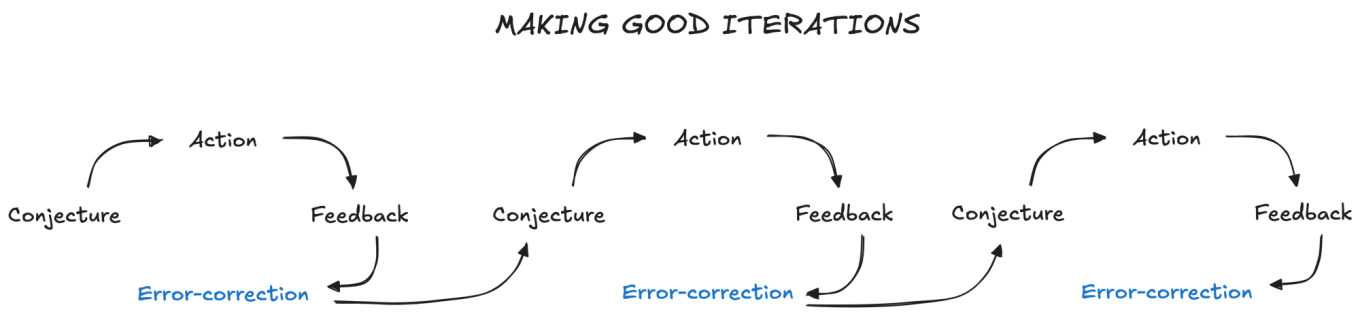
This version of your ego is durable, logical, and resource efficient.
No one can take it from you because it depends entirely on your own agency.
It keeps you optimising towards your own definition of success rather than the default handed to you by the society you happened to be born into.
And it makes comparison functionally irrelevant by acknowledging we are all dealt different starting hands, with different resources, different goals, and a different next best move to make. Comparing yourself to the person next to you simply doesn't make sense.
"How much time he gains who does not look to see what his neighbour says or does or thinks, but only at what he does himself." – Marcus Aurelius
Across months and years, that reclaimed time and resources compound towards building what matters to you rather than towards someone else's idea of success.
But knowing the trap exists doesn't prevent you from falling into it. Moving the needle requires daily practice against the default.
The 4 Tactics to Build an Iterations-based Ego
i. Get specific about your arbitrary life goals
You cannot iterate in a useful direction without clarity on what you're iterating towards. Write down your arbitrary life goals and review them regularly. Without that clarity, even good iterations can compound in someone else's direction.
ii. Score your day on iteration, not outcome
At the end of the day, ask one question: did I make a good iteration towards my arbitrary life goals? If yes, it was a good day, regardless of the outcome. Outcomes are partly outside your control. Whether you ran the cycle is not.
iii. Treat the sting as data
The moment you feel defensive about how others perceive your progress, your ego has defaulted back to external metrics. Write down exactly what triggered it and how you’re going to respond the next time. That turns an emotional slip into a successful internal iteration.
iv. Use spaced repetition to override the default
Years of conditioning don't shift from a single insight. They shift from daily, deliberate practice until the old default is replaced. I keep one or two sentences in my journalling routine as a reminder. Something like: an ego based on external metrics keeps me optimising for the wrong things. A better measure is an ego based on making good iterations. Find what resonates. Repeat it daily until it becomes your new default.
When you shift your ego to be based on good iterations, no failure, mistake, or critic will faze you. Because it is either information to inform the next good iteration, or noise to ignore. And it optimises how you allocate your finite life resourcesThe finite resources we expend to improve or implement misconcepts.Full definition (opens in a new tab)→.
What you're left with is something the outer scorecard never delivers, the unavoidable clarity of knowing exactly what you're building, and why.
Every day you run a good iteration, you reclaim a little more of the life that was quietly being spent on someone else's game.
If this was useful, the next one will be too.
Subscribe →