Why You Feel Lost
September 25, 2025
By Syn Yun Phee
Over the past few years, I've noticed an increasing trend amongst friends and colleagues sharing this gnawing sense of feeling "lost" in life. I’ve been there myself. We all seemed to believe in this idea of having a purpose in life, usually in our careers, which when found, would lead us to feel in control and fulfilled. The pressure to find this calling builds up day after day, month after month, year after year, as we become acutely aware of our limited time slipping through our fingers.
I spent years in this state of feeling “lost”, constantly learning, reading, and plotting different paths I could take to escape it. After years of trying, I finally learned that I wasn’t lost all along because it wasn’t about finding my path, but about creating it.
The First Clue
When you feel “lost”, you’re essentially saying that you’re unable to find your way, that you lack direction. This naturally implies that there are many directions available, and among these is a right direction to be found.
This observation gives us our first clue: we have many directions.
For those of us privileged enough to have our basic physiological and safety needs met, we are presented with the next challenge - what psychologist Abraham Maslow identified as higher-level needs: love and belonging, esteem, and self-actualization. Before our basic needs are met, the goal is obvious, there is only one choice - survival. But once our basic needs are reliably met, we start having more choices. This is where things get interesting.
We live in a time of such abundance that we don't merely have a few more options, but infinitely more options. This abundance of options leads to what psychologist Barry Schwartz termed “The Paradox of Choice”. He captured this beautifully:
"Learning to choose is hard. Learning to choose well is harder. And learning to choose well in a world of unlimited possibilities is harder still, perhaps too hard." — Barry Schwartz
While having some choices can be empowering, an excessive number produces the opposite effect: choice paralysis. Evaluating numerous choices can become cognitively overwhelming as we feel the increased mental effort required to weigh all options while simultaneously fear making the "wrong" choice and the subsequent regret. This overwhelm intensifies as we become acutely aware of our limited life resourcesThe finite resources we expend to improve or implement misconcepts.Full definition (opens in a new tab)→: our time, mental and physical resources are finite.
The infinite number of possible paths we can take in life has, ironically, kept us stuck in one place. The very progress that freed up our collective resources to pursue fulfillment has, ironically, left many of us unfulfilled.
But choice overload is only half the problem. Adding complexity to this multitude of choices is a host of defaults - both evolutionary and inherited from nurture - that prevents us from making choices we actually want to make.
For instance, we operate using a haphazard set of inherited “life goals” from our parents, community, school, peers, and broader culture. These inherited scripts inform our ideas of success and shape our beliefs of what we should strive for.
Most of us pursue these inherited life goals unconsciously, never questioning whether they align with what we actually want. We're navigating with multiple compasses, each inherited from different sources and pointing toward conflicting destinations. And we’re left wondering why we feel so directionless.
Our evolutionary programming compounds this problem. We're wired to seek belonging and social approval, making it cognitively painful to question these cultural defaults.
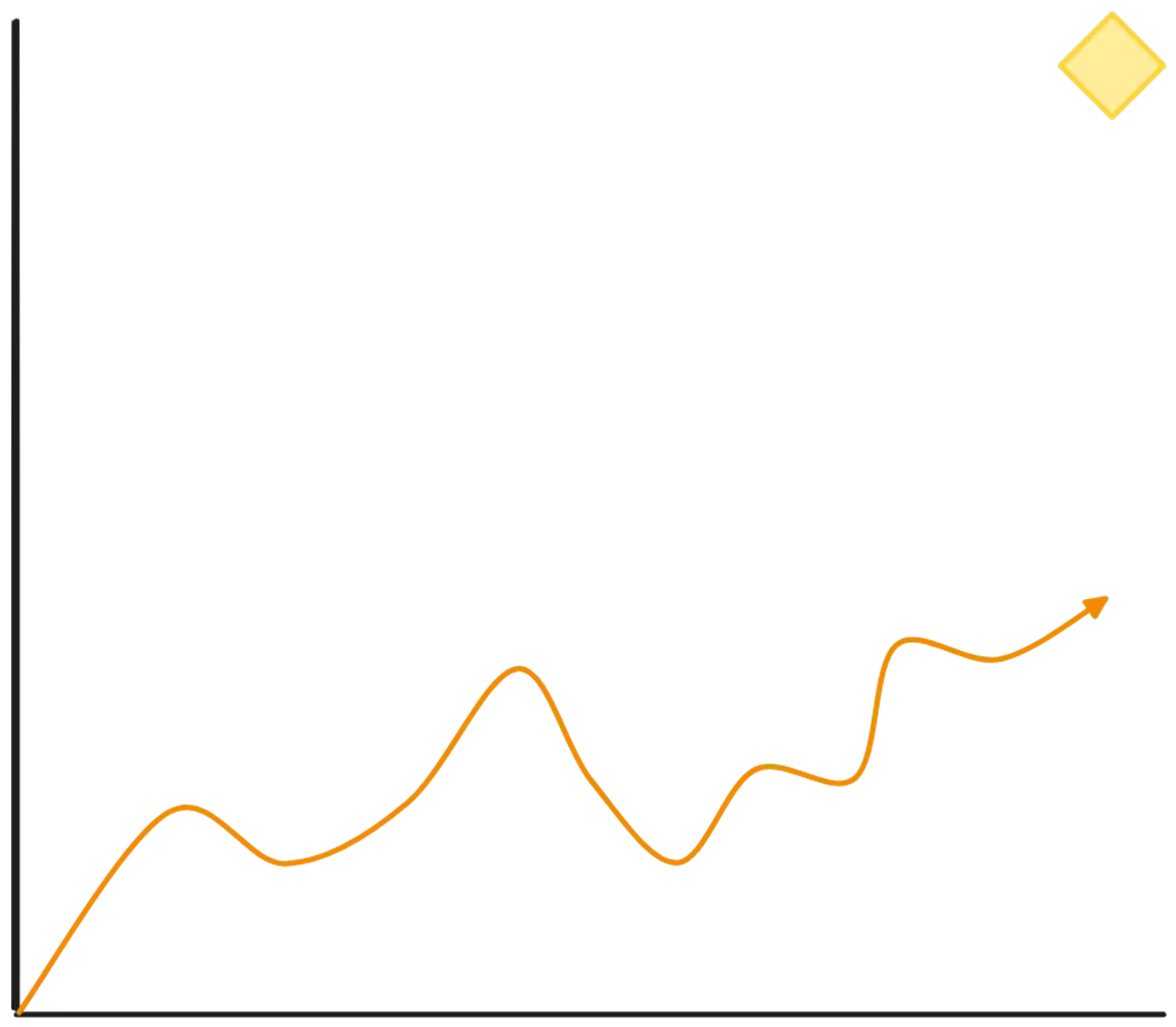
Life kind of feels like this…
As if that wasn’t enough, choice paralysis, inherited goals and evolutionary defaults aren’t our only obstacles.
The Second Clue
This brings us to our second clue: there is a right direction to be found.
An underlying assumption in our search for the right path in life is that there exists a single correct path. This belief creates enormous pressure as we torture ourselves with questions like:
“How do I know if this is right for me?”
“What if I'm wasting my potential on the wrong path?”
“What if I never find my path?”
But this assumption - that a right path exists - crumbles as you put on a scientific lens.
Firstly, neuroscientist Anil Seth's research on consciousness suggests that our consciousness is essentially "controlled hallucinations" created by our brain's mental models—which we call misconceptsMisconcepts are the explanations we hold about how the world works, synonymous with mental models but named deliberately to acknowledge their fallibility. Unlike a misconception, a misconcept is not necessarily wrong.Full definition (opens in a new tab)→ to emphasize its inherent fallibility. Our entire sense of self, including our perceived purpose, is constructed by our minds based on these fallible models. Our internal experience of the world is an imagined reality.
"We don't just passively perceive the world, we actively generate it." —Anil Seth
Secondly, our current understanding from evolution suggests that our existence is the blind product of evolution with no inherent purpose. Our human brains simply seek out a purpose because we are story-telling machines. Our genes configured us to build narratives around the idea of a "self". This benefits our “selfish genes” because if we care about our "self", we'll strive to protect it, and by surviving, we proliferate our genes.
"We are biological machines built by natural selection to be effective at passing on our genes. This is the nearest thing to a purpose we have." — Richard Dawkins
So essentially, there is no purpose. We made it up.
Instead of getting depressed at your apparent cosmic irrelevance, consider the liberating implications: if we have no inherent purpose, this means we are free to choose whatever our purpose is. What's more, you can change your mind and iterate on this rather than committing to one for the rest of your life.
There is no single "right" path waiting to be discovered. The paralysis we feel from having to make the "right" choice is based on the false assumption that there is one "right" choice.
The Liberation
We feel lost because we believe a right direction exists somewhere "out there", when in reality, we define what constitutes the right direction. We stay lost because there are infinite options that paralyze us and inherited defaults that cloud our judgement. Liberation comes from recognizing we can consciously define our own direction rather than searching for predetermined ones.
The question isn't "What is my purpose?" but rather "What purpose will I create?"
Through my own exploration, I've found these questions helpful in gaining clarity:
- If I knew I couldn't fail, what would I attempt?
- With complete financial freedom, how would I spend my time?
- When I'm on my deathbed, what would I regret having done or not having done?
- What would I want people to say about me at my funeral? Why?
- If I knew I would die in ten years, what changes would I make to my life today?
- What would my ideal ordinary week look like? Why?
- What looks like work to others but feels like play to me?
- What am I optimising for in my daily choices?
Your answers needn't be perfect or permanent. They simply need to be honest starting points for conscious experimentation. Conjecture, test, error-correct and iterate.
Your Objections
I hear the objections forming in your mind: "This sounds idealistic. I have responsibilities, financial constraints, and real-world limitations." I understand, because I’ve lived it.
Many times, our answers to the above questions might seem impractical or out-of-reach…for now. Change is not an overnight revolution, it requires strategic evolution.
The idea here is to intentionally set your own direction rather than defaulting towards the ones others have set for you. It is only with clear self-defined goals can you take the next steps on deciding how to reach your goals.
We don’t ignore the reality of our current lives. Quite the contrary, we start by taking an inventory of it: our time, mental resourceThe ability to creatively conjecture, rationally criticise, and focus.Full definition (opens in a new tab)→, physical resourceThe function of our biological machinery.Full definition (opens in a new tab)→, financial circumstances etc. These are the life resources we have to play our next hand. It is not about waiting for the right conditions but about actively creating the conditions you want through optimising how you invest your finite life resources. Your current circumstances are simply the starting point and the constraints you play the game with.
Making the Change
Liberation from feeling lost begins with a fundamental reframe: You don’t need to search for the right path, you need to start consciously creating it. Start by choosing one of the questions above and spending 10 minutes writing honestly about it. What might you be surprised to find?
If you discovered tomorrow that there truly is no "right" path waiting to be found—only paths you consciously choose to make meaningful—what would you stop searching for and start experimenting with instead?
Your direction doesn't need to be perfect. It needs to be yours.
If this resonated, get Micro Misconcepts in your inbox every Friday.
Subscribe to Micro Misconcepts →