The Rumination Trap
November 20, 2025
By Syn Yun Phee
It’s 2AM and you’re doing it again — replaying the same decision for the thousandth time, your stomach tightening as if the outcome might change if you just think about it hard enough.
It won’t.
I spent years in that mental prison. What finally freed me wasn’t trying to ignore the regret or transcend it through positive thinking. It was changing my relationship with it entirely.
Here’s what no one tells you: Regret isn’t actually the problem. Rumination is.
Most advice tells you to “just let it go” without telling you how. They give you the destination but not the map.
So this is the map — how I learned to finally break the rumination cycle and changed my relationship with regret. It starts with understanding what regret really is.
What Your Regret Is Telling You
In his book The Power of Regret, Daniel Pink distinguishes between two types of regret: regrets of opportunity (failing to become who we could be — our ideal self) and regrets of obligation (failing to become who we should be — our ought self).
We tend to feel greater urgency around obligations, so we’re more likely to address these over the opportunities our ideal self hopes for and dreams about. Part of this urgency is evolutionary. As social animals, we’re wired to prioritise conformity and meeting expectations because rejection from the group once meant death. Many of our “shoulda’s” are inherited defaults we never consciously chose, yet we feel compelled to fix them first.
As Pink puts it: “Coulda’s bug us longer than shoulda’s, because we end up fixing many of the shoulda’s.”
In other words, the paths we didn’t take haunt us more than the obligations we didn’t meet because we tend to address and fix the obligations. But the unchosen paths? These remain as unrealised opportunities, accompanied by the haunting question: “What could my life have been?”
For me, this showed up as a years-long fixation on a single decision point — a fork in the road where I chose one path and spent years wondering about the other. The pain wasn’t really about that moment in the past. It was about the gap between who I am now and who I think I could’ve been if I’d chosen differently.
This gap — between your actual self and your unrealised potential self, between your actual reality and your unrealised potential reality — is where the pain of regret lives. And it intensifies as you become acutely aware of your limited and constantly depleting time. This is where the rumination of “if only…” thrives.
But here’s the thing: the very existence of that gap reveals something important.
Regret as a Growth Signal
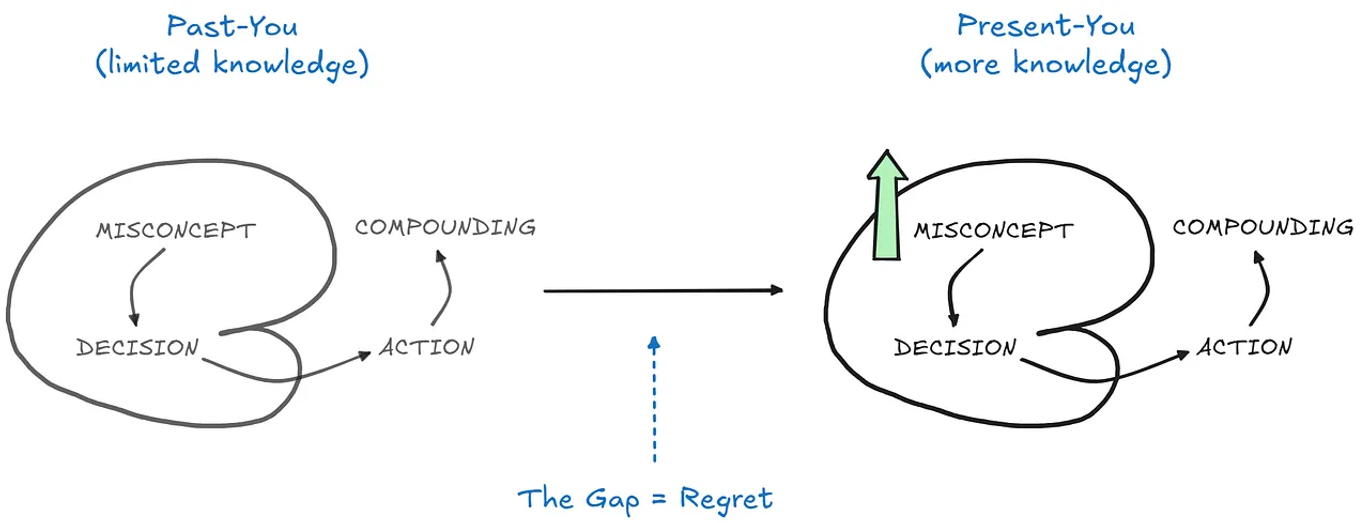
The use of “if only” reveals a change between past-you and present-you. It implies that present-you now have more knowledge and insight. The frustration arises because present-you is judging past-you with present-you’s evolved knowledge and circumstances, forgetting that past-you made those decisions with a different set of knowledge and circumstances.
What emerges is an uplifting perspective: the fact that you experience regret is proof that you’ve grown.
Try this simple exercise: Look back on yourself three years ago, one year ago, or even six months ago. Do you cringe at the thought of your past self? If so, that’s a sign you’ve grown.
The discomfort you feel when looking back isn’t evidence you made the wrong choice — it’s evidence you’ve become a wiser person. Past-you was operating with past-you’s knowledge. Present-you has more.
Regret is a growth signal, a sign you’ve outgrown who you were. And that reveals more than just the fact you’ve evolved.
Regret is the gap between Past-You’s misconceptsMisconcepts are the explanations we hold about how the world works, synonymous with mental models but named deliberately to acknowledge their fallibility. Unlike a misconception, a misconcept is not necessarily wrong.Full definition (opens in a new tab)→ and Present-You’s updated ones. That gap is proof of growth.
Regret as Data
The regret we feel now reflects the goals, values, and aspirations of our current selves. This means regret is data we can use to understand ourselves better.
If we know what we regret the most, we can reverse that image to reveal what we value the most, then take actions to align with those values. This is how regret can make us better.
Bronnie Ware, a palliative care nurse, documented what people regretted most at the end of their lives. The patterns were striking: wishing they’d lived a life true to themselves rather than to others’ expectations, stayed connected to people they loved, found the courage to express their feelings.
These are regrets about unrealised opportunities — chances to be more courageous, more authentic, and more connected. The kind that comes from seeing the gap between who they were and who they wanted to be. Unlike obligations, it didn’t feel urgent in the moment, but years eventually slip by.
Our regrets contain valuable information. But there’s a trap.
When Regret Becomes a Prison
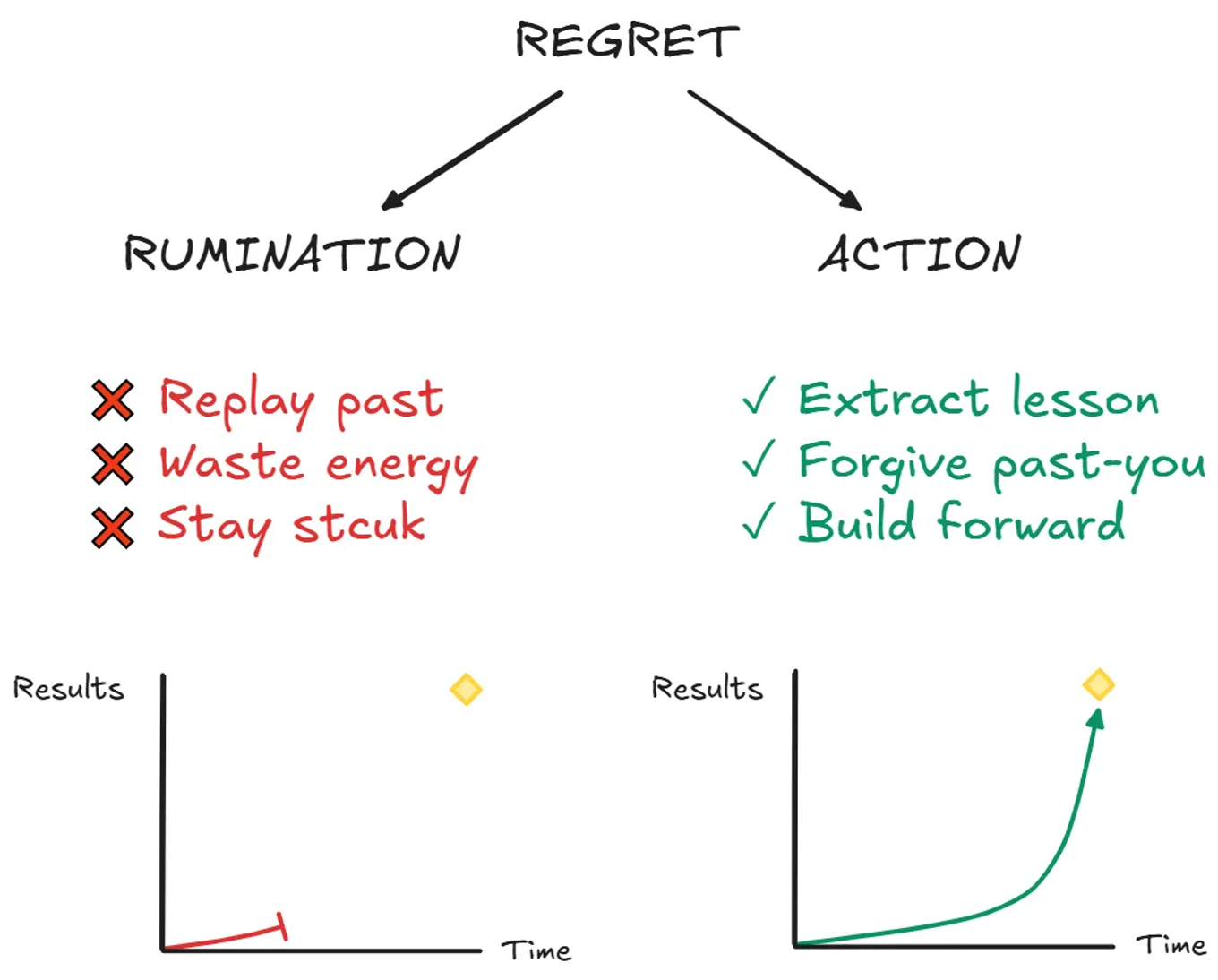
The problem isn’t regret itself — it’s getting stuck in the trap of rumination.
You can stay stuck for years, spending your precious time and mental resources replaying and wishing for an unchangeable past to change. I know because I did exactly this. The same mental reel, the same stomach knots, night after night.
But rumination doesn’t just waste your finite resources now. It also prevents you from taking agency in the present by learning from the regret and realigning your actions. This sets you up for even more regret and wasted opportunities in the future.
Rumination feels productive because it masquerades as problem-solving. Your brain tricks you into thinking that if you just replay it enough times, you’ll find a way to change what happened. But you can’t. So the loop continues.
How do we move from replaying “Why did I do that?” to “What can I do now?”
By breaking the rumination pattern first. You can’t extract regret’s lessons while you’re drowning in it.
How I Learned to Let Go
“We are products of our past, but we don’t have to be prisoners of it.” — Rick Warren
It’s easy to say “just let it go”. But no one tells you how.
This is the “how” I discovered that works for me.
The “Best Decision With What You Had” Reframe
Whenever I catch myself ruminating, I remind myself: past-me made the best decision possible with the knowledge and circumstances available at the time.
Of course I see things differently now — I have a different set of knowledge and circumstances.
This isn’t about excusing poor choices or absolving responsibility. It’s about recognising that past-you operated within constraints that present-you no longer have.
In my case, past-me was navigating an eating disorder I didn’t yet have the tools to understand nor manage. Past-me wanted the best for myself and tried to make decisions in line with that. Present-me feels regret because present-me knows better (but past-me couldn’t have known that yet).
Forgiving yourself isn’t about accepting that it doesn’t matter. It’s about accepting that past-you isn’t present-you. And being angry at past-you is like being angry at a child for not having adult wisdom.
Maya Angelou captures the balance between having grace for the past and responsibility for the future with her message: “Do the best you can until you know better. Then when you know better, do better.”
The Perspective Reframe
Another method I use is creating distance by adopting a second- or third-person perspective. If you were a friend or even a stranger observing from a distance, how would you view this regret?
When you zoom out, you put things in perspective. It normalises and neutralises the emotion by creating psychological distance — the same reason it’s easier to give good advice to friends than to ourselves.
From a distance, we see context instead of catastrophe. You recognise the regret isn’t as crushing as it initially seemed from a first-person perspective.
If you treated yourself like you’d treat a friend, you’d see it’s not as bad as you think. And if it were, you’d treat yourself with more compassion and kindness, recognising that you did the best you could — and that’s all you could’ve done. Would you judge a friend as harshly as you are judging yourself?
The Growth Reframe
Recognise that if you’re constantly growing, your past decisions will always seem suboptimal in hindsight. As you error-correct and improve your mental models of the world, you will have the benefit of better knowledge.
This means growth doesn’t just reveal regret — it creates it.
Every time you evolve, your past decisions will seem less optimal. That’s not a flaw in your decision-making. It’s proof of your growth.
Rather than asking “Why was I so stupid?”, change the question to “What has changed that makes me see this differently now?”
Perhaps what’s changed is better circumstances, greater clarity, more knowledge and insight — and that’s something to feel grateful for.
As such, it’s not about seeing regret as a problem in and of itself, but changing your relationship with regret and using it as a tool to keep getting better.
Which brings us to how we use regret to build a better version of ourselves.
From Rumination to Building
Our regrets contain lessons about what we value and what we hope for. To extract those lessons and move forward, try this three-step process:
1. Discover what the regret reveals about your values
What does this regret tell you about who you want to be? What matters to you?
2. Assess alignment with your life goals
Do these values still resonate with the life you’re trying to build?
This step matters because regret sometimes arises from default or inherited values we never consciously chose — standards that no longer serve us — but that we still use on autopilot.
3. Identify what you’d do differently with what you know now
This is the most important part. It is how you translate insights into actions you can take today to build the life you want. This clarity allows you to make intentional decisions with how you use your limited time and energy moving forward.
Sometimes, you might discover that you wouldn’t do anything differently to what you’re doing now. This outcome is also valuable information.
Let me show you how this played out in my own life.
I spent years regretting my degree choice — a decision I’d made whilst navigating an eating disorder. That choice led me down a career path I later regretted, convinced I could have been more “successful” if only I’d studied something different.
At first glance, the regret seemed to be telling me that I wanted a “successful” career by conventional standards. And I started planning for alternative careers.
But when I dug deeper, I realised the regret wasn’t about the career itself. It was about not feeling “good enough.” I’d been measuring myself against someone else’s definition of success rather than questioning whether that definition even resonated with me.
The regret arose because I was using inherited defaults — standards I’d absorbed but never consciously chosen. Once I saw that, the regret began to dissolve.
I didn’t need to change careers to chase external validation. I needed to ask: What does success mean to me? Then build toward that instead.
This is why inspecting regret matters. Sometimes it reveals your authentic values. Other times, like in my case, it reveals you’ve been chasing inherited ones. That’s when you can error-correct.
“You can’t go back and change the beginning, but you can start where you are and change the ending.” — C.S. Lewis
The Choice is Yours
You have finite time and mental resources. The question isn’t whether you’ll have regrets — if you’re growing, you will.
The question is: what will you do with them?
You can’t eliminate regret. But you can choose your relationship with it. You can stop trying to solve an unchangeable past and start shaping a changeable future.
So here’s the question to ask yourself: If your regret is a signal about what matters to you, what’s one thing you can do this week that aligns with that value?
Not what you should’ve done. What you can do now.
Because rumination keeps you stuck in the past. Action builds your future.
And that choice between rumination and action has always been yours.
If this resonated, get Micro Misconcepts in your inbox every Friday.
Subscribe to Micro Misconcepts →