The Paradox of the Highly Intelligent
November 27, 2025
By Syn Yun Phee
All your life, you’ve been told you’re smart and capable. Top of your class. Promising future. The trajectory seemed clear.
But reality hasn’t delivered — or at least not in the way you expected.
Right now, someone less intelligent than you is living the life you actually want. Not because they discovered some hidden formula, but because they possessed a bias toward action that ensured whatever intelligence they had was applied.
They’re not smarter. They’re just moving.
What Intelligence is Actually For
You’ve been sold a narrative that intelligence is measured by academic achievements and impressive titles — a narrative that keeps you optimizing within the wrong game entirely.
True intelligence is measured by its utility — your mind’s practical return on investment in navigating reality and closing the gap between where you are and where you want to be.
Perhaps you’ve earned the promotions, collected the credentials, and received the praise, yet you’re sitting here reading this article because something isn’t working.
Naval Ravikant captured this distinction perfectly: “The mark of a truly intelligent person is that they get what they want out of life.”
How Intelligence Weaponizes Itself
High intelligence grants you the ability to see vast potential and possibility. But it does something more surprising: it reveals the constructed nature of what you assumed were inevitable realities.
You’ve probably already recognized this. You’ve seen through the default life script — trade time for money, climb the career ladder, work forty years, retire at sixty-five. You’ve recognized it’s just one possible game among many, not the game.
Perhaps you’ve even started dreaming of alternatives. Time freedomThe state in which you can sustain your desired consumption level indefinitely without any further input of primary life resources (time, mental resource, and physical resource).Full definition (opens in a new tab)→ instead of time trading. Asymmetric leverage instead of linear compensation. Systems you design rather than systems that confine you.
The ambition that emerges isn’t a desire for more success within the existing game. It’s the recognition that you want to play an entirely different game.
But intelligence, it turns out, is a double-edged sword. The same capacity that revealed these possibilities can prevent you from pursuing them through three distinct barriers.
Analysis Paralysis
Your intelligent mind excels at identifying risks, anticipating failure modes, and making plans. This is tremendously useful, until it isn’t.
Before you take the first step, your mind has already documented every potential risk, complexity, and failure point. It insists on waiting until the idea is refined, the plan flawless, the approach optimised.
There’s a critical inflection point where productive planning transforms into productive procrastination. Past a certain threshold, additional planning doesn’t improve outcomes — it simply delays them.
Identity Protection
The second barrier is more insidious because it operates beneath conscious awareness.
If you’ve been labelled intelligent your entire life, your ego becomes dependent on maintaining that identity. Taking a messy, imperfect action doesn’t just feel uncomfortable — it feels like a threat to your core self.
This affliction runs particularly deep for those who built their self-worth on academic achievement. We learned early that being smart earned approval. We optimized for looking intelligent rather than being effective.
But here’s the uncomfortable truth: To become good at anything, you must first be willing to be bad at it.
Aikido instructor George Leonard articulated this perfectly: “It’s possible that one of the reasons you got on the path of mastery was to look good. But to learn something new of any significance, you have to be willing to look foolish.”
Sophisticated Self-Justification
The third barrier is perhaps the most dangerous: your ability to justify the first two.
Our minds are sophisticated story-telling machines, creating elaborate narratives that make our inaction seem not just reasonable but prudent.
You tell yourself you’re “being strategic” when you’re being avoidant.
The stories vary in specifics but follow predictable patterns: not enough time, not enough resources, timing isn’t right, conditions aren’t optimal, knowledge isn’t sufficient, more information is needed. The list goes on.
I’ll start the business after I finish this certification. And that certification. And after I read these fifteen books on business strategy.
We create the illusion of progress through perpetual planning and preparation.
Sometimes, the most rational-sounding justification is simply fear dressed in formal attire. The smarter you are, the better your excuses sound, even to yourself.
Your intelligence fuels ambition, but also prevents its execution. And the consequences compound over time, extracting a cost you might not fully recognize until years have passed.
What This Trap Extracts
When you’ve mentally rejected the old script but can’t execute the new one, you become paralyzed in a state of ambition without action. This is self-inflicted suffering.
You’re carrying the weight of what could be without ever lightening the load through progress.
The suffering presents itself subtly, registering as mild dissatisfaction rather than acute crisis. This is precisely what makes it dangerous — never quite painful enough to force immediate action, so it persists until it culminates in crisis.
Maybe it’s the Sunday evening dread you feel despite your “successful career.” The pre-sleep anxiety that you’ll wake up at sixty-five having spent your entire life playing someone else’s game brilliantly. Or the quiet desperation you experience during your morning coffee, recognizing you’re trapped in golden handcuffs, only to be swept back into the day’s demands a moment later.
This trap extracts two compounding costs.
The Accumulation of Regret
In a previous article, I explored how regret arises from unrealized opportunities to become our ideal selves — a gap between who we were and who we wanted to be. By holding onto an ambition without working towards it, you’re creating exactly such regret in slow motion.
The weight of this regret accumulates over years of delayed action. One year becomes five. Five becomes a decade.
The tragedy isn’t that you failed — it’s that you never really tried. And unlike failure, which at least generates data for the next iteration, indefinite preparation generates nothing except the growing conviction that you’ve wasted your finite time on this planet.
The Erosion of Self-Image
There’s a second, less obvious consequence: the impact on your self-image.
Each cycle of plan-without-action erodes confidence in your ability to follow through. It generates evidence that accumulates into a narrative: “I’m the kind of person who plans but doesn’t do.”
Once this becomes your self-concept, it becomes self-fulfilling. It leads to a lower likelihood of action, which generates more evidence of inability — a downward spiral that taxes every future endeavour.
Eventually, you stop trusting your own commitments. When you tell yourself you’ll start on Monday, a quiet voice whispers: “Sure you will.”
You have three options: work towards what you want, let go of the aspiration or continue to be tormented in the middle ground.
James Clear captured this choice elegantly: “It doesn’t make sense to continue wanting something if you’re not willing to do what it takes to get it. If you don’t want to live the lifestyle, then release yourself from the desire. To crave the result but not the process is to guarantee disappointment.”
It’s completely valid to decide you want to release an aspiration when you recognize the opportunity costsThe lifetime value of the next best alternative forgone when expending life resources to improve or implement misconcepts.Full definition (opens in a new tab)→ aren’t worthwhile in the context of your entire life. But if you decide you want to work towards it, the question becomes: how?
The Way Out
Each of the three barriers mentioned above requires a different reframe.
Iteration over Perfection
If you apply even modest logical analysis, a simple truth emerges: a B- effort executed today is infinitely more valuable than an A+ plan that remains theoretical forever.
The former generates real-world results for iteration. The latter leaves you with untested conjectures.
The math is simple:
- Starting imperfectly and iterating = compounding rate above zero.
- Never starting because you’re “not ready yet” = compounding rate guaranteed to be zero.
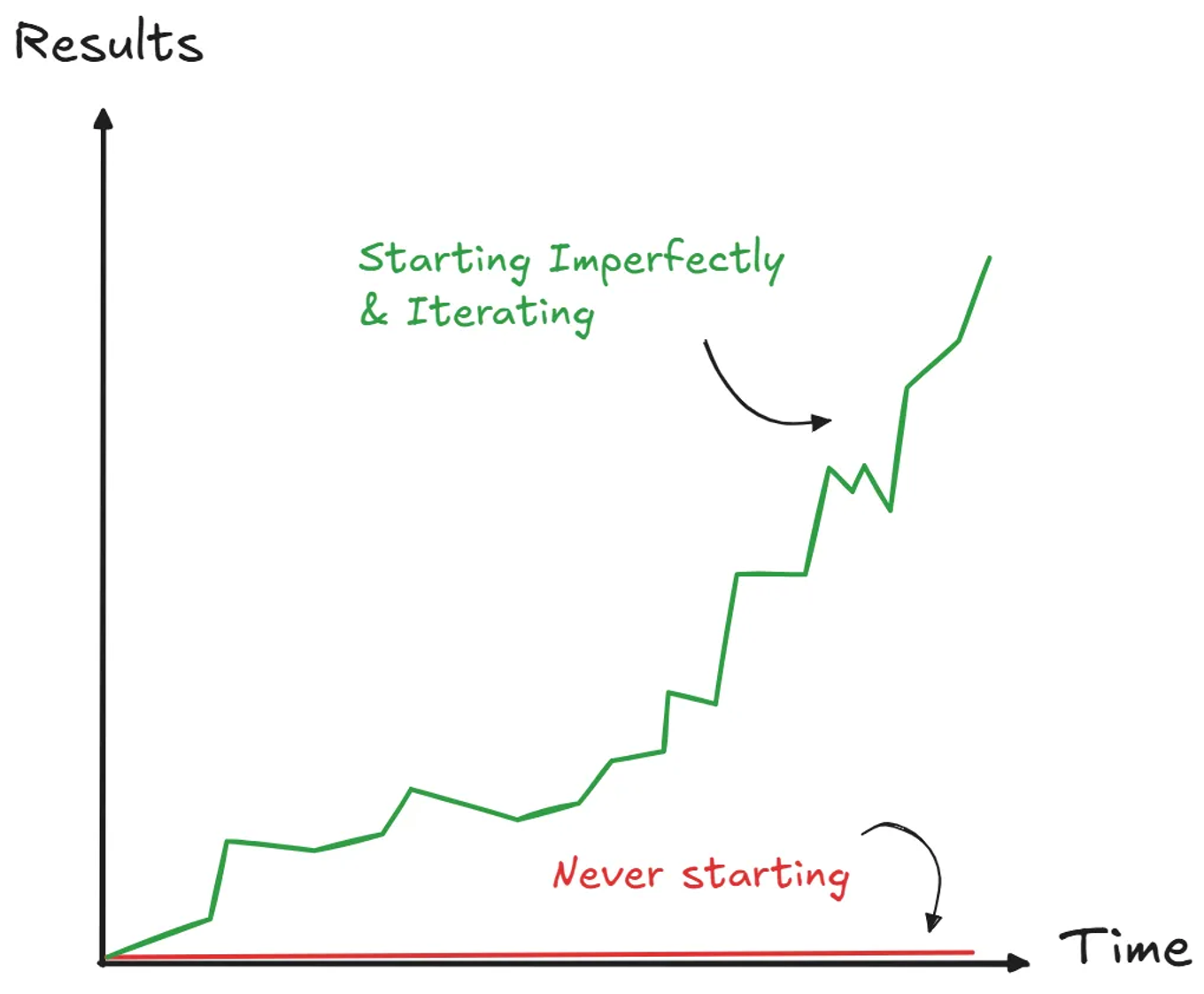
Each iteration provides feedback that no amount of planning can replicate.
Paul Graham, founder of Y Combinator, distilled his advice: “When in doubt, just try it. You’d be surprised how often that works.”
Use your intelligence to form a good-enough first conjecture — emphasis on good enough, not perfect. Then act, gather feedback, and iterate.
Your starting point matters far less than your willingness to iterate. If you’re error-correcting after each cycle, the gap closes eventually.
You don’t need the right answer on day one. You need the willingness to update it on day 100.
Making it Practical
Ask yourself: “What is the smallest action I can take this week that would prove to myself I’m serious about this?”
Then take it.
Logic addresses the analysis paralysis. But what about the identity threat posed by imperfect actions?
Redefining Smart
An attachment to your identity as “the intelligent person” will ironically cause you to become less intelligent over time. You fall into the trap of resisting error-correction for fear of appearing foolish — which serves neither you nor your goals.
The shift required is subtle but transformative: from “being knowledgeable” to “seeking knowledge.”
Reframe “looking foolish” as “looking like someone learning.”
Everyone begins as a beginner. It’s a natural part of the process.
The progression is inevitable: bad → good → excellent. You can’t skip steps. Trying to start at excellent guarantees never starting at all.
Adam Grant articulates the mindset shift: “Being wrong is the only way I feel sure I’ve learned anything.”
When being wrong becomes evidence of learning rather than evidence of inadequacy, the identity threat dissolves.
Making it Practical
Before starting something new, I tell myself: “I’m going to suck at this for the first 20 hours, but that’s how I know I’m learning something new.”
Setting this expectation up-front reduces the identity threat when reality inevitably delivers the early awkwardness, because now your expectations match reality.
Try it.
Shifting your identity removes the threat of looking foolish. But there’s still one barrier: the sophisticated stories you tell yourself about why now isn’t the right time.
Redirecting Fear
We tend to overweight immediate costs and underweight future benefits (hyperbolic discounting), which skews our opportunity cost assessments and nudges us toward what’s pleasurable now over what’s good long-term.
To recalibrate, adopt a lifetime perspective and use fear for you rather than against you.
Previously, you feared looking foolish. But what are you more afraid of: temporary discomfort now, or permanent regret later?
Making it Practical
I’ve found this mental time travelling trick particularly powerful: Imagine yourself at seventy, looking back at your life. Which discomfort would you rather have? Living with the regret that you never tried, or that you experienced temporary discomfort and grew from it?
The answer, when viewed from sufficient temporal distance, becomes obvious.
These three reframes work together to dismantle the barriers your intelligence created. But they only matter if you actually use them.
Making Intelligence Useful Again
The true utility of intelligence lies in your ability to get what you want from life. If your intelligence isn’t generating a practical return — if it isn’t making you happier, healthier, or wealthier by your own definition — then its theoretical potential is indistinguishable from absence.
Either learn to use your intelligence in service of your goals, or accept that its idle capacity will continue burning you from the inside. Let your intelligence narrate reasons why you can’t, or use it to figure out how you will.
What is your story costing you — and what’s the smallest action you’ll take this week to stop paying that price?
If this resonated, get Micro Misconcepts in your inbox every Friday.
Subscribe to Micro Misconcepts →