The one right path fallacy
August 20, 2026
By Syn Yun Phee
I was 12, sitting in Mr Smith's English class, when I was handed what turned out to be one of the most misread poems in the English language, "The Road Not Taken" by Robert Frost, first published in 1915.
You may be familiar with it.
It starts off with:
“Two roads diverged in a yellow wood,
And sorry I could not travel both”
Ending with:
“I took the one less traveled by,
And that has made all the difference.”
My first reaction was one of empowerment. I was inspired, like many readers of this poem, by the courageous call to be a non-conformist and take the "less conventional path." I wanted to live my life making decisions for myself, rather than what I thought the world expected of me. I was determined to take the road less travelled by.
This is the most common interpretation of the poem and I can see why. It is incredibly appealing, giving us the permission we wouldn't otherwise give ourselves to walk out of formation with the herd.
But funnily enough, I would only learn 18 years later that this was not at all what Robert Frost intended when he wrote it.
What Frost actually meant
Contrary to what most thought was a triumphant anthem of walking the road less travelled by, Frost originally wrote the poem as a gentle joke directed at his good friend, the English poet Edward Thomas.
When Frost lived in England, he and Thomas would frequently take long walks through the countryside. Thomas was notoriously indecisive. Whenever they came to a fork in the road, Thomas would agonise over which way to go. After they'd chosen a path and walked for a while, Thomas would inevitably sigh and express regret, convinced the other path would have offered better scenery or a more interesting walk.
Frost later wrote "The Road Not Taken" to poke fun at Thomas' tendency to romanticise the choices he didn't make. It was an observation of a very human condition, the tendency to wonder about the parallel lives we left behind on the roads we didn't take.
Hidden within the poem was Frost's own realisation that this habit of agonising over the path not taken was usually pointless, because whichever path you took, you'd end up romanticising and yearning for the other one anyway.
The poem's narrator gives this away twice, first noting in the second stanza:
“Though as for that the passing there
Had worn them really about the same,”
Then confirming again in the third stanza:
“And both that morning equally lay
In leaves no step had trodden black.”
To Frost, the two roads were practically identical.
Rereading the poem after learning what Frost actually meant, I laugh a little, because I fell (and continue to fall) for the exact same trap.
I chose to study Food Technology in university, for reasons that seemed plausible to the 17 year old me. This led me to a career in the food industry, specifically in Quality and Food Safety. But I often find myself thinking about the other careers I could’ve pursued, a doctor, a psychologist, an architect, options that I had weighed but ultimately decided against.
I imagine how differently things would have gone, usually imagining a better reality than the one I’m living in. But speaking with others in these professions, I’m reminded of my own ignorance of the daily friction and stressors unique to these career paths. And if I’m honest with myself, I know I’d be standing in those shoes wishing I’d taken yet a different path, because what I imagine is always a romanticised version devoid of the cons.
This tendency shines a light on a fallacy many of us carry, the belief that there's one right path in life and our job is to find it.
Projected onto the past, this leads to regret and rumination. We look backward and romanticise the paths we didn't take, believing them to be better, then suffer for seeing that those paths are now closed.
But this tendency doesn't just happen looking backwards. We also look sideways at other people's paths and feel a sense of lack, as if we've made the wrong decision in choosing "the right path." It's the classic grass-is-greener syndrome.
Whether we're looking backwards or sideways, there's a shared flaw in romanticising the paths not taken. I call it the resolution illusion.
The resolution illusion
The grass always looks greener on the other side. But is it really? Perhaps it's just as green on your side, but while you're busy looking over to the other one, you fail to notice how lush your own garden actually is.
The path you're walking is high-resolution. You see your 4k reality, every rock, every patch of dirt, and every weed. You experience the daily friction of this reality because you're standing in it.
But the unchosen path, the one you're admiring from afar, is a low-resolution fantasy. You don't have the data to render the weeds, the tedious moments, the hidden stressors of that alternative life. What renders instead is a smoothed-out, fuzzy green picture, the sensation of greener pastures without any of the texture that would make it real.
When we feel the sting of regret or the pull of the greener grass, we aren't comparing two realities. We're making an unfair comparison between a complex, high-friction reality and a simplified, frictionless fantasy.
We're all vulnerable to this simply by how our brains function. In Stumbling on Happiness, psychologist Daniel Gilbert points out our mind's capacity to misimagine:
“To see is to experience the world as it is, to remember is to experience the world as it was, but to imagine–ah, to imagine is to experience the world as it isn’t and has never been, but as it might be.”
“We use our eyes to look into space and our imaginations to look into time. Just as our eyes sometimes lead us to see things as they are not, our imaginations sometimes lead us to foresee things as they will not be.”
It's easy to stay stuck staring at the paths not taken, wishing we could rewrite the past. But none of us can, and no amount of wishing changes that.
Good enough
Believing in the one right path also paralyses us. Coupled with the genuine desire not to waste your one life, it creates immense pressure to find the perfect career, partner, or city, the one that will finally make everything fit into place. Sometimes that pressure is enough to stop us from deciding at all. This belief only results in an everlasting feeling of discontent because you’re always left wondering what if there was something better?
The infinite choices modern life presents us with doesn't help. As psychologist Barry Schwartz puts it in The Paradox of Choice, "Learning to choose is hard. Learning to choose well is harder. And learning to choose well in a world of unlimited possibilities is harder still, perhaps too hard."
More choice doesn't just make deciding harder, it makes you less satisfied with whatever you do land on because an infinite menu makes every choice taste slightly of regret.
Whilst there are certainly "bad" paths I wouldn't recommend anyone take, there are countless "good" ones, all viable routes to a well-lived life. It's there in Frost's own lines. The two paths, he tells us, were worn down about the same. There is no one right path.
Recognising this releases you from the pressure of having to make the perfect decision. There's no single correct decision to hunt for, but multiple viable ones. Besides, we never get complete information, and the future stays uncertain no matter how long we deliberate. Every decision is just our best hypothesis at the time. So the goal isn't the perfect choice but a good enough one that lets you move forward.
What’s still ahead
In 2021, Tim Urban, author of the blog wait but why, released an illustration on X that went viral. It shows two sides of life. On the left, black lines representing the past and all the paths now closed to us. So many of us replay these, the opportunities we didn't pursue, the relationships we let fade, the things we were too scared to try.
But there’s also the right side of the picture. Green lines representing the countless directions we can still take from here. Learning a new skill, starting that long-dreamt-of business, rebuilding relationships or creating new ones, it's all still possible. The future is wide open.
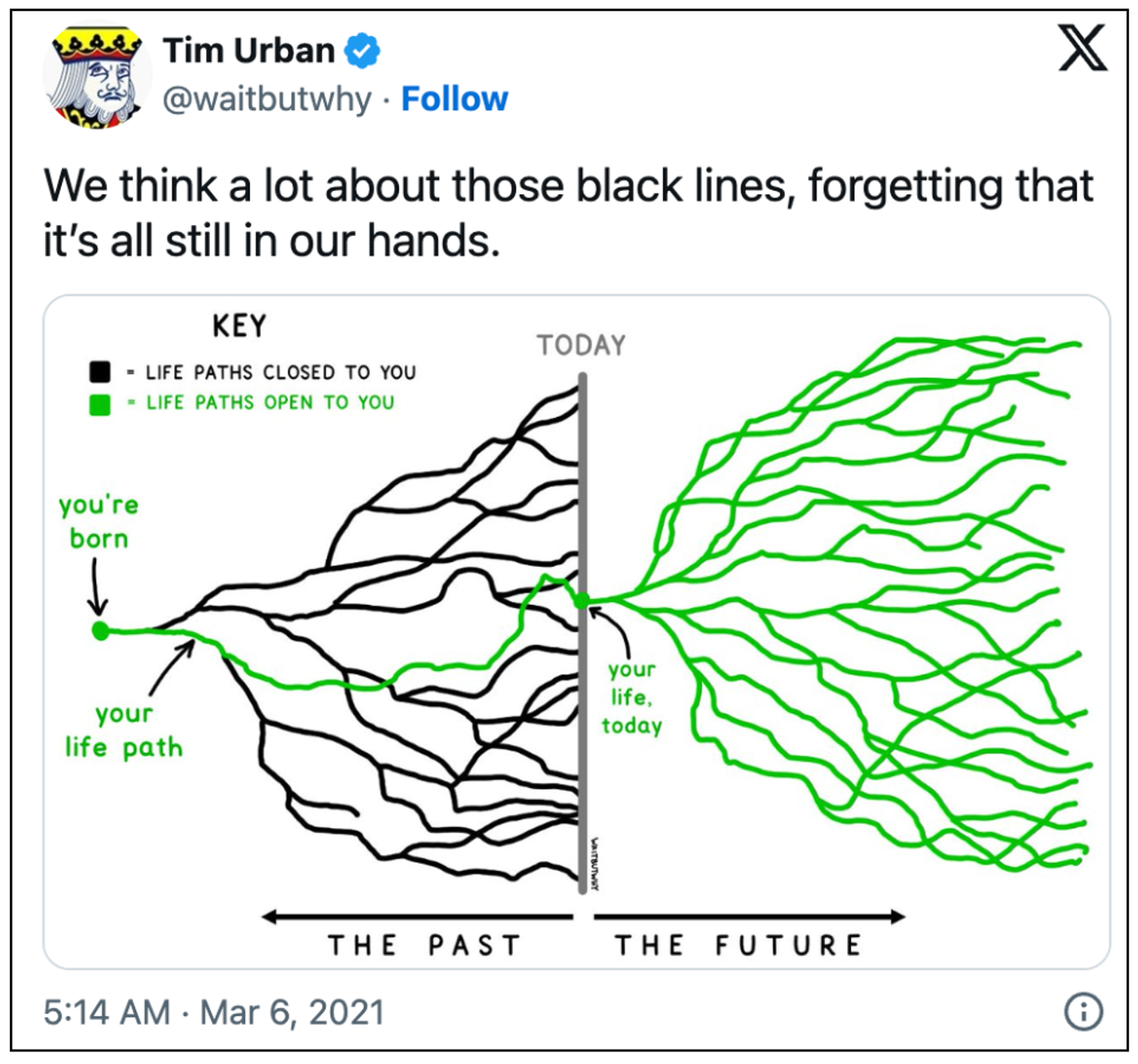
Urban's illustration was a reminder that while we stay fixated on what could've been, we fail to see the possibilities of what could still be. It was a call to reclaim agency in the present and recognise all the potential in front of you.
It's not too late, but it eventually will be if you stay stuck gazing at other paths instead of the one you're on. When you're focused on the other paths, you're withholding your finite life resourcesThe finite resources we expend to improve or implement misconcepts.Full definition (opens in a new tab)→ from the path you're actually on. The grass around you turns brown because you're looking away from it, not looking after it.
As the popular saying goes, the grass is greener where you water it.
Standing on the green dot where your life is today, the many green paths forward aren't a cause for paralysis. Any one of them is viable, because there are many paths that can lead to a good life. You don't need the perfect choice. You just need your best current hypothesis to move forward.
And what if the hypothesis is wrong? Well, as entrepreneur and speaker Jim Rohn puts it, “you’ll find out quicker.”
Water your grass
Our obsession with the “perfect path” distracts us from living in the present and paralyses us from moving forward. We either look backwards at the paths we didn’t take or sideways at the low-resolution fantasy of parallel lives. And while we are looking backwards and sideways, we are entirely absent from the one place where we actually have agency, the path we are on right now.
When you stop looking backwards or sideways and put all your life resources into the reality in front of you, when you water your own grass, something magical happens. Your grass gets greener. And from your well-watered patch, you're able to look forward to all the paths still ahead of you.
Water your grass.
If this resonated, get Micro Misconcepts in your inbox every Friday.
Subscribe to Micro Misconcepts →