The Hidden Taxes You Pay
October 23, 2025
By Syn Yun Phee
There’s a peculiar phenomenon emerging among high-performers in their late twenties and early thirties. They’ve done everything the script demanded - prestigious degrees, competitive careers, enviable weddings, beautiful houses, impressive trajectories. By conventional metrics, they’re winning. Yet beneath all this lies a growing sense of dissonance. A question begins to surface with uncomfortable persistence: Am I building the life I chose, or a life someone else chose for me?
We’re the first generation to experience the quarter-life crisis as a widespread phenomenon rather than an individual neurosis. The pattern repeats with remarkable consistency: we accumulate the conventional markers of success and discover they satisfy something, but not the thing we expected them to satisfy. The dissonance operates at every scale, from major life decisions down to the minor weekly obligations.
I’ve recognized it in my own life: the obligations I fulfill from inherited guilt rather than genuine desire, the identity as ‘the reliable one’ that means I can’t say no without triggering concern, the family gathering where I perform a version of myself that stopped fitting years ago, the traditions I maintain because “that’s what we do.”
This dissonance, from the major to the minor, all comes from the same source: inherited defaults we’ve been running on autopilot. And these defaults are taxing away our life resourcesThe finite resources we expend to improve or implement misconcepts.Full definition (opens in a new tab)→ without our consent.
The problem isn’t what we’ve added - more skills, better habits, optimized routines. The problem is what we’ve inherited and never examined.
Where Your Defaults Come From
“Until you make the unconscious conscious, it will direct your life and you will call it fate.” - Carl Jung
To understand why we’re paying these taxes (and how to stop) we need to understand where our defaults come from in the first place.
We operate with two modes of thinking - rational and default. Rational thinking (Kahneman’s System 2) is energy intensive which means we cannot use it all the time. Most of the time, we live and operate using our defaults (System 1), highlighting their substantial role in our day-to-day lives.
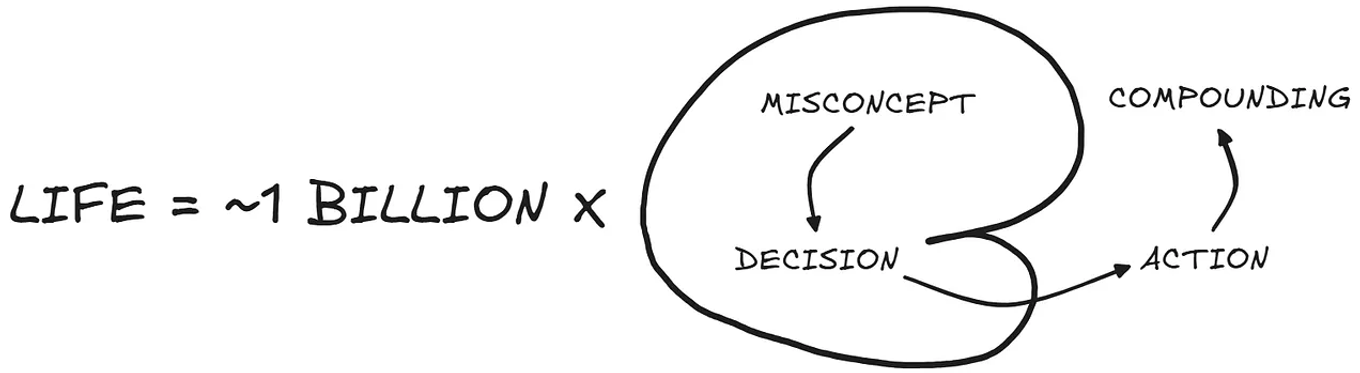
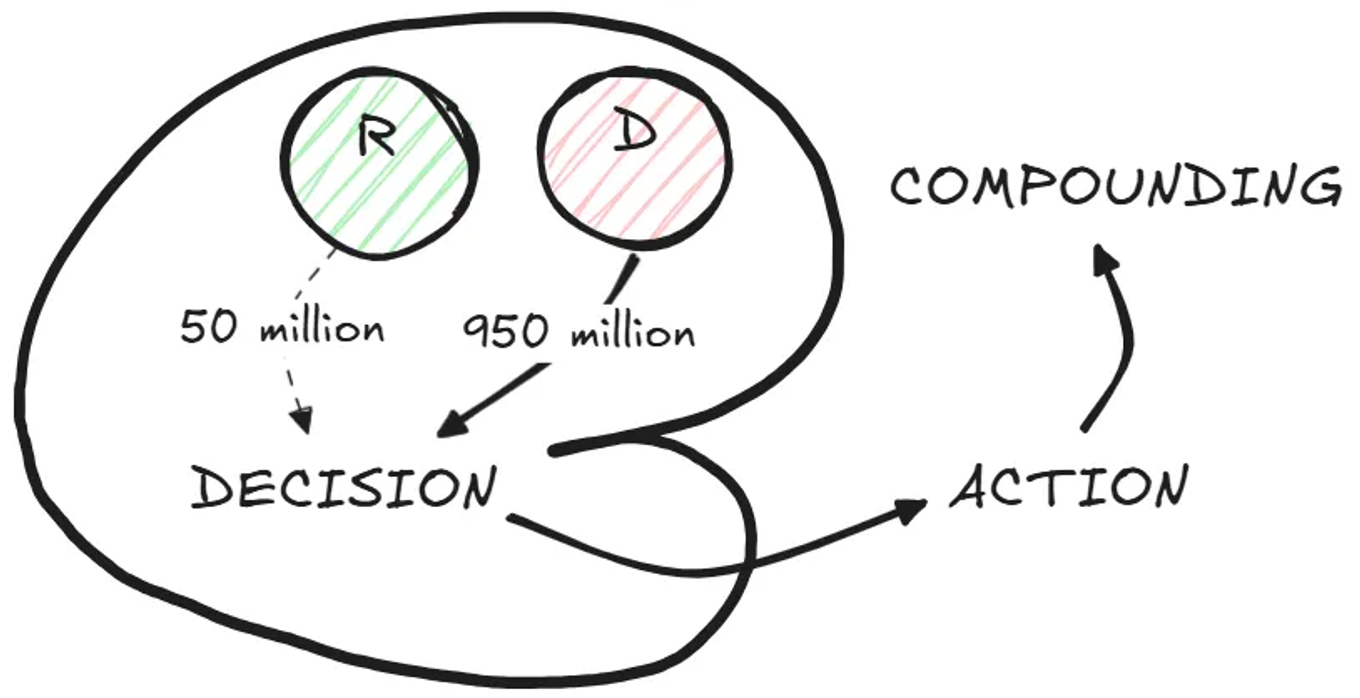
But where do these defaults come from? We don’t choose our initial set of defaults - we inherit it. And we inherit our defaults from two main sources: nature and nurture.
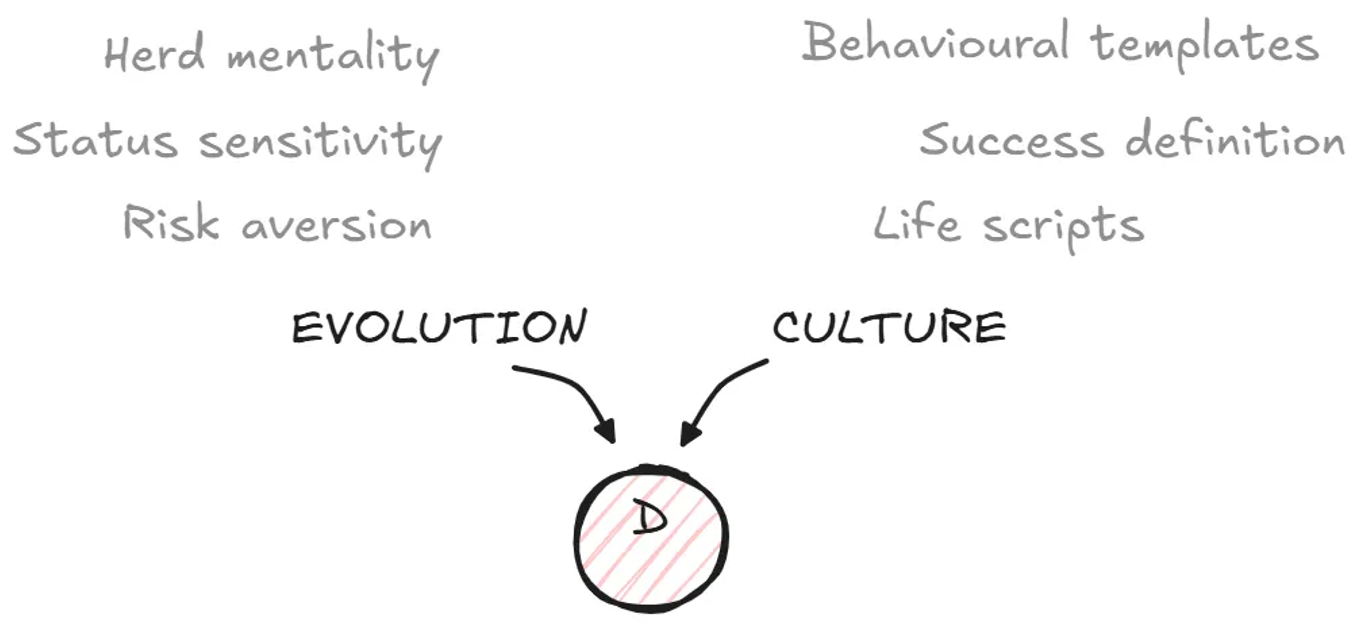
- Nature: Through years of evolution, we have been programmed with cognitive shortcuts that helped our ancestors survive but often misleads us in modern times. These evolutionary defaults form our baseline operating system. We can become aware of them and manage them, but we cannot get rid of them entirely.
- Nurture: As we grow, we inherit cultural defaults from our family, community, and environment. These defaults influence our beliefs, shape our expectations, and drive our behaviours. But unlike our evolutionary defaults, we can actually shift these cultural defaults. They only feel permanent because they were installed early and reinforced constantly. But we can audit them, question them, and systematically remove the ones that no longer serve us.
Both evolutionary and cultural defaults shape our lives profoundly, but they require different approaches. Evolutionary defaults can be managed but not eliminated, they’re like hardware. Cultural defaults can be rewritten, they’re like software. This article focuses on the latter because that’s where subtraction is possible. Managing evolutionary defaults deserves its own exploration, which we’ll do in a subsequent article.
The Obvious and the Insidious
So what exactly are these cultural defaults? They operate at two distinct levels, and it’s the second one that’s costing you more than you realise.
First, there are macro-level cultural defaults such as traditional definitions of success, career scripts and subscription to life milestone timelines. Get married, have kids, buy a house, all by (insert the age you’ve been told). These are the obvious ones and the ones we’re already openly challenging today.
The less obvious territory lies in the micro-level cultural defaults. These are things that shape and influence your smaller day-to-day decisions and behaviours. It includes cultural obligations that determine what events require your attendance, which traditions can never be questioned, and which relationships you’re obligated to maintain regardless of mutual value. It includes behavioural templates on what “responsible” looks like and social rituals that feel compulsory but superficial. It might even include self-defeating narratives you have adopted about who you are and what you are capable of.
These micro-level defaults are insidious as they silently tax our finite life resources. These are the hidden taxes that don’t get addressed because:
- They’re too small to seem worth examining
- They compound in small daily increments that are less obvious
- They’re enforced through ambient social pressure, not explicit mandates
- Questioning them feels petty or ungrateful
Most people understand they might be pursuing the wrong career or optimizing for someone else’s version of success. But fewer notice the micro-level taxation that happens in the shadows, in the inherited obligations and narratives that creep in slowly.
“The mass of men lead lives of quiet desperation.” - Henry David Thoreau
Consider this simple math: A thirty-minute weekly obligation you’ve never questioned costs you 26 hours annually. If that obligation also requires two hours of mental resourceThe ability to creatively conjecture, rationally criticise, and focus.Full definition (opens in a new tab)→ recovery due to the depletion, you’ve just spent 130 hours serving an inherited default.
Pause here. Think of one weekly obligation you fulfill automatically. How much time does it actually cost you in total? Not just the event itself, but the mental recovery afterward? Multiply that by 52. That number is probably uncomfortable to look at.
And most people are paying not one such tax, but dozens.
Why is it so hard to recognize these hidden taxes? Because they’re reinforced by something bigger than individual choice - your environment.
Why Your Environment Keeps You Stuck
When everyone around you treats certain traditions as sacred, certain obligations as non-negotiable, certain life scripts as the expectation, and they all share the same definition of success, you are very likely to believe it all too. Our environment reinforces our inherited cultural defaults by exploiting our evolutionary defaults of being social animals.
“You are the average of the five people you spend the most time with.” - Jim Rohn
Our innate desire to belong and deeply wired fear of social rejection makes the cost of deviation from the group unbearable. We mimic the crowd not because we’ve reasoned our way to their conclusions, but because belonging feels safer than standing alone. This is the herd mentality at work. Once we’ve adopted these beliefs, confirmation bias ensures they remain in place as we filter all evidence that might challenge the collective wisdom of the herd. The collective delusion becomes indistinguishable from truth.
When you challenge your cultural defaults, you risk disappointing people, being marked as selfish and ungrateful, or even rejected from the group as the person who “changed.”
The invisible pressure to conform to “the norm” is real.
This is why you can intellectually know that working 80-hour weeks isn’t sustainable, yet still feel compelled to do it when everyone around you treats working overtime as a badge of honour. This is why you can intellectually know that a particular obligation drains you, yet still feel compelled to fulfill it.
To make matters worse, this can easily become a self-perpetuating cycle where we select environments that validate our existing defaults, which then reinforces those defaults, which then shapes what environments we select.
If you’re feeling defensive or uncomfortable right now, that’s normal. That discomfort is data - it’s showing you where your inherited defaults are being threatened.
This self-perpetuating cycle is why addition alone won’t solve our problems. The path to progress requires subtraction.
Why Addition Fails
Whenever we think of self-improvement, we think of addition. We try to add new habits, new skills, new morning routines, or new tactics to optimize our days. While useful in their own right, they don’t solve the bigger problem of life resource allocation.
Think of it this way. We have a set of finite life resources. Our inherited cultural defaults are like hidden taxes that consume these life resources at every scale. The new habits and morning routines we add may help us better manage the life resources we currently have, but they do not change the fact that our life resources are still being consumed by those hidden taxes.
The path to progress isn’t addition, it’s subtraction. When you subtract the hidden taxes that no longer serve you, you unlock resources you already have but could not access before when they were being taxed away. By removing your hidden taxes, you can redirect this additional resource towards things that actually matter to you. You unlock more capacity than you thought was even possible.
“The sculptor produces the beautiful statue by chipping away such parts of the marble block as are not needed - it is a process of elimination.” - Elbert Hubbard
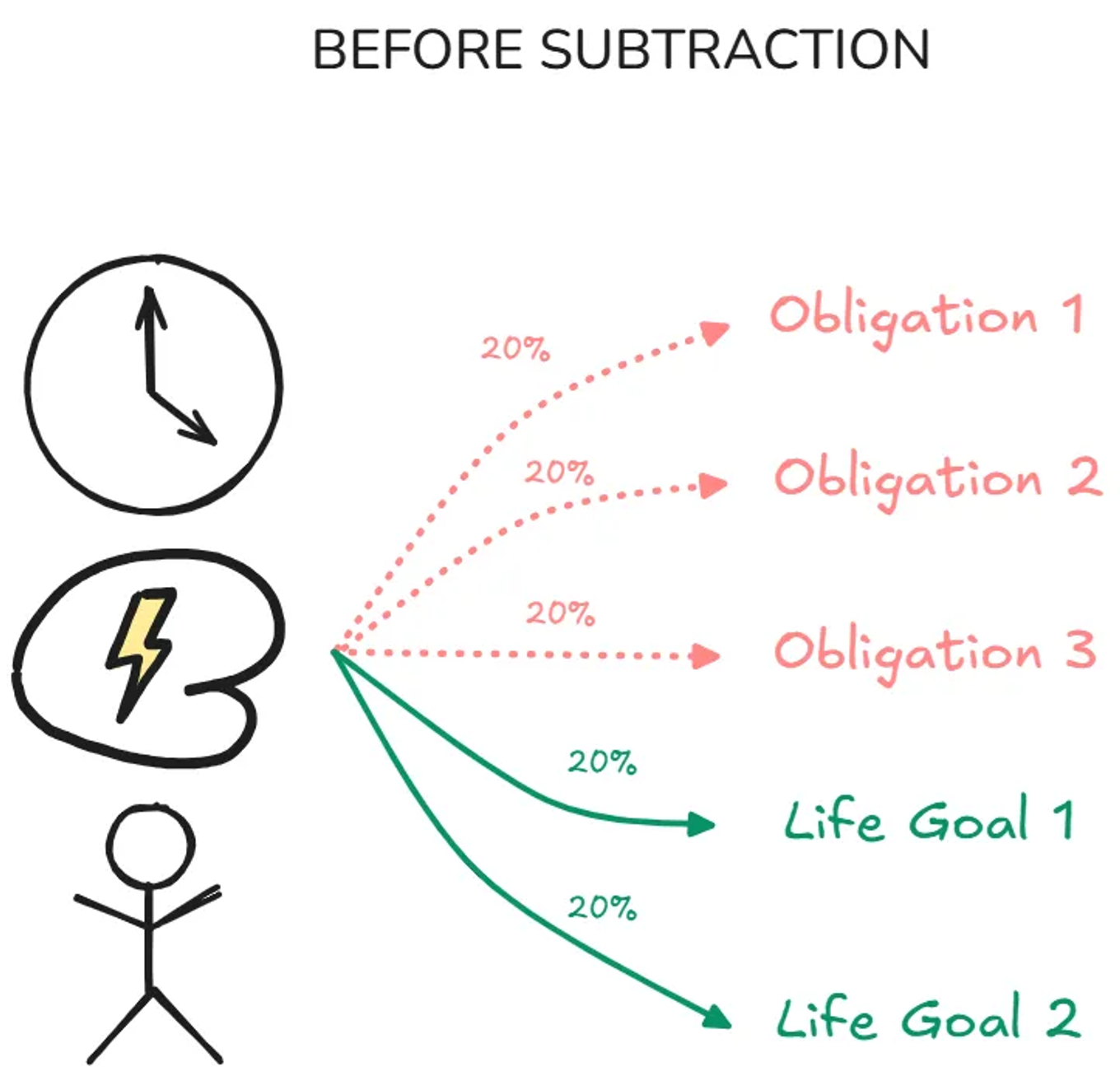
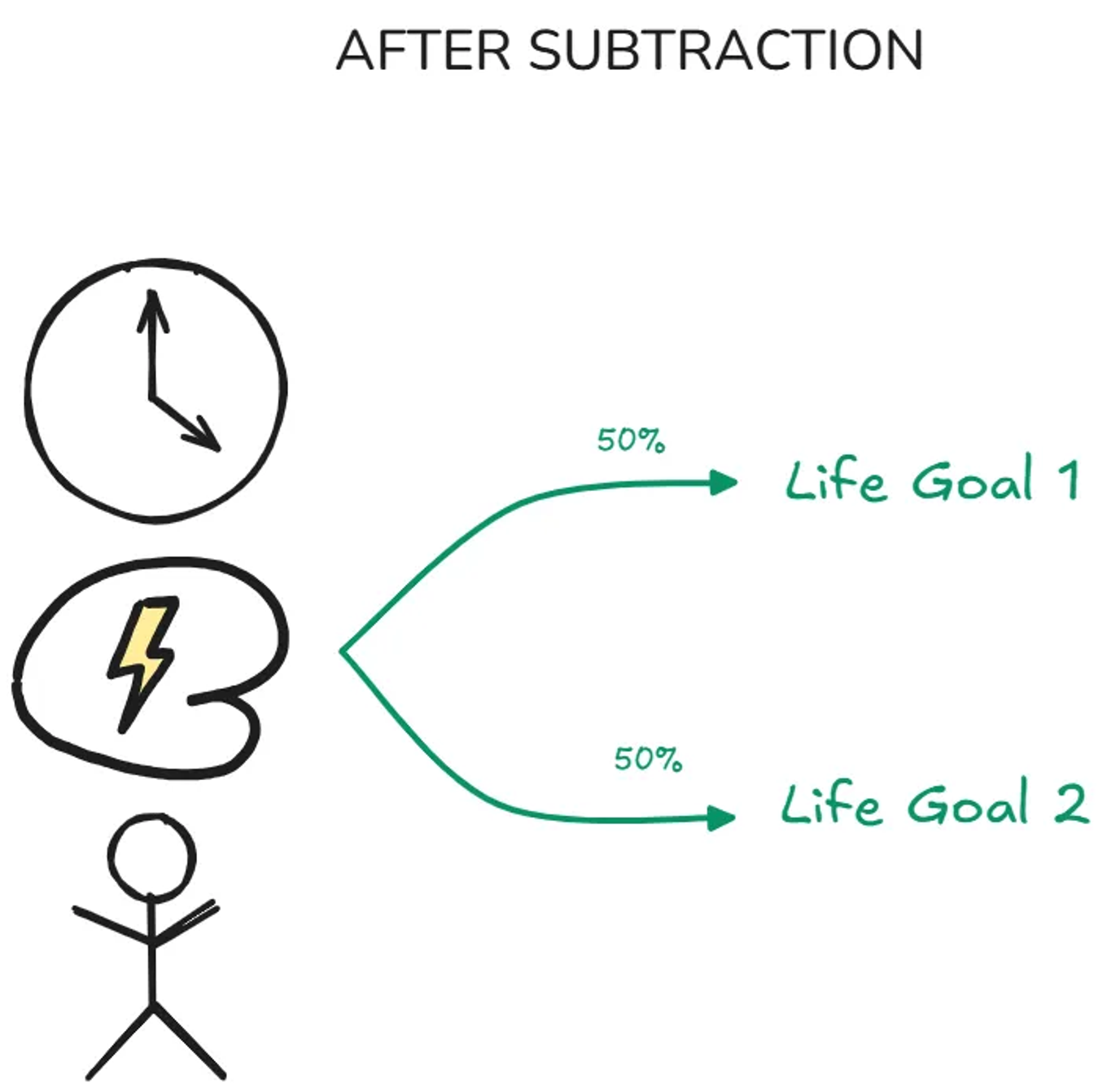
So how do we actually stop paying these taxes? I’ve found three approaches to be invaluable.
How I Audit My Own Inherited Defaults
The key lies in not fooling ourselves, and we’re the easiest person to fool. It is all too easy for us to generate sophisticated sounding “reasons” that protect our defaults from scrutiny.
From my own journey of questioning inherited defaults, I’ve found three approaches that help me cut through my self-justification and critically evaluate my defaults.
Tactic 1: Trace The Origins
When I trace the origins of a default, I quickly see whether it serves me or taxes me. My go-to approach is the 5 Why Method, one of the most classic problem-solving techniques, because it cuts through self-justification remarkably well.
This is how it works:
- Identify the belief you want to inspect.
- Ask yourself “Why do I believe this?”
- Then ask “why” to your answer four more times
Here are some examples of how I’ve applied this:
Example 1
Belief: “I need to respond to work messages within minutes, even on weekends”
Why? Because that’s what responsible professionals do.
Why? Because people expect it and delaying a response will disappoint them.
Why? Because I see other people behaving this way.
Why? Because other people might also feel the pressure to be constantly available.
Why? Because they (and actually me too) are afraid others might think less of them or question their commitment, and they see others doing it too.
Why? Because constant availability became equated with commitment. It started in corporate culture when email made us reachable 24/7, and the fastest responders looked most dedicated. This standard spread quietly until it became just “how things are done.”
Results: The idea that constant availability equals commitment to work is a culture passed down and never critically examined, so we all just feel the ambient social pressure to conform. Driven by our own insecurities of how others might perceive us if we do not conform, we go along with it. In reality, most people might not even expect it and secretly wish they could be free of it.
Example 2
Belief: “I’m the person who always shows up and always helps.”
Why? Because people depend on me.
Why? Because I’ve always put others before myself.
Why? Because I was praised as a child for being responsible and helpful.
Why? Because my parents and guardians categorised certain behaviours as desirable and gave more attention and approval for those than for just being myself.
Why? Because they likely inherited that belief from their parents.
Results:The “always helpful” identity is about securing love through utility. It’s a survival strategy from childhood that’s now draining me because I’m still performing that role years later even though I’d prefer to set some boundaries and prioritize my own needs.
As you apply the 5 Why method repeatedly, you’ll start to notice that almost all beliefs originated from someone coming up with some idea that served a purpose at some point in time, and that idea was simply passed down from one generation to the next without being examined further.
This realization can be unsettling. You’ve just discovered that beliefs shaping your entire life were blindly inherited, not intentionally chosen. But within that discomfort lies liberation: if they were inherited, they can be examined. If they were inherited, they can be changed.
“The privilege of a lifetime is to become who you truly are.” - Joseph Campbell
Tactic 2: Ask Clarifying Questions
This might seem like a simple one, but you can often make more progress by asking the right questions than seeking an answer to the wrong one. Over the years, I’ve collected questions that help me audit different dimensions of my inherited defaults. Here are some of my favourite:
- Am I doing this because I want to or because I think I have to?
- What’s the actual cost of this, and what am I not doing because of it?
- What would I do if no one would ever know my choice?
- If I repeated this daily for ten years, would I be moving closer to or further away from the life I want?
- If I could redesign my life from scratch, what would I not include?
- What trade-offs am I willing to make, or no longer willing to make?
- What do I need to let go of to become who I want to be?
- What traditions or obligations continue solely because “that’s how we’ve always done it”?
Tactic 3: Curate Your Environment
As we saw before, your environment has a much greater influence on you than you realise. Your environment will either support or sabotage you.
One of the most powerful things I’ve learned is to seek out and surround myself with people who encourage me to grow rather than people who hold me back. I look for people who’ve questioned their own defaults and won’t punish me for questioning mine. This is an environment that allows for error-correction and iteration. I also look for people who model the defaults I want to adopt and reduce exposure to people that enforce the defaults I’m trying to remove.
Questioning cultural obligations triggers shame as you feel selfish for even considering it. But if you surround yourself with people who all do it, then it feels normal.
What to Expect
I won’t pretend this is easy. The first time I questioned a cultural default, I felt selfish for weeks. I’ve also literally been called selfish by those around me. But what I’ve discovered is that this guilt is the inherited default defending itself. It’s the last line of defense for defaults that no longer serve you.
This isn’t a weekend project. I’ve been doing this work for a decade and I’m still discovering and working on defaults that don’t serve me. But each one I remove creates more space for what actually matters.
And a note of warning from my own experience: The goal isn’t to reject all cultural defaults, it’s to be deliberate about keeping what serves you and removing what doesn’t.
The path to progress isn’t addition. It’s subtraction. Not because addition doesn’t work, but because you cannot add your way out of a system that’s taxing away resources faster than you can generate them.
“Perfection is achieved, not when there is nothing more to add, but when there is nothing left to take away.” - Antoine de Saint-Exupéry
These hidden taxes don’t feel urgent because they seem small and trivial. But they extract resources slowly, day after day, year after year. You tolerate it in the days until it shapes the years. By then, you’ve built your entire life around it.
Where to Start
Every hour spent serving an inherited default is an hour you’ll never get back. The question isn’t whether you can afford to examine your inherited defaults. It’s whether you can afford not to.
Here’s what I’ve learned about starting: You don’t need to overhaul your life in one dramatic purge. Start with one micro-obligation. Something small enough that removing it won’t upend your life, but significant enough that you’ll notice the resource recovery. Notice what you gain, not just in time, but in mental resources. That recovered resource gives you momentum to examine the next default, and the next.
The work of subtraction isn’t about becoming selfish or rejecting all obligations. It’s about becoming deliberate. It’s about running your life on defaults you’ve examined and chosen, rather than defaults you inherited and never questioned.
What’s one inherited default you’re willing to examine this week?
Not remove, not even challenge yet, just examine. Trace its origin. Ask yourself one of the questions above. Notice the actual cost.
That’s the first step toward stopping the taxation.
If this resonated, get Micro Misconcepts in your inbox every Friday.
Subscribe to Micro Misconcepts →