Sustainable Consistency
December 4, 2025
By Syn Yun Phee
You already know consistency matters. Everyone does.
The advice is everywhere. The results, for most people, are nowhere.
Here’s why: Most people can design the initial system. Morning routine, exercise schedule, side project. It works brilliantly for weeks.
Then it starts feeling harder. By month three, you’re forcing it. By month four, you’ve abandoned it entirely and diagnosed yourself: insufficient discipline.
But what if the diagnosis is wrong? What if your system failed not because you lack discipline, but because it was designed for conditions that no longer exist?
“You do not rise to the level of your goals. You fall to the level of your systems.” — James Clear
And if those systems aren’t sustainable, you fall harder.
The problem isn’t that you can’t be consistent. It’s that your system isn’t built for a reality that never holds still.
The Misdiagnosis
Most people attribute consistency failures to personal inadequacy — not wanting it enough, lacking discipline or willpower. This misdiagnosis evades the very solution required.
The solution doesn’t lie in more willpower — it lies in better systems. Specifically, systems designed for reality rather than ideal conditions.
Here’s the fundamental error: We build consistency systems as if conditions and capacity will remain static — as if our energy levels, available time, competing demands, and priorities won’t shift.
We construct rigid standards based on assumptions about these conditions and capacity. Then when reality inevitably introduces variation, we interpret the friction as personal failure.
Every abandoned system doesn’t just cost you the goal you were pursuing. It trains you to distrust your own commitments. Each cycle of build-defend-collapse accumulates evidence that you’re “not the kind of person who follows through.” The real cost isn’t the missed outcome, it’s the eroded self-concept.
This rigidity shows up in two ways:
- Day-to-day: Systems that can’t absorb normal daily fluctuation
- Long-term: Systems that can’t adapt when conditions fundamentally shift
Sustainable consistency requires systems designed for reality’s variation at both timescales: adaptive execution to accommodate daily fluctuation, and systematic iteration to accommodate long-term evolution.
Both dimensions implement the same principle at different timescales: build flexibility into execution for daily variation, build feedback mechanisms and iteration for long-term evolution.
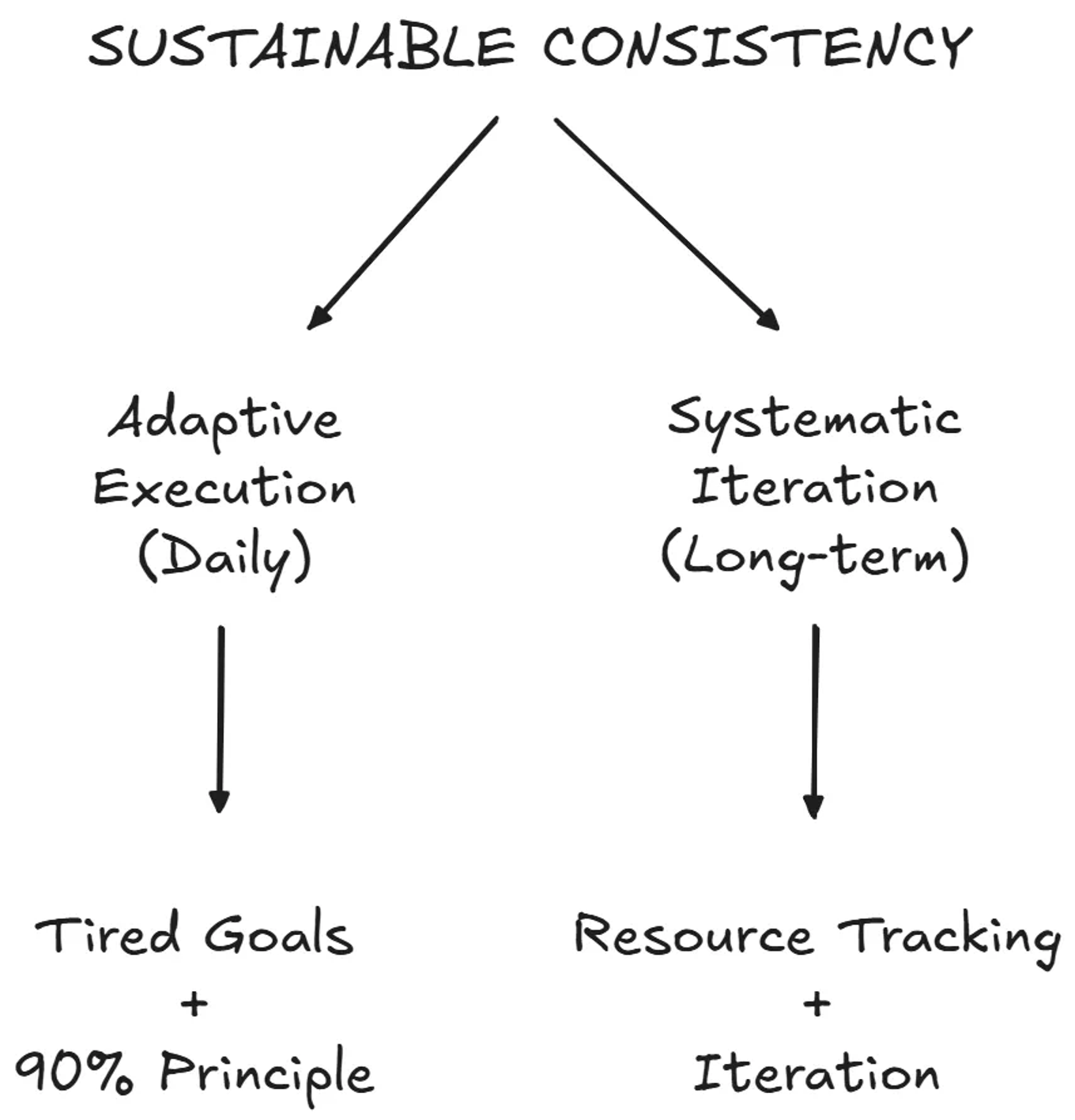
Adaptive Execution
The All-or-Nothing Trap
When you construct your system with specific standards and zero flexibility, you’re self-sabotaging.
Why? Life is unpredictable. Unexpected events will derail your plans. You’ll have days with depleted energy, compressed time windows, or competing urgent demands.
The moment the first slip-up arrives — missing a day or performing below those specific standards — you see it as failure.
This is what psychologists call dichotomous thinking: the tendency to view your efforts as either perfect successes or complete failures, with no middle ground. You’ll recognise this in your own mental chatter: “I’ve blown it now,” or “I’ve fallen off the bandwagon.”
A rigid approach discounts normal variation, creating inevitable frustration and abandonment. It also sacrifices the spontaneity and joy that make life worth living in the first place.
The Tiered Framework
The solution is deceptively simple: build flexibility in by setting multiple execution tiers — minimum, target, and stretch.
This approach, popularised by Sahil Bloom as his ABC Goal System, applies goal-setting flexibility to daily consistency. The core idea is to set three levels of goals for the action you want to execute consistently.
- A Goal (Stretch): The most ambitious scenario. This is what you hit on your best days when energy is high, time is abundant, and conditions align.
- B Goal (Target): The realistic middle ground. This is the goal you aim for most days — the standard execution level your system is designed around.
- C Goal (Minimum): The Minimum Viable Action, where “anything above zero compounds.” This is the bare minimum you commit to, even on your worst days, ensuring you maintain consistency and avoid losing momentum entirely.
For example, if I applied this to my writing practice:
A Goal: Write for 120 minutes, produce 2,000 words
B Goal: Write for 60 minutes, produce 1,000 words
C Goal: Open the document, write one paragraph
On difficult days — poor sleep, menstrual symptoms, unexpected demands — that C Goal keeps me in the game.
The key to its effectiveness, as Bloom notes, is the C Goal. It removes the guilt of a less-than-perfect day and prevents the “all-or-nothing” mindset from derailing your long-term efforts. Your C Goal must be small enough to hit even on your worst days. Even if it seems ridiculously small.
This isn’t lowering standards, it’s acknowledging that your capacity varies day-to-day.
The person who executes their C Goal on difficult days and B Goal on normal days maintains momentum far better than the person who executes perfectly for three months, then abandons entirely because they couldn’t sustain the rigid standard.
The 90% Principle
What about days you can’t hit even your C Goal?
That’s when achieving 90% consistency rather than 100% becomes critical. Sustainability requires being mostly consistent over time, not consistent all the time.
If a 100% standard will make you abandon the entire effort after one missed day, then 90% serves your goals better in the long run.
This principle recognizes an uncomfortable trap: consistency itself can become the goal, and you end up pursuing discipline for its own sake rather than as leverage toward your goals.
The math is simple: 90% consistency sustained over twelve months delivers vastly more results than 100% maintained for three months followed by abandonment.
How do you operationalize 90% in practice? Never miss twice.
This tactic recognises and accommodates the reality that there will be days you don’t even hit your C Goal — illness, travel, crisis, or simply life’s unpredictability intervening. It creates a clear boundary that prevents temporary interruption from becoming permanent abandonment.
It also allows you to get back on track quickly because you’ve already accepted and expected that interruptions will occur. You’re not interpreting the first missed day as failure that invalidates the entire endeavour. You’re treating it as normal variation within a sustainable system.
This is the first dimension of sustainability: building systems with adaptive execution so it doesn’t break under normal life fluctuation.
But daily flexibility alone isn’t enough. A system that adapts beautifully to Tuesday’s low energy might still collapse a few months later when your job intensity doubles or your living situation shifts.
For that, we need the second dimension of sustainability — the one most people never address.
Systematic Iteration
“It is not the strongest of the species that survives, nor the most intelligent, but the one most responsive to change.” — Leon C. Megginson (A paraphrase of Darwin’s theory, often misattributed to him.)
The Incomplete Conjecture
When you design a system, you form your best hypothesis using provisional knowledge. You’re designing for a present that’s already becoming past. You can’t predict how conditions and capacity will shift in three months.
Your system contains hidden assumptions about both. These assumptions feel like constants. They’re variables, always have been.
Conditions drift: work intensity, living situation, obligations.
Capacity fluctuates: sleep quality, stress levels, health.
The system that assumed you’d have X mental resourceThe ability to creatively conjecture, rationally criticise, and focus.Full definition (opens in a new tab)→ and Y physical resourceThe function of our biological machinery.Full definition (opens in a new tab)→ encounters a reality where you now have 0.6X and 0.7Y.
Your actions stay the same. Your ability to execute them doesn’t.
This gap between assumed capacity and actual capacity announces itself gradually. You interpret mounting difficulty as personal inadequacy rather than systematic misalignment. “I’m losing discipline” becomes the default narrative, preventing the adaptation your system requires.
But here’s the reframe: When your system begins to degrade, you’re not experiencing failure. You’re receiving information. The original hypothesis is meeting conditions it wasn’t designed for, revealing which assumptions have become invalid.
The Identity Trap
An insidious trap emerges when you execute a system successfully for months and begin identifying as “someone who does this.”
When your system starts breaking down, you feel like you’re breaking down. The system’s failure feels like your failure. You interpret it as proof you lack discipline. So you double down to protect your identity rather than questioning whether the system still fits.
Sunk cost reinforces this — months of investment feel wasted if you change now. The cycle compounds: harder execution, stronger failure narrative, more rigid adherence, faster resource depletion, eventual collapse.
I’ve experienced this trap myself.
When my morning routine started feeling like a burden rather than a tool, my first instinct wasn’t “What changed about my circumstances?” It was “Why am I losing discipline?” This self-blame prevented me from seeing the obvious: the system designed for my previous life no longer fit my current one.
The alternative interpretation is more liberating:
The question isn’t “Why am I losing discipline?”
It’s “What assumptions no longer match reality?”
“When the facts change, I change my mind. What do you do?” — John Maynard Keynes
The key isn’t building the perfect consistency system and sticking with it forever. It’s building systems that can be iterated upon so they remain sustainable when conditions inevitably change.
The system needs iteration to match new realities, not harder execution based on outdated assumptions.
The Iteration Protocol
Remember: Your system is a hypothesis. Reality tests it continuously. When evidence contradicts your hypothesis, refine it.
This is how knowledge advances — through successive approximation, not through discovering perfect unchanging truth. Your consistency system should evolve the same way.
“The measure of intelligence is the ability to change.” — Albert Einstein
The protocol has three steps.
Step 1: Watch for Warning Signs
Traditional consistency tracking asks: Did I execute? This is a lagging indicator that only confirms what you already know after the system has failed.
You need a leading indicator — something that signals degradation while you can still course-correct.
Resource tracking provides this. Instead of asking “Did I do it?” Ask “Are my mental and physical resource levels stable, improving, or declining?”
Here’s why this matters: Declining resources signal an unsustainable system before collapse. If you’re consistently depleting more than you’re restoring, you’re running a deficit.
Track mental and physical resource levels on a 0-100 scale over 3 check-ins (weekly, monthly, or quarterly depending on system stability). Focus on the trend, not the number.
- Declining = System unsustainable. Iterate now.
- Stable = System working. Continue monitoring.
- Improving = System well-aligned. Keep going.
When resources decline for three consecutive check-ins, that’s data. Time to iterate.
Step 2: Diagnose What Changed
What shifted in your conditions or capacity?
Step 3: Modify Variables
Modify variables as required to match new conditions.
Common variables to modify:
- Time: When you execute
- Frequency: How often
- Intensity: How much effort
- Context: Where or with whom
Test for 2-4 weeks.
Evaluate using resources: Did this stabilize or improve them? If yes, you’ve found your modification. If not, try another iteration.
Here’s what this looked like in practice for my partner.
First conjecture: Gym after work, Monday to Friday. We maintained execution consistency, but unpredictable work hours meant sometimes squeezing in the gym at 8pm after an early dinner and studying for his final anaesthesia exams. Resources declined steadily — technically working, practically unsustainable.
First iteration: Shift gym to 6am, modify eating to breakfast-and-lunch pattern. This freed evenings but revealed a new constraint within three weeks — insufficient early-morning appetite meant caloric deficit. Resources continued declining, now from under-fueling rather than time conflicts.
Second iteration: Gym on Wednesday, Saturday, Sunday evenings (reliably available times) + short transition runs after work other days (dual purpose: movement + mental shift to study mode). Revert to lunch-and-dinner eating.
Result: Resources stabilized within two weeks. The system became sustainable not because we found the “perfect” routine, but because we iterated until variables matched his actual current constraints (noting this might shift again in the future)
You’re not searching for permanent optimal design — you’re continuously refining as you and your conditions evolve.
Building Systems That Bend Without Breaking
The unified principle underlying both adaptive execution and systematic iteration is this: design for variation, not ideal conditions.
Build systems that bend rather than break.
Build systems that evolve rather than ossify.
That’s how you achieve sustainable consistency. Not through perfect initial design, but through adaptive design that accommodates reality’s inherent dynamism.
Most people build systems once and defend them forever.
You’re going to build systems once and refine them continuously.
That’s the difference between rigidity and sustainability. Between abandonment and adaptation.
Pick one system you’re struggling to maintain right now. Ask yourself:
Is this system designed for my reality now, or for my reality then?
If it’s the latter, you already know what to do. The question is whether you’ll give yourself permission to do it.
If this resonated, get Micro Misconcepts in your inbox every Friday.
Subscribe to Micro Misconcepts →