How to Buy Back Years of Your Life
October 16, 2025
By Syn Yun Phee
There’s a transaction happening in your life right now that no one taught you to see.
Every time you earn money, you’re converting your finite time, mental resourceThe ability to creatively conjecture, rationally criticise, and focus.Full definition (opens in a new tab)→ and physical resourceThe function of our biological machinery.Full definition (opens in a new tab)→ into currency. That part’s obvious.
But there’s aninvisible part: Every time you spend money, you’re not just buying goods and services. You’re also deciding how many years you’ll work.
There’s a hidden exchange rate between the money you spend today and the years of life you’re trading for it. And most of us are making these decisions on autopilot, following a script written by marketing, social media, and “the norm”.
Once I learned to see this exchange rate, my relationship with money fundamentally shifted. I started making choices based on what they actually cost me in time, not just what they cost in dollars. I started asking better questions - not “Can I afford this?” but “What am I actually trading for this?”
Once you see it, you can’t unsee it. Let me show you what I mean by starting with a question most people never ask: What is money actually for?
Understanding The Game
“Money solves money problems.” — Naval Ravikant
Naval’s insight: money’s power is limited and specific. It can’t solve everything, but it can solve two big problems that really matter:
First, the obvious one: Meeting our basic physiological and safety needs to maintain our biological machinery - water, food, shelter, warmth.
Second, the one most people never see: Time freedomThe state in which you can sustain your desired consumption level indefinitely without any further input of primary life resources (time, mental resource, and physical resource).Full definition (opens in a new tab)→.
Once basic needs are reliably met, most people try to use money to solve problems that money alone can’t fix, attempting to buy their way to good relationships, good health, internal peace and fulfillment. Take the holiday everyone takes hoping it will bring fulfillment. Buy the things promising to fix your health problems. Upgrade the lifestyle to fill internal voids with external things. It feels normal because everyone’s doing it.
Most people spend decades trapped in the earn-spend-repeat cycle, trading time for money to fuel consumption they never consciously chose. This consumption treadmill is one of the biggest distractions in modern life as it hides the fact that there’s another route: using money to buy back your time.
That route is time freedom. Here’s how it works.
Time Freedom
Time freedom occurs when your consumption level can be met by your financial resources indefinitely without requiring further input of time, physical resource and mental resource. In practical terms? You no longer need to work for money. You no longer need to be in a certain place, at a certain time, doing a certain thing someone else chose for you.
Time freedom is not about doing nothing, but about having the choice to do nothing if you want. It’s the difference between “I get to” and “I have to”. You get to choose what you’d do anyway if money weren’t forcing your hand.
For those of us who acutely feel the finite and constantly depleting time we have in life, time freedom naturally becomes an important goal.
“Time is the only real currency - you can make more money, but you can’t make more time.” — Morgan Housel
But to understand how to get there, we need to understand the mechanics underneath. Let’s start with a simple money cycle.
The Money Cycle
Think of money as an IOU from society for the value you’ve provided. You invest your time, physical resource, and mental resource in solving problems through a job or a business. The bigger the problem and the more people you solve it for, the larger the IOU.
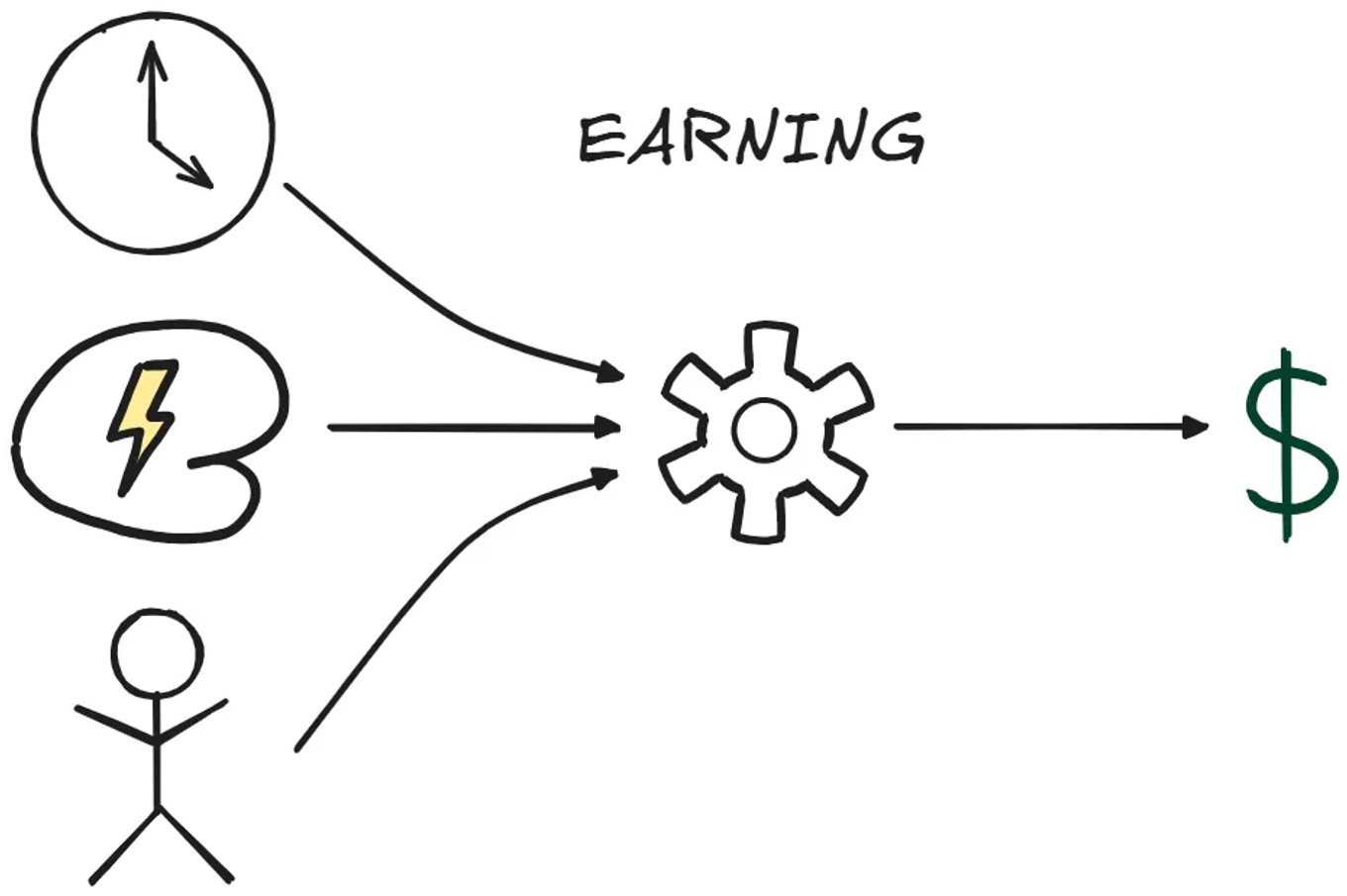
Once you have that IOU, you face a choice every time you use it:
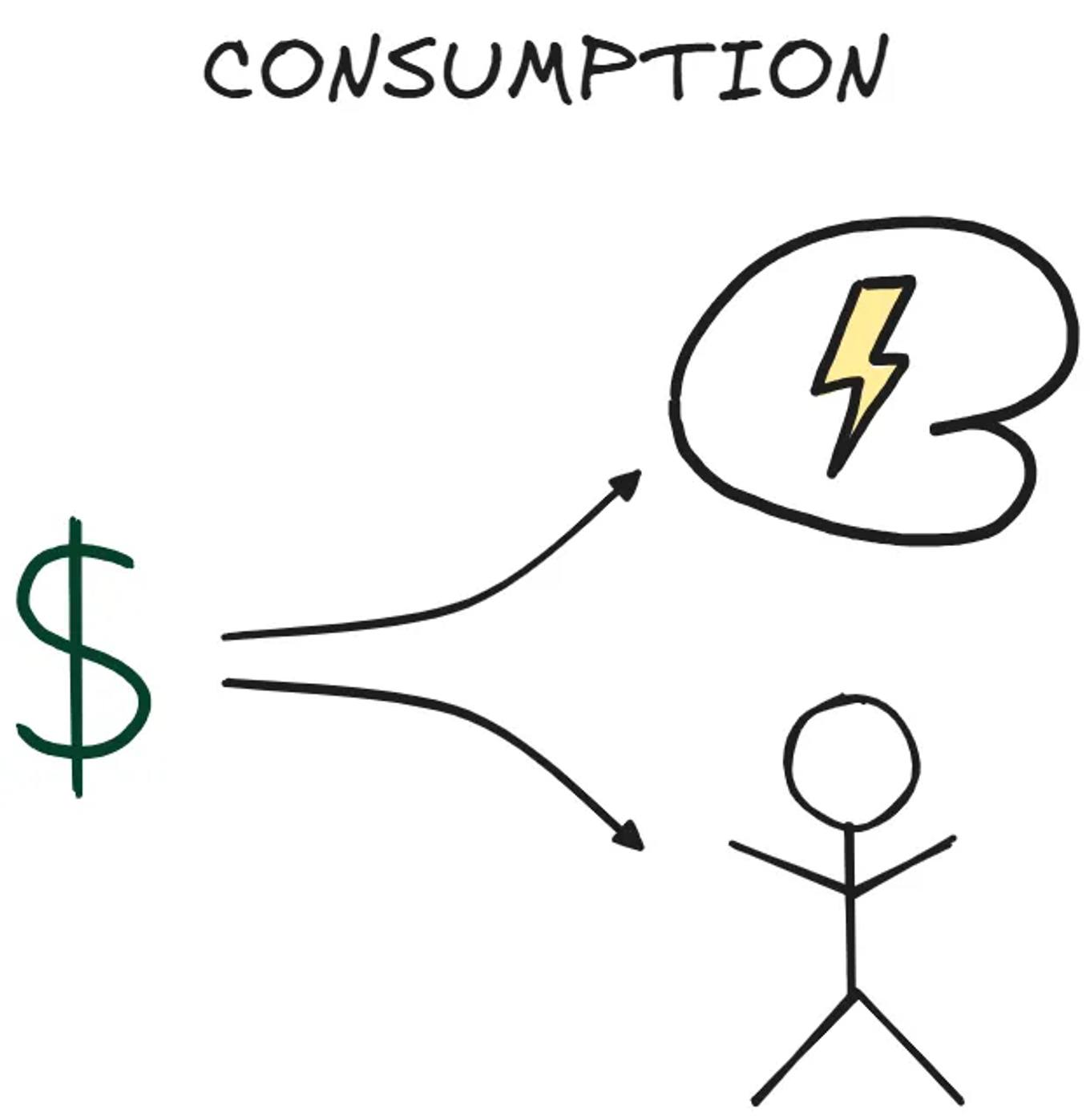
Consume now: Exchange it for goods and services that restoreyour mental and physical resources, starting with basic needs (water, food, shelter, warmth), then moving onto everything beyond survival (entertainment, travel, status goods).
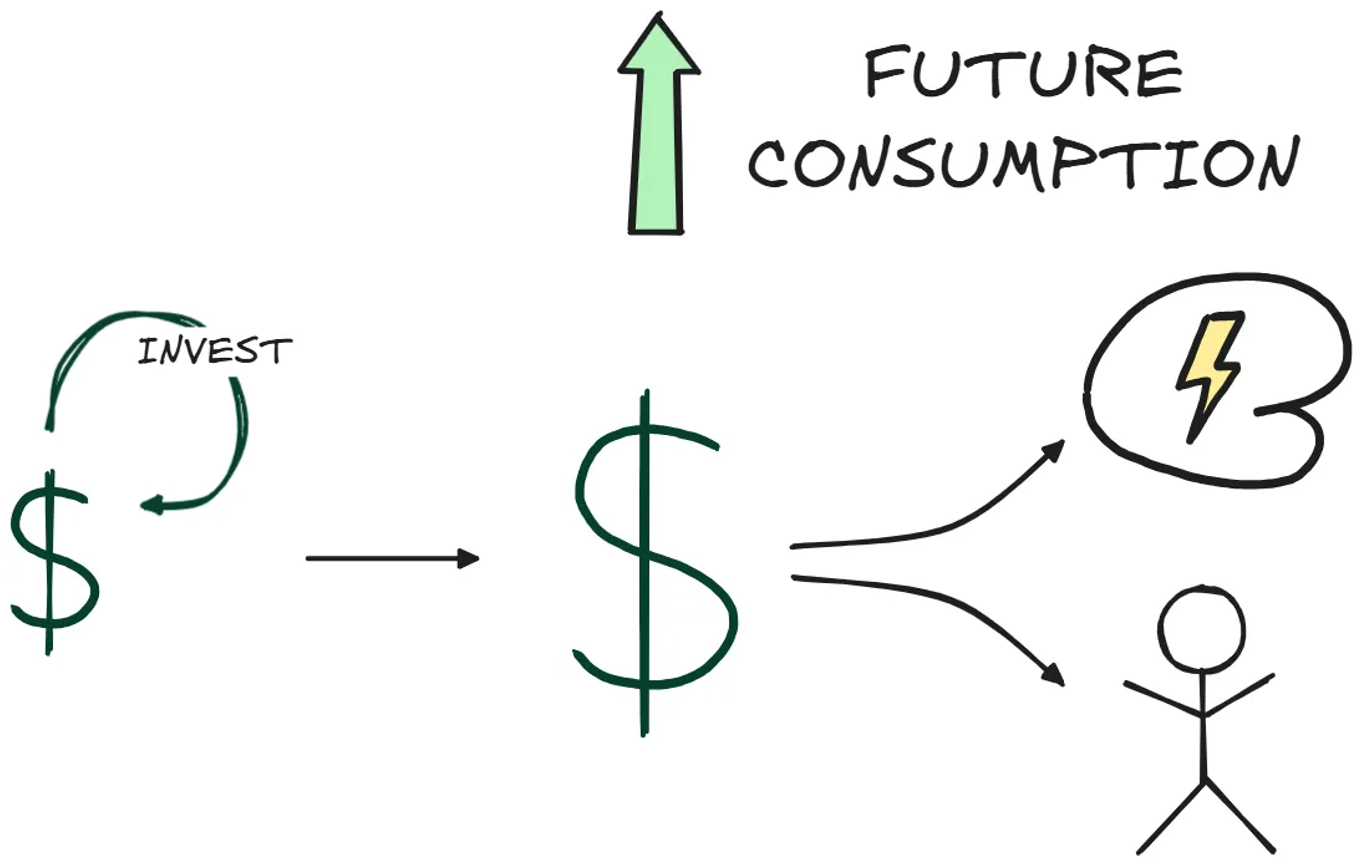
Invested for later: Let it grow so you can consume more in the future.
Note: The rest of this article assumes income from employment, though the principles apply to any income source.
Putting all these components together, we get a simple money cycle that looks like this:
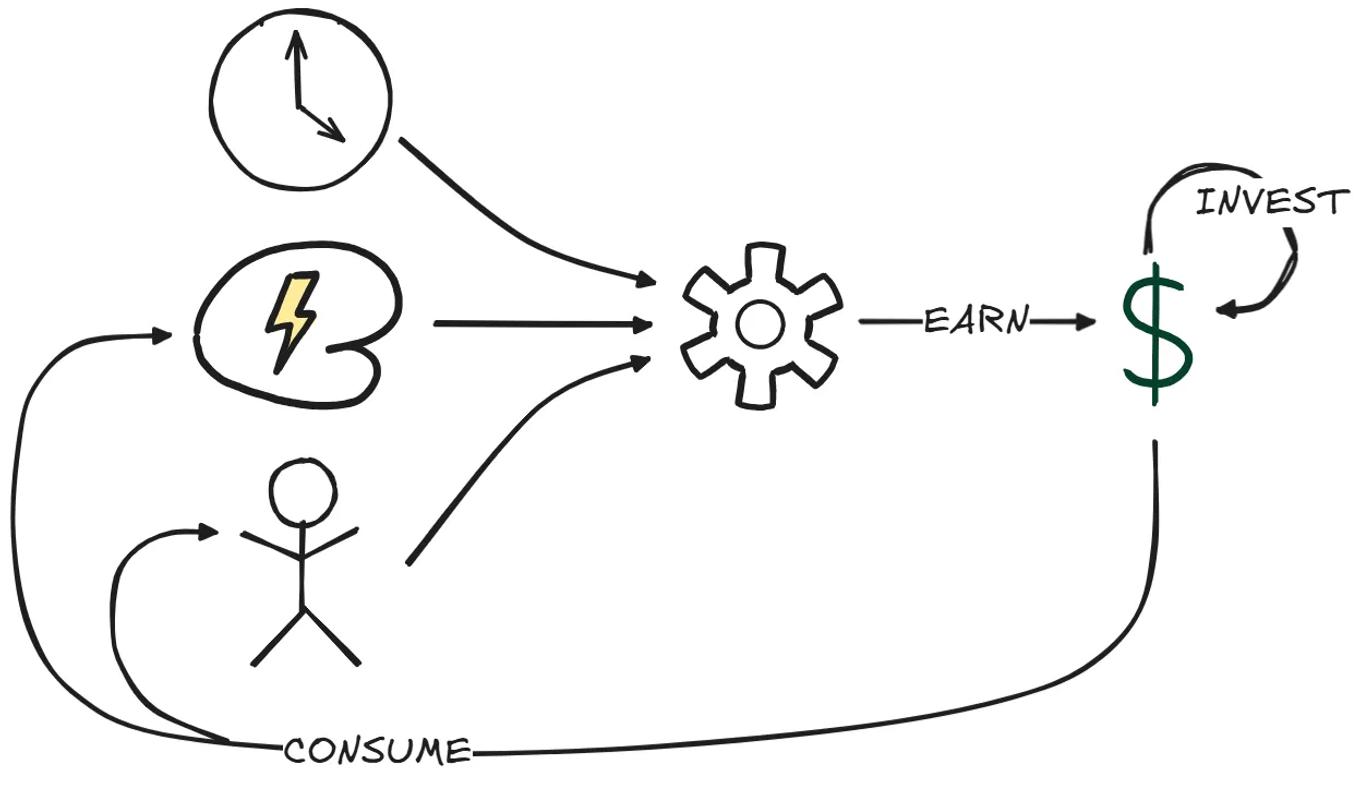
Here’s where the first opportunity costThe lifetime value of the next best alternative forgone when expending life resources to improve or implement misconcepts.Full definition (opens in a new tab)→ emerges: Whenever we are choosing to consume anything, we are choosing between consuming more now or consuming more in the future.
Every dollar you spend on consumption now is a dollar that won’t compound into future consumption potential. Every dollar you invest now delays gratification but grows into future consumption potential. And that future consumption potential is what determines whether you become time-free.
The degree to which we choose less consumption now for more consumption in the future determines how soon we become time-free. And the younger we are, the greater the implications of this because the runway and effect of compounding is greater.
Here’s what this cycle also reveals: money is simply your primary life resourceThe life resources we are born with. They are expended to improve or implement misconcepts, and to acquire secondary life resources.Full definition (opens in a new tab)→ in disguise. The conversion steps of life resourcesThe finite resources we expend to improve or implement misconcepts.Full definition (opens in a new tab)→ → money → goods and services → life resources makes it easy to lose track of what money actually represents. If you earn $30/hour and spend $150, you are actually spending 5 hours of your life.
We think we buy things with money when we are actually paying with years of our life.
“The cost of a thing is the amount of life you exchange for it.” — Henry David Thoreau
Time freedom is possible when you realise your options are not just about enhancing the money cycle by earning and consuming more, but about using money to eventually escape the cycle altogether.
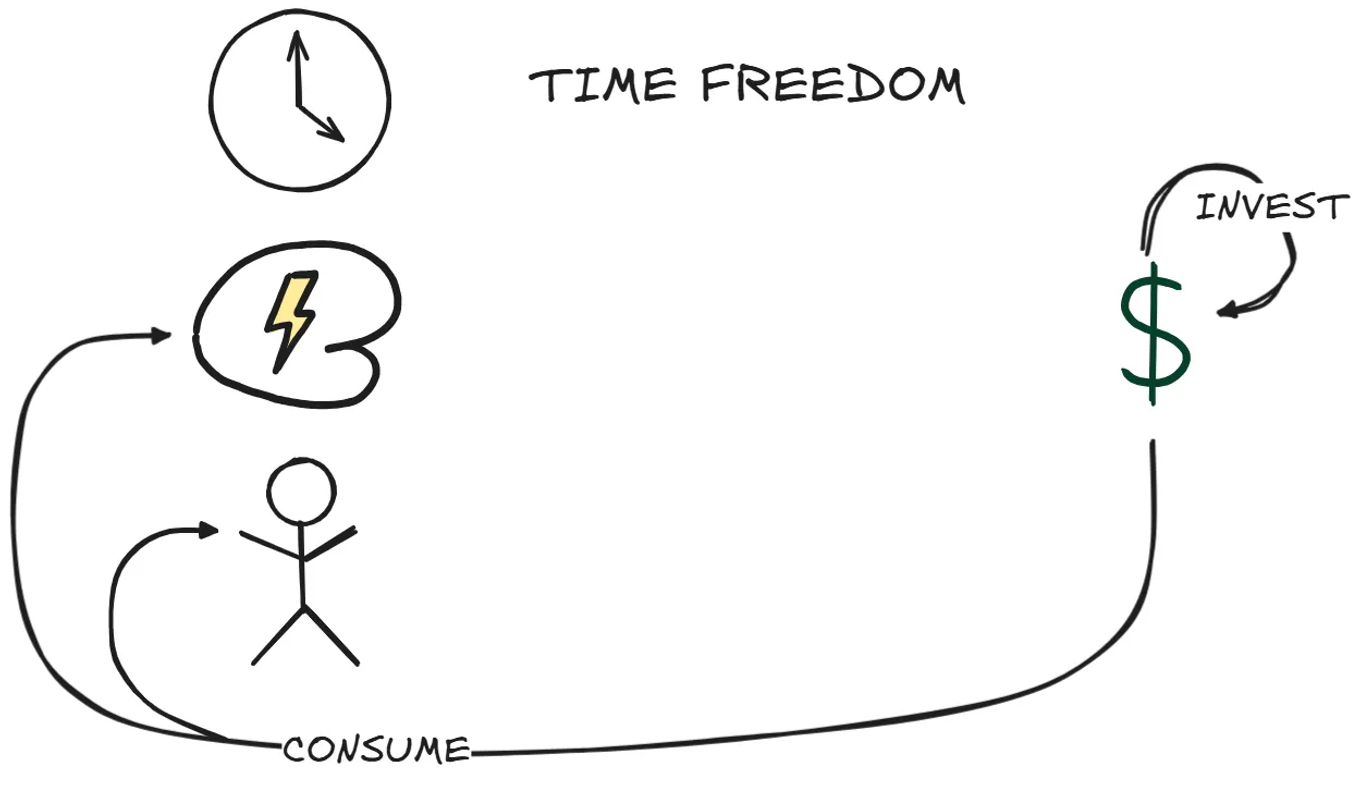
With this understanding of the money cycle, the path to time freedom becomes clearer.
But before we explore the framework, an important caveat: we recognize this framework only works above a certain income threshold. If you’re in survival mode, genuinely unable to save because every dollar goes to basic needs, this isn’t your reality yet. This framework also does not apply in contexts of conflict, political instability, currency instability, or insufficient supply of basic goods and services to meet physiological needs. This is written for those of us privileged enough to be in a stable environment and have choices about consumption. That’s not everyone, and we don’t take that for granted.
We are also assuming your job is not the same as your intrinsic goal. But for the lucky few who wouldn’t spend their time and resources any other way even if they were time-free, you are already time-free. Congratulations! We envy you.
The Framework
So how do we get there? How do we find the right balance between consuming enough now to live well and investing enough to be time-free as soon as possible?
That’s where lifetime value-based consumption comes in.
Assuming your total earnings are fixed across a lifetime and any leftover money goes into investments, when you escape the cycle comes down to one variable: your consumption.
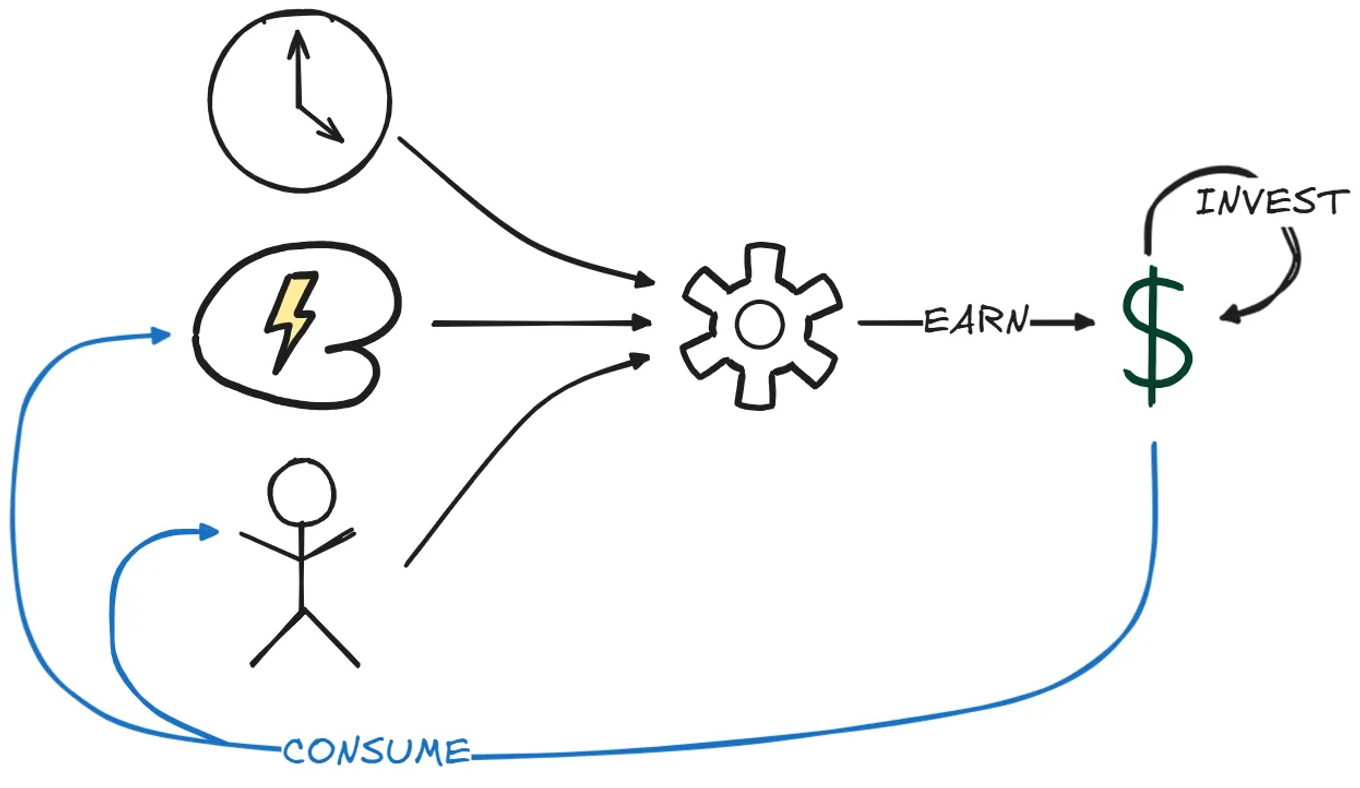
Note: We’re focusing on the consumption side in this article, but earning more absolutely accelerates the timeline. We’ll explore the earning side in a future piece.
As we discussed, present consumption comes at the trade-off of future consumption. However, it is not practical to consume nothing now, we wouldn’t survive. But spending everything we earn now also means we will never escape the cycle.
To find the right balance, we’ve developed a framework that helps us get the highest ROI of consumption across our entire life. We call this approach lifetime value-based consumption.
Our framework is based on using lifetime value as the metric. Lifetime valueThe net value in life resources across a lifetime — short, medium, and long term — from expending life resources to improve or implement misconcepts.Full definition (opens in a new tab)→ is the net effect on our mental and physical resources across short, medium, and long-term horizons from a decision.
The key question becomes:
What do we consume now (and hence what do we invest) to maximize our lifetime value?
Answering this question requires knowing what consumption provides a very high ROI for the money you spend.
The first type of consumption is using money to meet our basic needs (the line in green). This is what we need to survive and thus represents the highest ROI of money.
Consumption beyond these basic needs takes us towards diminishing marginal lifetime value (the line in orange). These are consumption for mental resource gain beyond mere survival e.g., a dinner out, a holiday overseas, a super yacht.
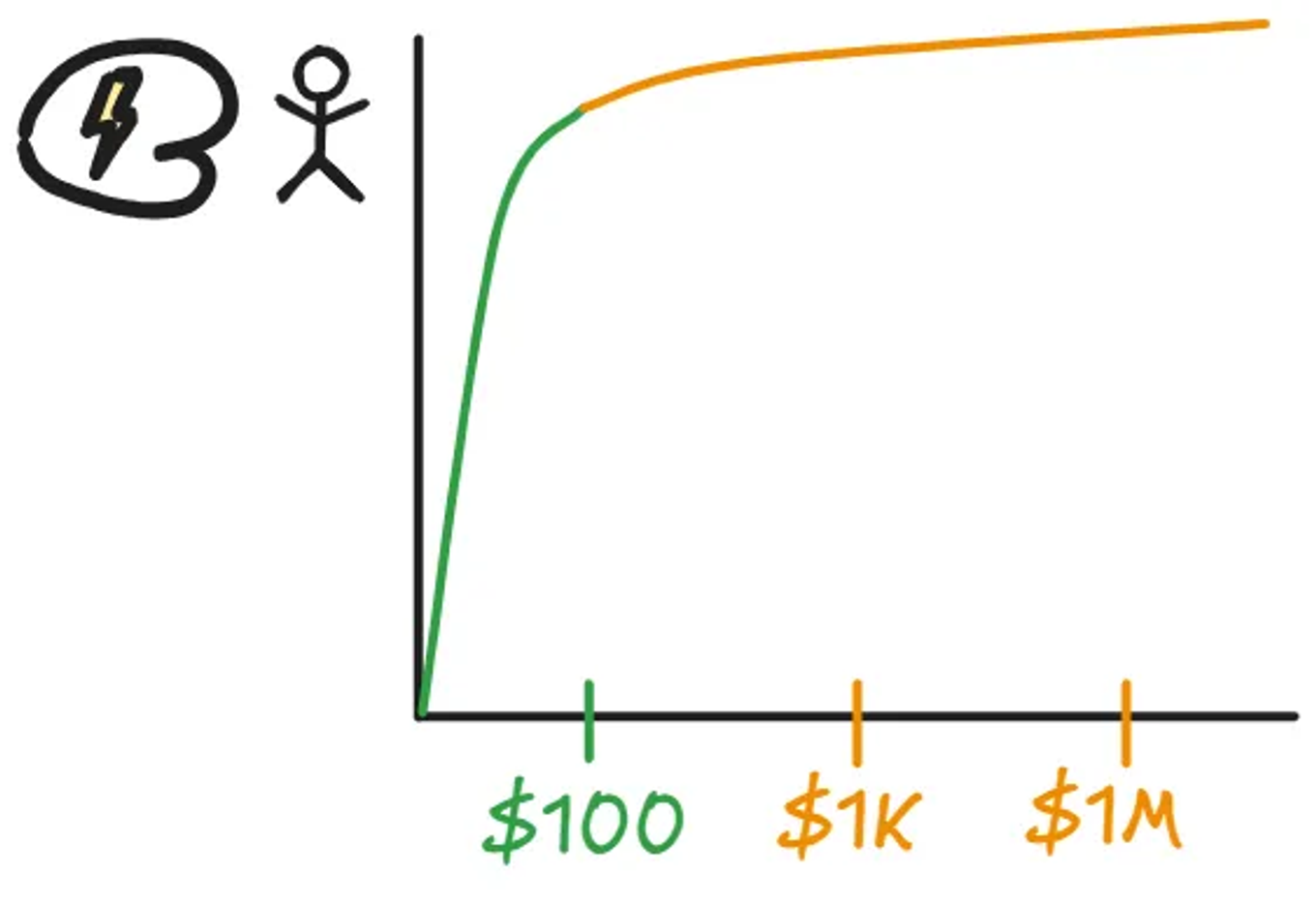
There is nothing wrong with consuming beyond basic needs. We all do it. The key is acknowledging that the opportunity cost of doing so is a delay to achieving time freedom. And only you can decide what opportunity costs you’re willing to accept.
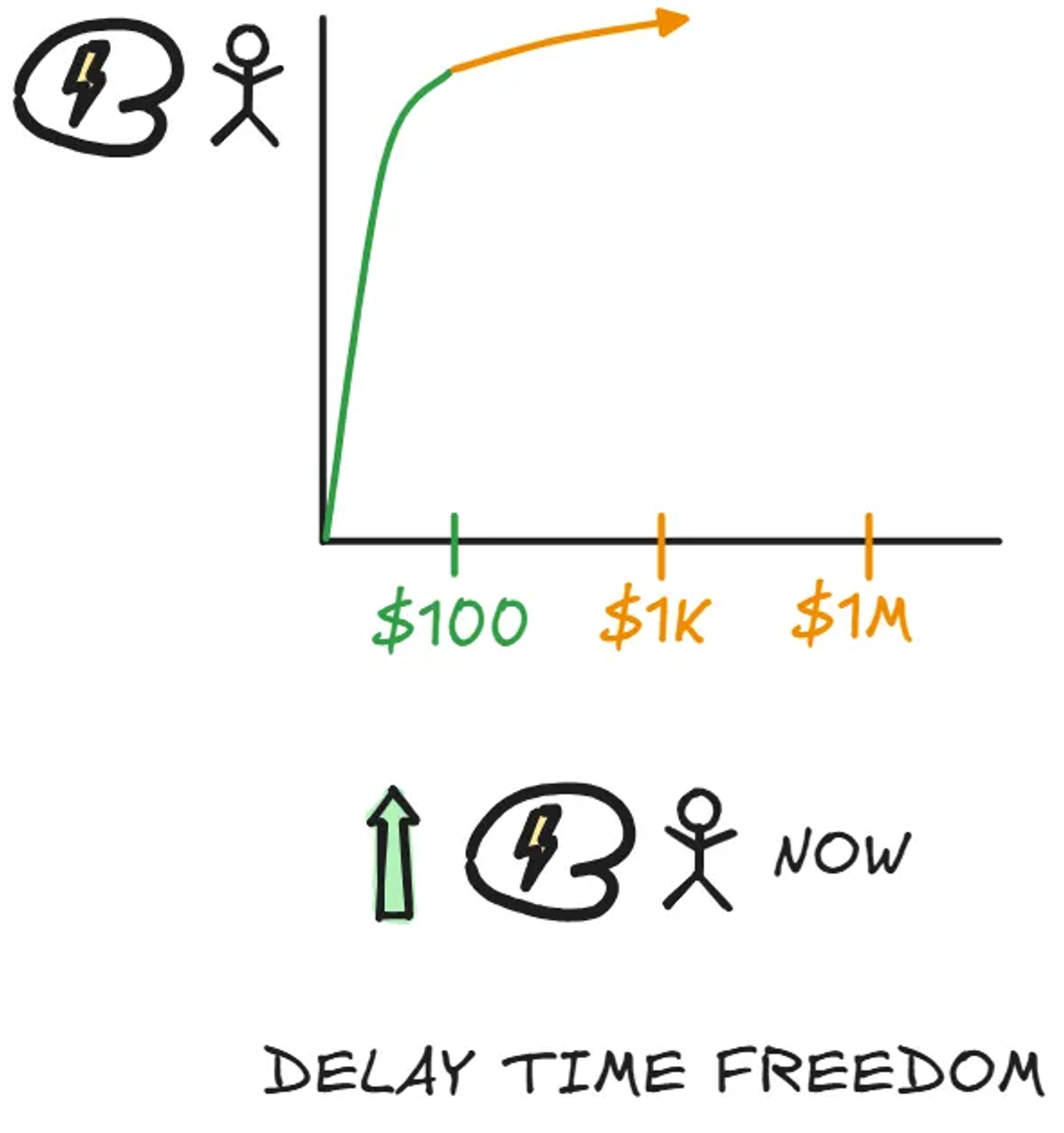
Let’s make this concrete with a simplified example.
Meet Sarah. She’s 25, earning $60,000 a year (post tax), and like many financially responsible people, she’s already investing 10% ($6,000/year) into index funds. She spends the remaining $54,000, including a $10,000 annual international trip that feels essential.
But here’s what Sarah doesn’t see: a seemingly simple decision about an annual $10,000 trip can significantly influence when she buys back her time.
If Sarah maintains her current spending ($54k/year), at her current investment rate (assuming 7% annual returns), she reaches time freedom around age 63.
If she redirects that annual travel money into investments instead ($44k/year spending), she reaches time freedom around age 53.
If she takes the middle path and travels every two years instead of annually ($49k/year spending), she reaches time freedom around age 55.
That decision about travel is worth ten years of her life. Ten years where she could do anything she wants rather than be forced to trade her finite time for a paycheck. Ten years is 520 weekends or 3,650 days.
And we’ve only looked at travel. What about the slightly nicer car, the frequent restaurant meals, the small purchases that seem insignificant in the moment? Apply this lens to everything, and Sarah could be time-free even faster.
So what’s the right path?
There isn’t one. It’s simply the trade-off you’re willing to accept based on your self-defined life goals.
Maybe those annual trips are genuinely worth those extra years of mandatory work. Or maybe the middle path is the sweet spot: 80% of the value, many years of life back. Or maybe what she really craves isn’t the trips themselves, but the novelty and break from routine and she can get 80% of that from long weekends exploring her own region or joining a hiking club, for a fraction of the cost and a decade of her life back.
The point isn’t that any of these paths is “right” or “wrong.” The point is that most people on Path A have no idea that these other paths exist. They’re not making a conscious choice. They’re just doing what everyone else does, what TikTok and Instagram told them “living your best life” looks like. They never stopped to ask: “Is this annual trip worth a decade of freedom?”
But now you know. When you choose, make sure it’s actually your choice, not the default one.
This is what Steve Jobs meant when he said: “People think focus means saying yes to the thing you’ve got to focus on. But that’s not what it means at all. It means saying no to the hundred other good ideas.”
In this case, it’s about saying no to the countless “normal” consumption patterns you’ve unconsciously adopted so you consume only things that truly provide lifetime value to you.
Making it Work
Right now, you’re likely part of the 95% who drift into consumption patterns designed by marketers, not by you. This framework is your invitation to the 5% who choose consciously. To help you with that, here are three questions that help us cut through the noise:
- What is the lifetime value I gain from this spend?
- How much closer would my time freedom be if I didn’t spend this?
- Am I happy with this opportunity cost?
This framework is simple, but not easy.
It takes trial and error to accurately assess the lifetime value you derive from various goods and services.
Several obstacles can interfere with this assessment: self-doubt from seeing what others around you are doing, potential criticism or social isolation for not conforming to expectations, the discipline required for delayed gratification while others are “living it up.”
The path of conscious consumption often feels lonely because you’re swimming against the current. But that’s precisely why most people never achieve time freedom, they optimize for social comfort rather than lifetime value.
However, by practicing this lens, you will establish a level of consumption over time that genuinely maximizes the ROI from your money for your unique context.
And there’s a hidden advantage to conscious consumption: once you’ve established a higher lifestyle baseline, scaling back feels like a loss even if you never consciously chose that baseline. But when you design your consumption intentionally from the start, you never miss what you didn’t have.
You may find that modest spending delivers most of life’s value. This creates a double benefit: you save more for future consumption while needing less to feel content.
Objections
I know what you’re thinking. “But what if I die before reaching time freedom and regret not living my best life?”, “Isn’t this just being cheap?”
I hear you. These are real tensions we’ve wrestled with and still do. Here’s how we’ve come to think about them for now:
First, yes, we don’t deny there’s risk. You could absolutely die before being time-free. That’s why the opportunity cost assessment is entirely personal. If you’d genuinely rather spend everything now at the trade-off of not saving for future consumption, that’s valid - as long as you’ve made that choice consciously, not by default. Most people will fall somewhere in the middle. You have to find the right balance for yourself.
Second, this isn’t about frugality nor deprivation. This is about spending on what genuinely adds lifetime value (which looks different for everyone). The tricky part is being able to separate ‘what I value’ with ‘what I’ve been told to value’ as we have been so conditioned by marketing and can all too easily fool ourselves. Separating those two requires self-awareness and honesty that’s uncomfortable.
Making the Change
By treating money as a tool for lifetime value rather than just consumption, we can achieve the highest return on our finite life resources. This may conflict with many conventional ideas about “enjoying life,” but when you apply this lens, you realise you may not agree with many of those ideas. For those who acutely feel time’s constant depletion, the urgency to control it is undeniable.
Most people spend decades earning their way into a lifestyle they never consciously chose. You don’t have to be most people.
Most people ask: “How do I make more money?”
Fewer ask: “How do I spend and invest money so it maximizes my lifetime value and buys back my time?”
Both questions matter. But mastering the second determines whether earning more actually buys you freedom, or just traps you in a more expensive version of the same cycle.
Over the next week, notice one thing you’re currently spending on that, if you’re honest, feels more like following the script than choosing your own story.
Consider what redirecting that money would mean, not just in dollars, but in freedom gained.
Then decide: Is this worth what it’s actually costing me?
That’s where you start. That’s how the invisible becomes visible.
If this resonated, get Micro Misconcepts in your inbox every Friday.
Subscribe to Micro Misconcepts →