Front-load the pain
July 30, 2026
By Syn Yun Phee
We're taught that time heals all wounds.
It's a comforting idea. Whatever hurts now will hurt less eventually, and no further input is required from us. We just have to wait it out.
But time doesn't heal. It compounds.
If you're actively working through pain, facing what it reveals and changing your behaviour because of it, time compounds that effort into resilience. If you're avoiding it, keeping it just quiet enough to ignore, time compounds that avoidance into more pain, perhaps in the form of bitterness, fear, or regret.
Pain doesn't automatically fade on a fixed schedule. It fades on the schedule set by what you actually do about it.
This points to a piece of advice I wish more people were told earlier in life: front-load the pain.
Whatever discomfort you're currently managing, and here I'm talking about the psychological pain of comparison, ego, envy, and standing apart from the crowd, facing it now will cost you less across your lifetime than if you spend years avoiding it, even though facing it means more pain today.
Wired to avoid
Emotional pain isn't random. It's a signal, evolved for good reason. The pain of social rejection, of not fitting in, of loneliness, exists because belonging was once a matter of survival. Outcasts from the group didn't tend to live long, and that wiring hasn't updated even though the stakes have changed in the world we live in today.
So when a trigger arrives, be it the sting of failure or the quiet fear of not keeping up with the script you were handed, you feel pain. Your default response is to protect yourself from it. Numb it, run away from it, explain it away, distract yourself from it. You're not short on options for how to do this either.
It's the easy choice, both psychologically and materially. You're biologically wired to minimise pain in the next five minutes rather than across the next fifty years. We all do this to some degree. It also feels like the more sensible path, because it's another quirk of the human mind that weighs the pain in front of us far more heavily than the pain still to come.
But zoom out to a lifetime perspective, and that strategy starts to make less sense.
The maths of avoidance
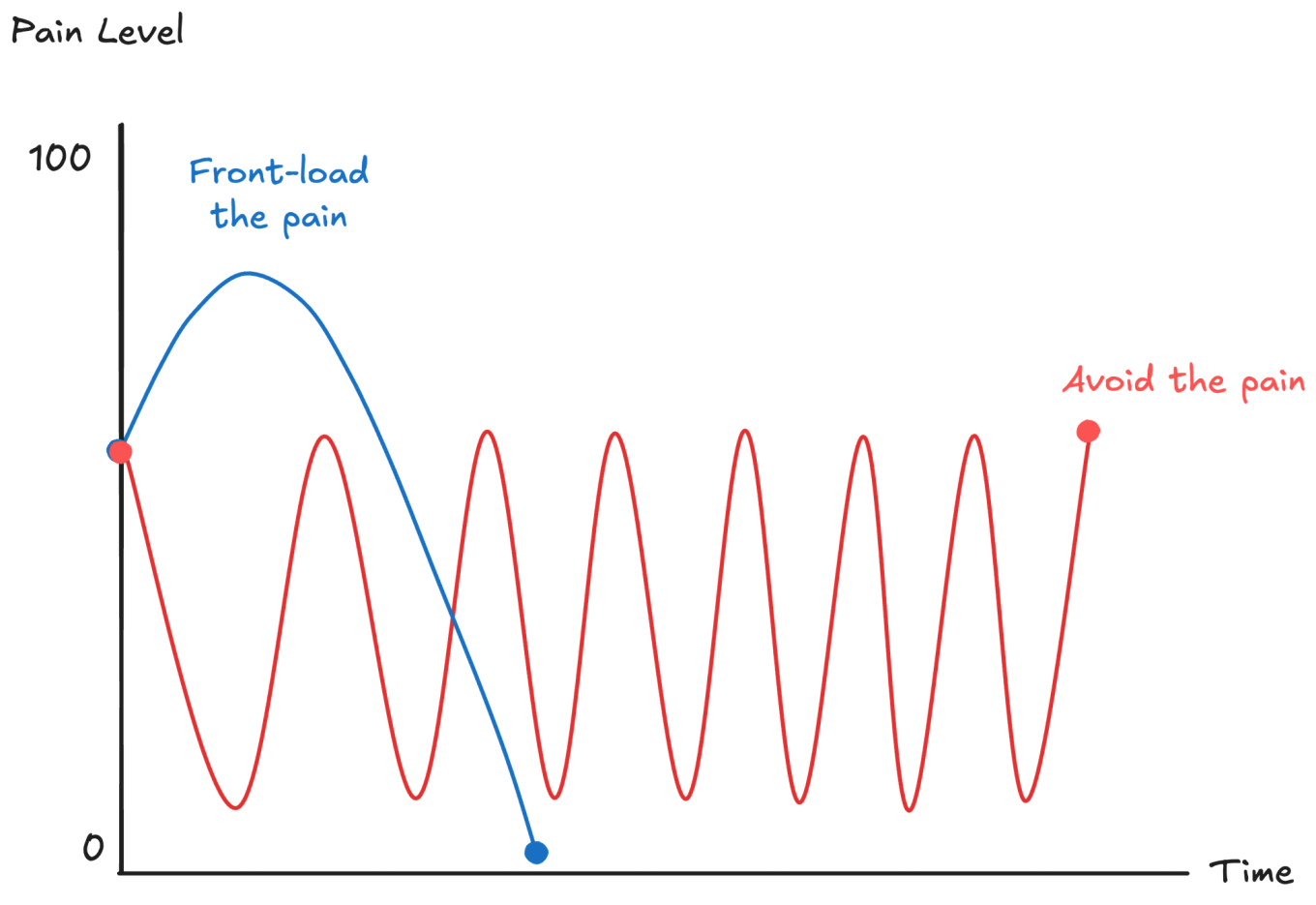
Consider how the maths stacks up. Picture a trigger that causes pain at a level of 50 out of 100. You have two options: face it, or avoid it.
Facing it hurts more at first. It might require you to sit with a harsh truth about yourself or a mindset you've outgrown, spiking the pain to an 80 instead of a 50.
Avoiding it, on the other hand, brings it down to a 10, below the threshold where it registers, quiet enough to live with for another day.
With a short-term time horizon, avoiding makes more sense. It looks less painful, and it is. But extend the time horizon to cover your entire lifetime, and the picture changes.
Avoiding the pain doesn't make the trigger disappear. It returns, and when it does, you're back at 50. Every time you choose to avoid rather than face it, you pay that 50 again, and again, for as long as you keep avoiding it. Face it properly, though, and the specific trigger that caused it starts losing its grip. Eventually it stops registering at all. You now have one less thing costing you mental resources, and your baseline lifts.
Over a lifetime, the person who keeps avoiding accumulates far more total pain than the person who paid the higher price up front and got it over with.
The path to zero
To be fair, facing a trigger once doesn't make the pain disappear forever. The numbers above are illustrative, not literal. What actually happens is an iterative process of confronting the same trigger again and again, its intensity dropping a little more each time.
The first confrontation might genuinely spike to an 80. But because you've faced it once, the next time that trigger appears, the spike is smaller. Maybe a 75. Then a 60. Then a 35. Then a 10. Eventually, something closer to a 0, a flicker you notice and let pass. You don't defeat the pain in a single sitting. You chip away at it, and it fades on a curve rather than a cliff edge.
But that curve still adds up to far less pain over your lifetime than the alternative: running from the same trigger indefinitely and absorbing the full spike of a level-50 pain every time it resurfaces.
The failed hypothesis
The maths makes its case in total lifetime suffering. But if that wasn't enough, there's a second logical case for facing the pain up front: avoidance doesn't actually do what it promises.
When you feel a trigger and run from it, you're operating on a hypothesis that says "if I avoid this, I'll be safe." But the pain keeps coming back, which means the hypothesis has failed. If the pain keeps returning, avoiding it clearly isn't keeping you safe from it, it's just postponing it.
In Critical Rationalism, a theory that fails to predict reality is falsified. Avoidance as a strategy is a falsified theory of well-being, kept alive only by the momentary comfort it offers. That comfort optimises for short-term relief over long-term resolution, and it's an illusion, because the bill still arrives later.
By facing the pain instead, you stop protecting a failed hypothesis. You let it die, and you test something else in its place. You're admitting the old theory, run away, doesn't work, and you're willing to test a new one against reality to see what actually does.
"Let our conjectures, our theories, die in our stead." — Karl Popper
One of the most common places this flawed theory hides is your ego. Many of us grow up in a culture where our egos are built on external metrics, on being ahead, on being impressive. We spend our lives feeling the sting of envy and inadequacy whenever someone else wins or gets slightly ahead, which is often.
The default response is to double down, grind harder, in the hopes of getting back ahead, but that's itself a form of avoidance. The harder move is to sit with the discomfort of acknowledging your ego was quietly built on external validation, even if you'd like to think you're above needing it. Then comes the actual work: shifting where you derive your ego from, towards internal metrics like your own agency and your commitment to iteratively improving yourself.
Confrontation, not rumination
At this point, you might be thinking that you sit with your pain all the time but nothing changes. This is where it's easy to fool yourself.
Confrontation and rumination can look identical from the outside. Both involve sitting with something uncomfortable for a long time. But rumination replays the pain. Confrontation asks what to do about it.
David Deutsch argues that all evils are caused by insufficient knowledge, and that problems are soluble. Rumination treats pain as an insoluble fact of nature, something to endure or complain about, with no real agency attached. Confrontation treats it as a problem with a solution. You still feel the pain, but it isn't a fixed fate, it's information pointing at your next problem to solve. What knowledge am I missing? What do I actually need to change?
Facing pain was never about suffering for its own sake. It's about uncovering and understanding the problem the pain is pointing at, so the problem can actually be solved.
This is why time is an amplifier rather than a benevolent force that fixes everything if left to its own devices. Time is completely neutral. It simply amplifies whatever trajectory you're already on. Confront and front-load the pain, and time compounds that into resilience. Avoid and numb it, and time compounds that into a growing psychological debt. Time doesn't heal. Agency over time does.
Front-loading the pain doesn't just minimise your lifetime suffering. Do this consistently over time, and you get a second, compounding payoff.
Emotional F-you money
In personal finance, F-you money is the amount you'd need saved to say no to a bad job, an unreasonable demand, or a timeline that isn't yours, without it costing you your security. Its value was never really about the money itself. It's the autonomy it buys you.
Front-loading pain builds the emotional version of the same thing. While financial F-you money buys you freedom from other people's schedules, emotional F-you money buys you freedom from other people's expectations.
Much of the psychological pain we encounter in our lives finds its roots in our ego, the need for approval and to fit in. By default, we outsource our life choices to the dominant culture, choosing the well-trodden path and the standard definitions of success, because breaking from them means facing the pain of being misunderstood, judged, or isolated. The dominant culture is essentially a giant collection of inherited, unexamined conjectures about how life "should" be lived, busyness equals importance, more is always better. But when you spend your life avoiding this pain, you sentence yourself to a lifetime of quiet misalignment with what truly matters to you.
If you aren't able to face the pain, you remain in emotional handcuffs. But when you dare to face it head-on, you earn the autonomy to design a deeply intentional life, unencumbered by the noise of the crowd, because the threat of other people's judgment no longer dictates your choices.
That is emotional F-you money. The freedom from other people's expectations. The freedom to choose how you actually want to live, based on your own values and what matters to you, rather than the version of a life the culture around you keeps quietly prescribing.
Where this leaves you
None of this makes the upfront pain smaller. An 80 is still an 80 while you're in it. But run from a trigger and you'll meet it again and again, at nearly full strength, for as long as you keep running. Face it, even once, and you start down the curve toward a 5, then closer to nothing at all.
Time was never going to do this for you. It only compounds whatever you're already doing. The only real question is which direction you want it compounding in.
If this resonated, get Micro Misconcepts in your inbox every Friday.
Subscribe to Micro Misconcepts →